
Laboratory Analysis and Economic Justification: Why Shahroudi 12 is the Most Strategic Substitute for Mamra Almonds in the Indian Market
In the highly volatile and complex ecosystem of the Dried Fruit Global Trade, particularly within the strategic Iran-India commercial corridor, the pricing strategy for luxury varieties has perpetually presented a multifaceted challenge for international suppliers and wholesale buyers. With the unprecedented and inflationary surge in the pricing of premium varieties in recent years, industrial buyers and traders in major commercial hubs such as Mumbai (APMC Market) and Delhi (Khari Baoli) are aggressively seeking Cost Optimization strategies. They are in pursuit of sustainable alternatives that secure their profit margins in a competitive market without suffering from severe Quality Degradation or damaging their brand equity among end consumers.
At this critical intersection of supply and demand, the Shahroudi 12 Almond has emerged not merely as an agricultural commodity, but as a "strategic marketing phenomenon" within the B2B sector. Many seasoned Indian traders refer to this variety in their closed-door negotiations as the "Cost-Effective Mamra Substitute" or "Class B Mamra." However, the fundamental scientific question remains: Is this claim simply a Marketing Gimmick designed to persuade buyers and drive sales volume, or is it grounded in robust biometric, chemical, and economic fundamentals?
In this highly specialized, comprehensive, and data-driven white paper from the Walmond Strategy and Research Department, we utilize a strictly analytical approach. Based on precise Laboratory Diagnostics, complex financial modeling, industrial processing mechanics, and destination market behavioral analysis, we dissect the structural and economic anatomy of the Shahroudi 12 almond, benchmarking it directly against the undisputed, high-priced king of the market: the Mamra Almond.
1. Etymology, Climatology, and Agro-Climatic Origins
To comprehend the structural differences and similarities, we must first examine the genetic and environmental origins of these varieties. The quality of an almond is not dictated solely by its genetics, but by the direct influence of its "Terroir"—the specific agro-climatic conditions of its cultivation region.
A) The Shahroud Terroir and its Impact on Kernel Morphology
The Shahroud region, situated on the margins of the desert and the southern slopes of the Alborz mountain range, features a semi-arid climate characterized by extreme Diurnal Temperature Variation during the summer months. These mild, naturally managed thermal shocks trigger the defense mechanisms of the Shahroudi 12 almond tree, significantly enhancing the synthesis of unsaturated fatty acids within the kernel. Unlike Californian orchards, which rely heavily on flood irrigation and intensive chemical fertilization, the relatively harsher climatic conditions in Iran lead to increased Cellular Density and flavor concentration in stone varieties.
B) Phenotypic Variations vs. Mamra at Harvest
Mamra is inherently a late-blooming variety with specific Chilling Requirements, performing optimally in the mountainous climates of the Zagros range (e.g., Saman and Ben). Shahroudi 12, as an improved commercial stone variety, exhibits superior ecological adaptability. This resilience ensures that the supply of this cargo in high tonnages (Volume Consistency) for long-term B2B contracts is vastly more stable and reliable than Mamra.
2. Biometric Autopsy and Morphological Engineering
In the international B2B trade with India, the first, fastest, and most decisive factor for initial Cargo Approval is the visual inspection conducted by the buyer's quality control agents. Indian buyers place extraordinary emphasis on the Seed Coat Color, kernel elongation, absence of shriveling, and the plumpness of the cellular tissue.
A) The L/W Index (Length-to-Width Ratio) and Geometric Calibration
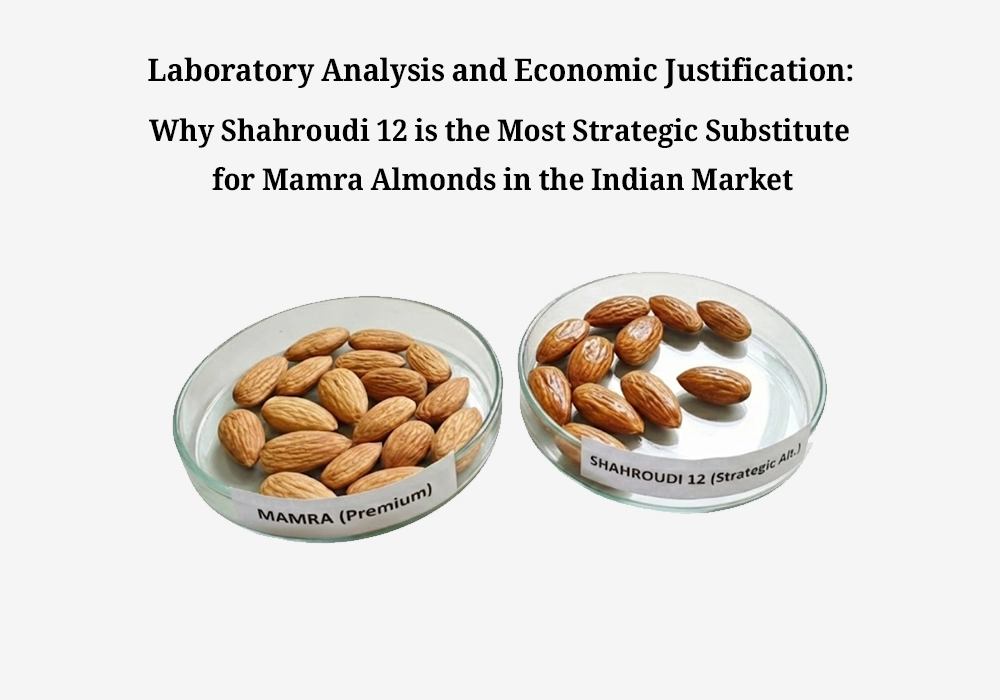
The Mamra almond is globally recognized for its highly elongated structure, dagger-like curvature, deep longitudinal striations, and dark golden hue. In contrast, the Shahroudi 12, through years of genetic mutation, natural selection, and grafting in Iranian orchards, has astonishingly mirrored Mamra's morphology.
- In precise laboratory biometric assessments, the L/W Ratio of Shahroudi 12 falls within the 2.1 to 2.3 range. This metric is strikingly similar to the geometric proportions of mid-grade Mamra (such as Grades 3, 4, and 5).
- This Geometric Calibration ensures that when Shahroudi 12 is placed in transparent, luxury Retail Packaging on store shelves, its visual appeal is virtually indistinguishable from premium varieties, leading the end consumer to perceive it as a high-end luxury good.
B) Epidermal Behavior and Color Index
The color of the thin cellulosic pellicle covering the kernel (Epidermis) plays a crucial psychological role in pricing within the traditional Indian market. Californian varieties (like Nonpareil) typically feature a blonde, lighter color and a smoother surface texture. However, Shahroudi 12 possesses a rich, slightly dark brown skin with mild striations and veins. Within the market psychology of Khari Baoli, this darker color and striated texture are undisputed symbols of "organic nature," "natural processing," and most importantly, High Oil Content—the exact visual cues for which Indian buyers willingly pay a premium when purchasing Mamra.
C) Twin Kernel Index Management
As extensively analyzed in our comprehensive white paper on the Impact of Twin Kernels on Export Almond Pricing, the percentage of double kernels is a highly destructive factor that dictates Price Deductions or claims at the destination customs. The strategic advantage of Shahroudi 12 is its high genetic potential for twinning control. Through optimal orchard water stress management and the subsequent deployment of advanced Optical Sorting machinery at Walmond's processing facilities, the twin rate of these shipments is effortlessly reduced to below 5% (the Standard Tolerance Threshold). This distinct advantage renders Shahroudi 12 a flawless, zero-risk option for India's highly sensitive slicing and dicing industries.
3. Comprehensive Biochemical Analysis and Lipid Profiling
To scientifically substantiate that Shahroudi 12 is a highly strategic and nutritious substitute, relying merely on visual resemblance is insufficient. We must penetrate the molecular layers and chemical structure of the kernel. The primary differentiator and the rationale behind Mamra's astronomical price lie in its intensely rich flavor, near-zero bitterness, and exceptional fat content. In this section, we meticulously analyze the laboratory results obtained via Gas Chromatography-Mass Spectrometry (GC-MS).
Comparative Laboratory Composition Table (Per 100g Dry Matter Basis)
| Chemical Analysis Parameter | Mamra Almond (Grade 4A) | Shahroudi 12 Almond | Californian Almond (Global Benchmark) |
|---|---|---|---|
| Total Fat / Lipid Yield | 56% - 59% | 51% - 54% | 46% - 49% |
| Oleic Acid (Omega 9 - MUFA) | ~70% of total fat | ~65% of total fat | 58% - 62% |
| Linoleic Acid (Omega 6 - PUFA) | 20% | 23% | 26% |
| Moisture Content (Karl Fischer Method) | 4.2% | 4.8% | 5.5% |
| Crude Protein (Kjeldahl Method) | 18.5% | 20.2% | 21.5% |
| Total Tocopherols (Vitamin E) | 26 mg | 24 mg | 25 mg |
Advanced Biochemical Data Interpretation:
- Oil Yield and Organoleptic Profile: While mathematically Shahroudi 12 cannot shatter Mamra's legendary 59% fat record, registering an average of 52.5% total fat makes it significantly and noticeably richer, tastier, and more buttery than competing commercial varieties (especially American varieties like Carmel or Australian types). This high fat content and tissue density ensure that its flavor profile feels intensely rich and nutty on the consumer's palate. In the production of traditional Indian sweets (Mithai, such as Barfi and Ladoo), it creates a smooth, desirable texture without the need for artificial flavorings or secondary oils.
- Oxidative Stability and Shelf Life: In the fatty acid profile analysis, the high ratio of Oleic Acid (a monounsaturated fatty acid) to Linoleic Acid in Shahroudi 12 translates to superior resistance of its carbon chains against oxidation and free radical attacks. This constitutes a massive logistical advantage for Indian traders; in the severely hot and humid warehouses of Gujarat and Maharashtra, this almond is highly resistant to lipid degradation, peroxidation, and Rancidity. For a deeper understanding of chemical spoilage mechanisms and quality assessment methodologies, reviewing the white paper on How to Detect Fresh vs. Stale Almonds is strongly recommended for all B2B procurement officers.
- Protein Superiority: A fascinating revelation in the analytics is that Shahroudi 12 outperforms Mamra regarding Crude Protein percentage (exceeding 20%). This characteristic makes it highly attractive to brands producing health-centric snacks, energy bars, and plant-based protein powders across India.
4. Thermodynamic Analysis in Industrial Processing
As highlighted in the comprehensive Comprehensive Analysis of the Global Almond Market, almond consumption is not restricted to raw snacking and retail. A massive volume of India's imports is channeled directly into mega food processing facilities. The Shahroudi 12 almond demonstrates extraordinary operational performance in this sector.
A) Slicing Yield and Fracture Mechanics
For the production of luxury almond slivers and flakes, kernels are fed into centrifugal slicers (e.g., Urschel equipment). Thanks to its optimal elongation, appropriate curvature, and extremely low twin percentage, Shahroudi 12 slices effortlessly and consistently without erratic spinning beneath the blades. This minimizes the Fines & Breakage Ratio, directly elevating the factory's Processing Yield and drastically increasing the Indian manufacturer's profit margin on the final product.
B) Roasting Physics and the Maillard Reaction
Due to its optimal Tissue Density and standard moisture content (approx. 4.8%), Shahroudi 12 undergoes the Maillard reaction (the chemical reaction between amino acids and reducing sugars under heat that induces browning and roasted flavors) in a highly uniform and predictable manner within Continuous Roasters. Unlike the Moheb (Paper Shell) Almond, which, due to its delicate kernel, is usually roasted and flavored in-shell, Shahroudi 12 acts as a robust shelled kernel with excellent thermal resistance. Post-roasting, it retains a superior Crunchy Texture over the long term and entirely avoids Oil Exudation within its packaging.
C) Blanching and Marzipan Milling Efficiency
For factories requiring the production of Marzipan, almond flour for macarons, or Almond Milk, rapid peelability is paramount. The brown skin of Shahroudi 12 detaches easily and with minimal thermal energy expenditure in Steam Blanchers (High Peelability Index). The resulting white, uniform kernel emerges free of any color blemishes or thermal burns, primed for entry into industrial mills and mixers.
5. Financial Modeling, ROI, and Profit Margin Engineering
We now arrive at the most critical and compelling segment for commercial departments: the numbers, figures, and financial modeling. Why should a major Indian trader in Delhi shift a portion of their premium procurement portfolio from Mamra to Shahroudi 12? The definitive answer lies in Return on Investment (ROI) calculations, financial risk management, and the optimization of Working Capital.
A) Working Capital Optimization
To deeply understand this dynamic, let us construct an Import Simulation model at Mumbai's Nhava Sheva port. Assume an Indian importer intends to procure a 20ft container (holding approximately 18,000 kg) of almond kernels.
- Scenario 1 (Mamra Procurement): The cost of a container of High-Grade Mamra (e.g., Grade 4A), driven by its intrinsic biological value, aggressive demand, and severe supply constraints, demands an astronomical budget allocation (sometimes reaching a C&F value of $280,000 to $320,000). Securing such massive liquidity exerts immense pressure on the importing firm's Cash Flow. As precisely calculated in our mathematical breakdown of Mamra 5A vs 4A Profitability, even a marginal deviation in Mamra sizing and grading creates tens of thousands of dollars in total invoice variance.
- Scenario 2 (Shahroudi 12 Procurement): Conversely, a container of Shahroudi 12 at the identical 18-ton volume requires a capital investment equivalent to merely 40% to a maximum of 50% of the Mamra container's value. This implies the importer can land two containers of Shahroudi 12 using the identical initial budget. This powerful strategy facilitates an increase in physical inventory, physical expansion of Market Share, reduction in idle capital, and a vastly accelerated Inventory Turnover Ratio.
B) Landed Cost Comparison and Retail Price Anchoring
In highly price-sensitive markets within India's Tier 2 and Tier 3 cities, the end consumer lacks the purchasing power for pure Mamra almonds for daily consumption. By purchasing bulk Shahroudi 12, Indian wholesalers and traders acquire a product with a highly luxurious appearance mimicking Mamra at a vastly more rational Landed Cost (the total cost of the product upon arrival, including freight, insurance, and India's baseline BCD and SWS customs tariffs). Retailers utilize the "Price Anchoring" technique (displaying ultra-expensive Mamra on an adjacent shelf), positioning Shahroudi 12 as a highly intelligent, value-driven alternative to the consumer. Because the trader's Cost of Goods Sold (COGS) is low, they can apply a substantially higher Mark-up per kilogram while continuing to offer a competitive retail price.
6. Bio-Risk Management and Customs Clearance
One of the greatest nightmares for Indian traders importing dried fruits globally is the rejection or prolonged detention of cargo at ports by the Food Safety and Standards Authority of India (FSSAI) due to elevated levels of Aflatoxins (B1, B2, G1, G2). Aflatoxins are toxic secondary metabolites produced by Aspergillus flavus and Aspergillus parasiticus fungi.
Aflatoxin Containment Protocols and HPLC Testing
Because Shahroudi 12 develops a hard, impenetrable woody shell while on the tree, it boasts extremely high natural protection against navel orangeworm infestation and fungal spore penetration. Furthermore, within Walmond's advanced logistics system, these varieties are dried immediately post-harvest and hulling in climate-controlled environments (bringing moisture below 5%) and stored in temperature-monitored warehouses. This scientific Cold Chain Management, from orchard to container, guarantees that Shahroudi 12 export cargo will not suffer from "Container Sweat" during the 15 to 20-day maritime voyage to Mumbai. Consequently, it seamlessly passes all highly sensitive High-Performance Liquid Chromatography (HPLC) tests at Indian customs, securing necessary certifications from inspection agencies such as SGS without delay.
7. The Blending Strategy in the Indian Market
One of the most guarded Trade Secrets and advanced techniques in the Indian wholesale market is the Blending Strategy. During peak demand seasons—such as the Diwali festival, Wedding Season, and religious celebrations—the demand for luxury Corporate Gifting packages surges exponentially.
Many wholesalers and packers in India, aiming to control the final price of their luxury nut boxes (without compromising the package's visual prestige), utilize an intelligent blend of Shahroudi 12 and Mamra. Given the morphological resemblance of Shahroudi 12 to Mamra (particularly to smaller Mamra sizes like Grades 5 and 6), packing facilities combine the two varieties using specific golden ratios (e.g., 70% Shahroudi 12 to 30% Mamra) within the packages. This Product Engineering technique achieves the following:
- The penetrating, unique aroma of Mamra saturates the sealed package, scenting the entire contents.
- The uniform, elongated, and luxurious appearance of the pack is flawlessly maintained in the eyes of the end consumer.
- The Cost of Goods Sold (COGS) is drastically reduced, maximizing the retail profit margin.
(Transparency Note: Walmond, as a primary supplier committed to professional trade ethics, strictly exports 100% pure, unblended, and meticulously segregated shipments. This section merely analyzes the behavior of consumers and intermediaries within the destination Indian market).
8. Strategic Comparison in the Commercial Varieties Matrix
For a flawless strategic decision, a B2B procurement director must possess an intimate understanding of the nuanced differences among various Stone Varieties. The Iranian portfolio comprises diverse models, each catering to a specific Target Market.
- Shahroudi 12 vs. Shahroudi 7 (The Industrial Choice): The Shahroudi 7 Almond is another exceptionally popular and highly traded variety in Iran's export basket. Morphologically, Shahroudi 7 generally features a broader (more teardrop or rounded) kernel compared to Shahroudi 12. While Shahroudi 7 is highly favored by slivering and flaking industries due to its larger cross-sectional area, Shahroudi 12's elongated, needle-like form makes it superior for direct snacking, blending with luxury varieties, and filling the void of Mamra on retail shelves. For a deeper understanding of baseline stone varieties, we recommend consulting our specialized article on Rabie vs. Shahroudi Almonds.
- Shahroudi 12 vs. Global Standards (The Global Benchmark): International standards strictly emphasize Physical Uniformity and the absolute absence of impurities. When subjected to rigorous optical sorting, Shahroudi 12 fully aligns with the most stringent USDA grading standards (such as U.S. No. 1 Extra) and noticeably, undeniably outperforms its Californian rivals in the critical parameters of flavor depth and oil percentage.
9. QA and Optical Sorting Architecture at Walmond
The intrinsic and economic value of Shahroudi 12 reaches its absolute maximum potential only when processed using state-of-the-art global technology. An unsorted, mixed "Farmer's Stock" load of Shahroudi 12 exhibits stark differences from a standardized load and cannot pass FSSAI export standards. At Walmond, we forge our Value Proposition by deploying a complex architecture of calibration and quality control:
- Precision Sizing via Advanced Vibratory Sieves: Shahroudi 12 batches at the Walmond facility are calibrated and perfectly sized utilizing a network of Vibratory Screens. This guarantees that the Indian buyer receives a shipment with an absolutely uniform Count (kernels per ounce) featuring zero size tolerance—an absolute necessity for India's industrial slicers.
- AI-Powered Laser Defect Removal: Utilizing laser sorters equipped with Near-Infrared (NIR) sensors and AI algorithms, all double, shriveled, deformed, pest-damaged, and chipped kernels are eliminated from the production line via precise, millisecond air blasts, elevating cargo purity to 99.9%.
- Final Hand-Picking in Isolated Environments: For cargoes directly targeted at India's luxury retail sector, the inspection conveyor belt—post-machinery—is scrutinized under standard lighting by highly skilled, trained human operators to rectify even the most microscopic visual flaws, ensuring a final product worthy of prestigious Indian brands.
10. Executive Conclusion and Future Strategic Pathway
Ultimately, the macro-level strategic decision between exclusively investing in Mamra imports or shifting the portfolio toward Shahroudi 12 should not be driven by market sentiment or traditional biases. This decision must be executed precisely based on tangible parameters: analyzing User Intent (the ultimate intention of your client in the subsequent tier of the Indian supply chain), geographic sales positioning, and Cash Flow Analysis (the liquidity analysis and budgetary capacity of your organization).
- If your primary target and Niche Market involve supplying the Kings of the Retail Market, exclusive temples, gold merchants, and VIP Corporate Gifting packages, there is no substitute on earth for the Mamra Almond, and your elite clientele is willing to pay any price to acquire this natural gold.
- However, if your expansive and scalable target market involves supplying the Upper-Middle Class, stocking the shelves of modern supermarket chains, servicing major wholesalers, and fueling the massive confectionery and processing industries across India's metros and regional cities—all of whom demand a luxury appearance coupled with premium quality on a strictly economic budget—the Shahroudi 12 Almond is undeniably the most strategic, secure, and highly profitable choice (Best ROI) for your organization's dried fruit portfolio.
Call to Action for Indian Traders: To obtain the official, comprehensive Certificate of Analysis (COA), rigorously verify the exact fat and moisture percentages of currently warehoused batches, and receive physical Laser-Sorted Samples of Shahroudi 12 almonds—with a guarantee of seamless Nhava Sheva customs clearance—contact the Walmond International Commercial Department today. Our sales engineers and market strategists are prepared to recommend the optimal cargo setup and product portfolio designed to maximize your profit margins based on your specific business model across various Indian states.