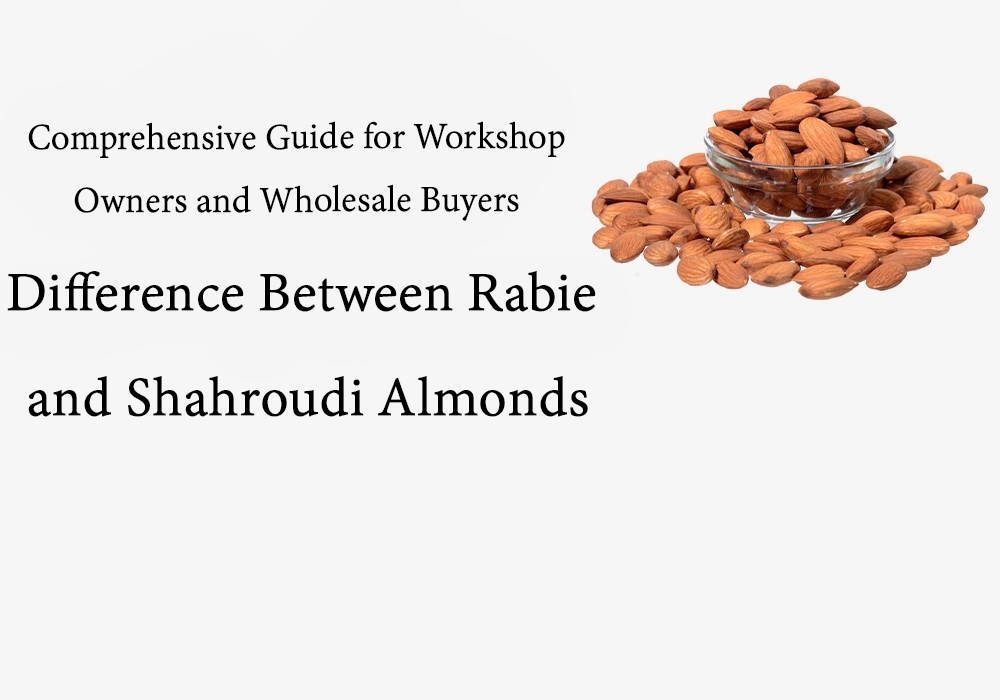
Technical Anatomy: Rabie vs. Shahroudi Almonds; A Comprehensive Guide for Processors and Bulk Buyers
In the deep layers of the Iranian dried fruit market, where multi-ton deals are closed, two names are constantly heard side-by-side: Rabie Almonds and Shahroudi Almonds. Due to their similar appearance and close price points, many intermediaries and brokers mix these two varieties or sell one in place of the other. However, for a professional buyer—whether you own a cracking facility or are an exporter—the difference between these two varieties is the difference between "Net Profit" and "Hidden Loss."
Do you know which one suffers less breakage in industrial cracking machines? Which one offers a higher Kernel Yield? And which is preferred for export to Arab nations versus India? In this specialized article from Walmond, we analyze the files of these two competitors from the perspective of agricultural engineering and commercial viability.
1. Rabie Almond: The "Kernel Yield" Champion
Native to the Saman and Ben districts in the Chaharmahal and Bakhtiari province, Rabie is known in local market slang as the "Smart Almond" because you get more kernel for the money you pay.
Technical Analysis of Rabie:
- Shell Type: Semi-Hard. The shell is thick but not stone-hard. It cracks easily with a standard hammer blow, separating cleanly from the kernel.
- The Yield Factor: This is the most critical point for processing workshops. Rabie’s shelling percentage usually ranges between 33% to 40%. This means for every 10 kg of in-shell almonds, you obtain about 3.5 to 4 kg of pure kernels.
- Kernel Quality: The kernel has a light color, balanced fat content, and most importantly, guaranteed sweetness. The probability of finding bitter nuts in authentic Rabie loads is extremely low.
- Machine Behavior: In industrial cracking lines, Rabie suffers less "breakage" or "scrap" due to its relatively brittle shell structure compared to stone varieties.
2. Shahroudi Almond: The Giant of "Appearance & Storage"
Shahroudi (which includes multiple cultivars like 12, 17, 18, and 21) is a modified, late-blooming variety. It is the most "Display-Friendly" stone almond in Iran.
Technical Analysis of Shahroudi:
- Shell Type: True Hard-Shell (Stone). The shell is thick, solid, and woody. It requires significant energy to crack.
- The Yield Factor: Shahroudi’s yield is generally lower than Rabie, ranging between 28% to 32%. This means you are buying a higher volume of shell (waste).
- Kernel Shape: The Shahroudi kernel is elongated, slender, and very elegant. Its tip is sharper than Rabie's, giving it a luxury appearance in mixed nuts.
- Shelf Life: The thick shell acts as a "Natural Vacuum Pack." This almond can be stored for up to 3 years in a standard warehouse without the kernel changing color or developing a stale odor.
3. B2B Comparison Table (For Financial Calculations)
Use this table to run your numbers before committing to a bulk purchase:
| Comparison Index | Rabie Almond | Shahroudi Almond |
|---|---|---|
| Processing Profitability | Excellent (High profit in volume) | Medium (Higher shell cost) |
| Shell Hardness | Medium (Semi-Hard) | Hard & Thick (Stone) |
| Kernel Geometry | Oval, Broad, and Plump | Elongated, Slender, Dagger-like |
| Machine Breakage % | Low (Less Waste) | Medium (Needs precise calibration) |
| Primary Use | Almond Slivers, Powder, Oil | Roasted Nuts, In-Shell Export |
| Target Export Market | Arab Nations (For Taste) | India & Pakistan (For Appearance) |
| Kernel Color | Light Bright Brown | Reddish/Dark Brown |
4. Visual Identification Guide: Spot the Difference in 3 Seconds
When you stand in a warehouse and a sack is opened, how do you determine if the load is Rabie or Shahroudi?
- The "Tip" Test: Look at the kernel. If the tip is sharp and elongated like a pencil point, it is Shahroudi. If the tip is rounder with a gentle curve, it is Rabie.
- The "Shell Texture" Test: The wooden shell of Rabie usually has tiny pores and a slightly softer texture. Shahroudi’s shell is polished but looks very solid and bony.
- The "Sound" Test: Bang two nuts together. Shahroudi makes a sharp, high-pitched "stony" sound (like two rocks hitting). Rabie makes a slightly deeper sound (due to lower wood density).
5. Buying Scenario: Which Fits Your Business?
A) If you own a Cracking Factory:
The Clear Winner: Rabie You crack almonds to sell "Kernels." Every 1% increase in yield translates to substantial profit per truckload. Rabie cracks easier (less wear and tear on machines) and gives you more meat.
B) If you are a Retailer or Nut Shop Owner:
The Winner: Shahroudi (Kernel) Your end customer buys with their "eyes." Shahroudi kernels look larger and more luxurious in a nut bowl. Even if selling in-shell, Shahroudi is preferred for its large size and clean shell appearance.
C) If you produce Almond Slivers or Powder:
The Winner: Rabie Rabie kernels have a dense, oily texture that holds its shape during slicing, preventing it from turning into powder. Its light color also produces beautiful, white almond slivers.
6. Market Tricks (Common Scams)
Unfortunately, some sellers offload "Generic Stone Almonds" or small local crops under the name "Shahroudi" or "Rabie."
- Security Tip: Always request the "10-Nut Crack Test." Randomly pick 10 nuts from the center of the bag (not the top) and crack them.
- In a good Rabie load, you should get at least 35g to 40g of kernel per 100g of nuts.
- In a Shahroudi load, check for size uniformity (there should be no mix of small and large nuts).
Conclusion
The war between Rabie and Shahroudi is not a war of quality; it is a war of Utility.
- Rabie is the profitable worker in your factory.
- Shahroudi is the stylish model in your shop window.
At Walmond, by eliminating local middlemen, we source Rabie and Shahroudi loads directly from certified orchards in the Saman region. All our loads are Calibrated and yield-tested before shipment, so you know exactly what you are paying for.
[View Wholesale Price List & Request Samples (Rabie & Shahroudi)]