
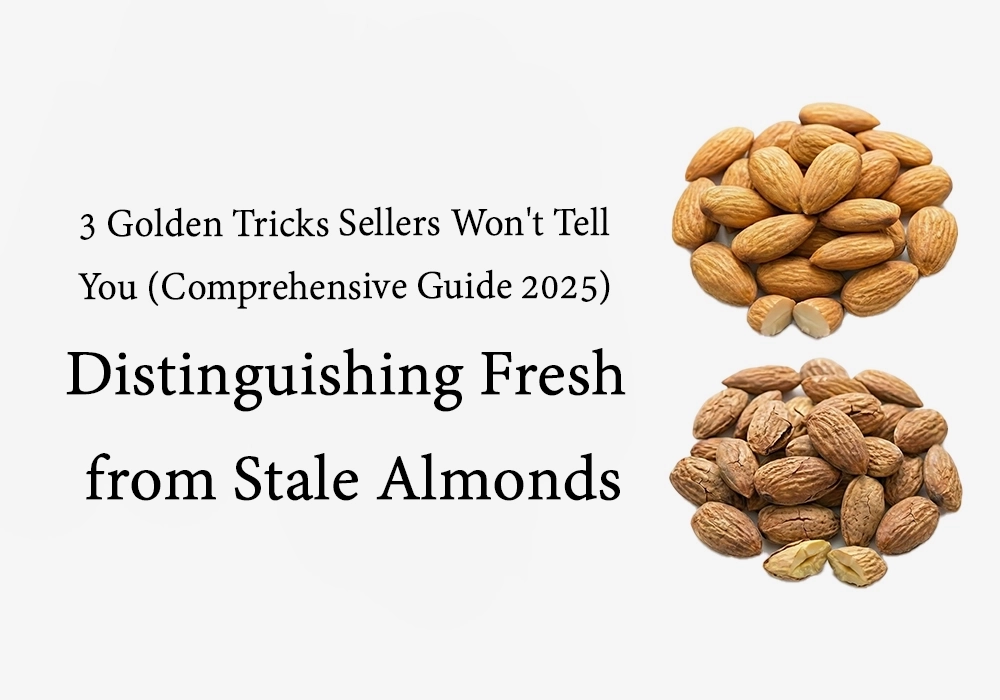
How to Detect Fresh vs. Stale Almonds? 3 Insider Tricks Sellers Won't Tell You (2025 Guide)
Buying almonds always comes with a hidden fear: "Are they selling me last year's harvest (Old Crop) disguised as the new crop?" This fear is not unfounded. In the dried fruit market, there are techniques to "polish," "salt," and "blend" old almonds with new ones that can deceive even semi-professional traders. Stale almonds are not just bad-tasting; due to fat oxidation, they turn into toxic capsules filled with free radicals.
At Walmondhe, we believe an informed customer is the best customer. In this bold and comprehensive guide, we translate complex laboratory tools into simple language and teach you 3 field-tested, rapid tricks (along with advanced techniques) that greedy sellers would prefer you didn't know.
Why Do Almonds "Age"? (The Chemistry of Food Spoilage)
Before we learn how to test, we must understand what happens inside the almond. Almonds are rich in unsaturated oils (like Oleic Acid). These oils are chemically unstable. When almonds are exposed to air, heat, or light, a process called "Oxidation" begins.
- Stage 1 (Hydroperoxides): At this stage, the almond doesn't smell yet, but its nutritional value is destroyed.
- Stage 2 (Aldehydes & Ketones): The fats break down, producing a sharp "Rancid" smell and a bitter taste. Detecting Stage 1 is hard, but with the following tricks, you can catch a manipulative seller red-handed.
Trick 1: The Cross-Section Test (Visual Check); Does the Appearance Lie?
Many buyers only look at the "Brown Skin." However, the skin can be made to look fresh and shiny using brine, acids, or food-grade waxes. The real secret lies in the Heart of the Kernel.
1. The Knife Test
Pick an almond and cut it in half with a sharp knife. Look at the central tissue (Cotyledon):
- Fresh Almond: The center of the kernel must be "Snow White" or very light cream. The texture must be uniform, dense, and solid.
- Stale Almond: The center leans towards "Yellowish" or "Amber." This color change is due to the Maillard reaction and fat oxidation. If the internal texture looks like a "Honeycomb" (porous and hollow), it means the almond oil has dried out, and the cargo is at least 2 years old.
2. The Insect Pinhole Test
Stale almonds (especially Paper Shell/Moheb) are targets for insect larvae. Inspect the kernel surface closely.
- Micron Holes: If you see pinhead-sized holes surrounded by a little "flour" (white dust), that almond is being eaten from the inside. This is a definitive sign of long-term storage in a warm warehouse.
Expert Note: This test is vital for luxury varieties like Mamra Almond. Because its price is high, some scammers mix old stock with new. Always pick 5 random kernels from different points in the sack and crack them open.
Trick 2: The Shake, Rattle, and Texture Test (Physical Check); What Does Physics Say?
Did you know that fresh and stale almonds have different "Densities" and "Audio Frequencies"? This is due to the loss of natural Moisture Content inside the kernel.
For In-Shell Almonds
If you intend to buy Stone Almonds:
- The Rattle Test: Take a handful of almonds and shake them near your ear.
- Stale: You will clearly hear the kernel hitting the shell wall. Why? Because the kernel has lost its water and "Shriveled," so it rattles inside its house.
- Fresh: Silent or a very muffled sound. A fresh kernel fills the shell space completely.
- Volumetric Weight Test: Stale almonds are lighter. If you lift a sack of almonds and it feels suspiciously "light" or "hollow," do not doubt that it is old stock.
For Almond Kernels
Place a kernel on your molar and crack it (Texture Test):
- Fresh Almond: Has a clear, loud "Crunchy" sound and breaks apart quickly. The texture is crisp.
- Stale Almond: The texture is "Chewy" or rubbery, sticking to the teeth (like hard gum). Or conversely, in cases of extreme age, it becomes hard as a rock and crumbles into powder. To better understand texture standards, read Comprehensive Guide to Almond Quality Control for Bulk Buyers.
Trick 3: The Smell and Boiling Water Test (Chemical Check); Chemistry Never Lies
This is the most important and accurate test. The human nose is capable of detecting volatile oxidation compounds before the sense of taste.
1. The Sniff Test (Rancidity)
When unsaturated fats in almonds (which make up about 50% of its weight) go bad:
- Method: Rub your palms together until they are warm (heat releases scent molecules), then cup a handful of almonds and inhale.
- Rancid Smell: A smell resembling "Old Oil," "Fish," or "Oil Paint." This means the almond is toxic.
- Musty/Earthy Smell: An earthy smell is natural, but if it smells like "Mold," "Damp Sack," or "Basement," it means the cargo was in a humid warehouse, and there is a risk of Aflatoxin (a dangerous fungal toxin).
2. The Boiling Water Trick
This is a pro trick that very few know:
- Throw a handful of almonds into a cup of boiling water and cover it.
- After 3 minutes, remove the lid and smell the steam.
- The steam releases the hidden stale odor trapped in the almond tissue with 10x intensity. If you smell anything unpleasant, cancel the purchase immediately.
Warning: If you are buying "Roasted" (Salted) almonds, your job is very hard. Spices (saffron, salt) mask the stale smell. Our suggestion is always to buy raw almonds. (Read more: Raw vs. Roasted Almonds: Which is Healthier?).
Dissecting the Fraud: What is the "Mixing Scam"?
One of the most common scams is mixing this year's crop (2025) with bottom-of-the-warehouse stock (2023 or 2024). For example, they blend 30% old almonds with 70% new ones to dilute the bad taste.
How to Catch the Scammer?
The Uniformity Test: Pour a handful of almonds onto a white A4 paper and spread them out.
- Color: Are all kernels the same shade? Or are some dark brown and some light? Color variation is a sign of mixed years.
- Shriveling: Are some kernels shriveled and skinny while others are plump? Almonds from one orchard and one year must be genetically "Homogeneous." Stark differences are a red flag.
Signs of Aging by Variety (Mamra vs. Stone)
Every almond ages differently. Knowing these differences makes you look like a pro.
1. Mamra Almond
This almond has very high fat content (up to 60%).
- Weakness: It goes "Rancid" quickly. In stale Mamra, the kernel color darkens significantly, and brown spots appear on the surface. (Read more: Mamra Almond Export Specifications).
2. Stone Almond
Has a hard shell and is resistant.
- Weakness: Rarely goes rancid, but it "Dries Out." The sign of age in Stone almonds is excessive hardening of the kernel, turning it woody.
3. Paper Shell (Moheb)
Has a thin shell.
- Weakness: Insect attack. In this variety, the presence of powdery dust and pinholes is the most common sign of age.
For Bulk Buyers: The B2B Lab Tests
If you plan to buy tons, do not rely solely on your five senses. You must ask the seller for a Lab Report.
- Peroxide Value (PV): Indicates the start of oxidation.
- Standard: Must be below 5 meq/kg. Above 10 means the cargo is spoiled.
- Free Fatty Acids (FFA): Indicates fat breakdown.
- Standard: Must be below 1.5%.
- Aflatoxin Test: Carcinogenic fungal toxin. Especially for export to Europe, this number must be checked in ppb (parts per billion).
Why Is Eating Stale Almonds Dangerous? (Beyond Bad Taste)
Buying stale almonds isn't just a waste of money; it's playing with health.
- Inflammation: Oxidized fats contain free radicals that cause cellular inflammation and premature aging.
- Digestive Issues: Rancid almonds can cause stomach pain and mild poisoning.
- Liver Risk: If it smells musty (Aflatoxin), long-term consumption seriously damages the liver.
Conclusion: Where to Buy With Peace of Mind?
Detecting fresh almonds is a skill, but the easier way is to buy from a source that offers a "Return Guarantee" and "Product Certification." At Walmondhe, by eliminating middlemen, we source almonds directly from the orchards of Saman and the Zayandeh Rood banks. Our almonds are stored in controlled conditions (low temperature and humidity), and the sorting process happens exactly before shipping. This means the almond stays in its protective shell until the moment of your order.
- Are you looking for this year's Paper Shell/Moheb Almonds that crack with a hand squeeze?
- Or do you want Super Luxury Mamra Almonds with a Peroxide Test guarantee?
Contact our experts right now and request a "Sample" to test the quality yourself using the 3 tricks and the Boiling Water method.