
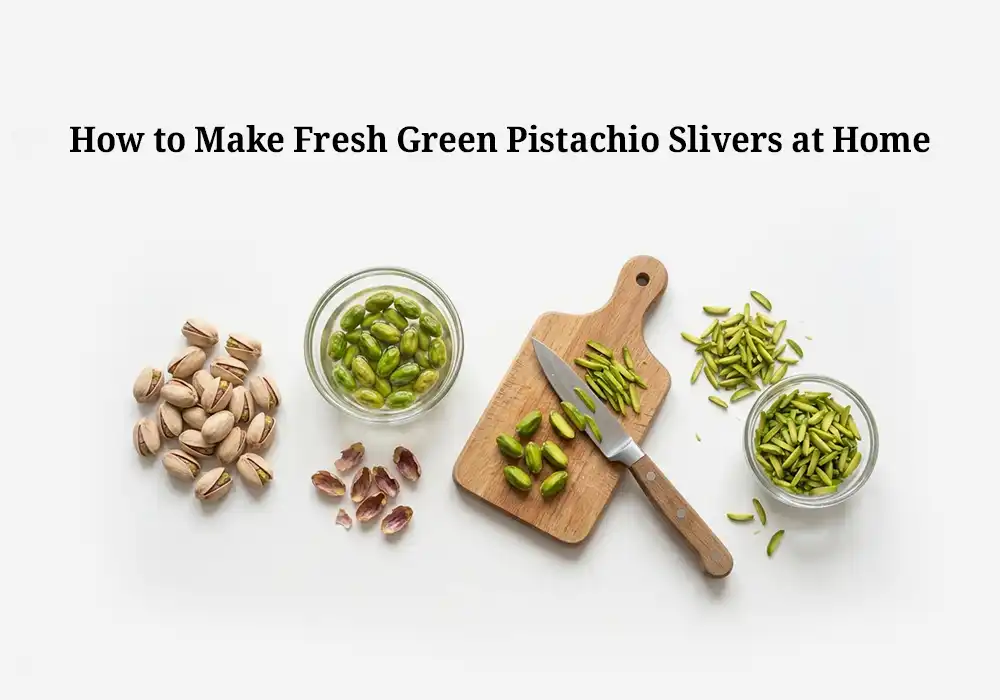
How to Make Fresh Green Pistachio Slivers at Home (Mastering the Art of Crafting Emerald Culinary Jewels)
Slivered green pistachios (Khalal-e Pesteh) represent the aristocratic signature and crowning jewel of Persian, Middle Eastern, and haute international pastry arts. From illuminating saffron jeweled rice (Morassa Polo) and saffron rice pudding (Sholeh Zard) to elevating artisan chocolates and luxury confections, these razor-thin emerald ribbons transform an ordinary dish into a breathtaking gastronomic masterpiece. Yet, anyone who has attempted to purchase elite slivered pistachios in retail markets has encountered two harsh realities: an astronomical price tag, and the rampant commercial fraud of synthetic dyeing!
A staggering volume of suspiciously neon-green pistachio slivers sold commercially are manufactured from cheap, stale, yellow kernels submerged in industrial food dyes or artificial chlorophyll baths. These synthetic pigments bleed immediately upon touching warm food and compromise nutritional safety.
The exhilarating truth is that you can craft the purest, most intensely aromatic, elongated green pistachio slivers on Earth—with zero synthetic dyes—right inside your domestic kitchen! However, if you have ever pressed a chef’s knife down onto a dry pistachio kernel, you already know the frustration: the dry nut instantly shatters into messy crumbs and coarse dust. Engineering long, intact, vibrant green slivers requires a precise understanding of moisture biochemistry, thermal shock, and chlorophyll preservation.
In this comprehensive culinary masterclass, we will dissect every professional workshop secret step-by-step, empowering you to produce homemade slivered pistachios whose vibrant color, structural elegance, and buttery aroma eclipse any store-bought version.
1. Raw Material Selection: Which Pistachio Is Engineered for Slivering?
The ultimate brilliance of your slivers is determined long before you lift a knife—it begins at the moment of kernel selection. To guarantee long, uniform, emerald ribbons, enforce three foundational rules:
- The Absolute Raw Rule: You must never attempt to sliver roasted or salted pistachios. Industrial roasting incinerates moisture, making the cellular structure violently brittle while dulling the green interior into a muddy brown-yellow. As detailed in our biochemical comparison of Raw vs. Salted Pistachios, only 100% raw, unsalted kernels retain living chlorophyll pigments and the physical elasticity required for clean slicing.
- Elongated Geometry: Round pistachio cultivars (like Fandoghi) yield stubby, irregular fragments. For dramatic, needle-like luxury slivers, exclusively choose elongated almond-shaped cultivars (such as raw Ahmad Aghaei or early-harvest green kernels).
- Peak Harvest Freshness: Aged kernels lose their green chlorophyll through light and oxygen exposure, turning pale yellow. To ensure you select vibrant, current-crop kernels at the market, consult our guide on how to identify fresh and high-quality pistachios. If you plan to source ultra-green, early-season fresh pistachios, checking the best time to buy fresh pistachios reveals the ideal harvest window.
2. Phase One: Thermal Shock (Blanching) and Stripping the Pellicle
Every raw pistachio kernel is wrapped in a paper-thin, purplish-brown skin known as the pellicle. To reveal the luminous emerald core without cooking the nut, execute the precise blanching technique:
- The Brief Boiling Bath: Bring a saucepan of purified water to a vigorous rolling boil. Submerge the raw pistachio kernels for strictly 45 to 60 seconds—not a second longer! Over-boiling cooks the nut's surface proteins, turning the texture mushy while leaching volatile aromatics and color into the water.
- The Ice Shock (Locking in Chlorophyll): Immediately drain the kernels and plunge them directly into a bowl of ice-cold water. This violent thermal shock accomplishes two critical feats: it halts residual heat cooking instantaneously, and it chemically stabilizes the vibrant green chlorophyll pigments.
- Friction Peeling: Drain the chilled kernels and spread them inside a clean, lint-free cotton kitchen towel. Fold the towel over the nuts and gently rub them with your palms for 1 to 2 minutes. The gentle textile friction cleanly slips the loosened purple skins right off, unveiling glowing green jewels. (For additional peeling techniques with fresh-harvested in-hull nuts, consult our tutorial on how to peel fresh pistachios).
3. The Workshop Secret: The "Moisture Sweet Spot" Against Crumbling
The single most common mistake home cooks commit is allowing blanched kernels to dry completely before slicing! Once fully dehydrated, a pistachio becomes rigid and snaps unpredictably into powder under blade pressure. Conversely, slicing dripping-wet kernels causes them to slip and bruise.
The Master Slicing Window: The optimal moment to sliver pistachios is 10 to 15 minutes after peeling—precisely when the exterior surface has been patted dry with a towel, yet the internal cellular matrix retains a slight, pliable, semi-elastic humidity from blanching! During this narrow golden window, a sharp blade glides effortlessly through the kernel like slicing cold butter, yielding unbroken, uniform, needle-thin ribbons with virtually zero crumbling.
4. Phase Two: Precision Slicing Architecture (Knife vs. Sliver Cutter)
To engineer uniform slivers measuring 1 to 2 millimeters thick, select one of two disciplined approaches:
- Method 1 (Razor-Sharp Chef’s Knife): First, split each peeled kernel along its natural center seam with gentle finger pressure into two symmetrical halves. Place the flat interior face down onto a dry cutting board (eliminating rolling and protecting your fingers). Using a razor-sharp, thin-bladed knife held strictly perpendicular, slice lengthwise in steady, parallel motions.
- Method 2 (Mini Nut Slicer / Handheld Mandoline): If you are processing larger batches (500 grams to 1 kilogram), a dedicated rotary nut slicer or precision mini mandoline accelerates output tenfold while guaranteeing factory-grade uniformity across every single ribbon.
5. Phase Three: Controlled Dehydration (Keeping the Emerald Hue Alive)
Your pristine slivers are now sculpted, yet they still harbor residual internal blanching moisture. Sealing them in a jar immediately guarantees destructive mold growth within 48 hours. However, your drying protocol dictates whether they remain jewel-green or turn dull brown:
- Enemy #1 (Direct Sunlight): Never dry pistachio slivers in direct sun! Ultraviolet (UV) rays rapidly shatter chlorophyll molecules, bleaching your vibrant emerald ribbons into lifeless straw-yellow within hours.
- Enemy #2 (High Oven Heat): High thermal exposure accelerates oil oxidation and browns the delicate edges.
- The Shade Air-Dry Standard: Spread the slivers in a single thin layer across a clean cotton cloth in a cool, shaded, well-ventilated room (or beneath gentle indirect fan airflow). Depending on ambient humidity, within 24 to 48 hours the slivers become completely dry and crisp while retaining 100% of their vivid green hue.
- The Accelerated Low-Heat Option: If pressed for time, arrange the slivers on parchment paper inside a food dehydrator or oven set to its absolute lowest temperature (maximum 45°C to 50°C / 115°F) with the door slightly ajar for 1.5 to 2 hours—evaporating moisture gently without roasting.
6. Anti-Oxidation Storage Protocol: Protecting Color and Crunch for a Year
Because slicing drastically multiplies the exposed surface area of the nut's delicate unsaturated oils, pistachio slivers oxidize and turn rancid far faster than whole kernels. To master the science behind nut spoilage and prevent bitterness, study our analysis on why pistachio kernels turn bitter or stale.
Lock in day-one brilliance using these rules:
- Airtight, Opaque Glass Storage: Once bone dry, transfer the slivers immediately into an airtight glass jar with a silicone gasket and keep it inside a dark cabinet.
- Sub-Zero Freezing (Best for 1+ Months): For long-term storage, portion slivers into airtight freezer bags (evacuating all trapped oxygen) and freeze them. Sub-zero temperatures virtually halt chlorophyll degradation, stop lipid rancidity, and eliminate insect pests. Follow our protocols on how to freeze fresh pistachios and how to prevent worms in pistachios to ensure flawless preservation.
7. Luxury Culinary Uses and Selecting the Ultimate Cultivar
Your pure, artisanal pistachio slivers are now ready to crown saffron rice, gourmet cakes, and classic Middle Eastern treasures like authentic Turkish pistachio baklava and homemade Persian pistachio ice cream. (Chef’s Tip: Before garnishing rice or desserts, soak the dried slivers for 15 minutes in pure rose water with a pinch of sugar to amplify their floral aroma and impart a radiant glaze).
Remember that long, unbroken, intensely flavorful slivers begin with elite agricultural genetics. The Ahmad Aghaei Pistachio, prized for its aristocratic elongated shape, dense non-hollow structure, exceptionally high stable Oleic acid content (resisting rancidity), and rich green interior, is among Iran’s finest varieties for crafting long, buttery, shatter-resistant slivers.
The Walmondhe engineering and trading group proudly supplies Iran’s freshest, most uniform raw Ahmad Aghaei pistachios directly from premier desert orchards. Laser-sorted and hermetically packed, our current-harvest cargo is guaranteed completely free of industrial salts, staleness, and Aflatoxin—delivering the ultimate raw ingredient for luxury pastry kitchens and discerning home chefs.
To secure bulk commercial orders for gourmet bakeries, restaurants, organic retailers, and export markets, or to inquire about real-time pricing, connect with our sales department through our official channels below:
- Direct & Fast WhatsApp Communication: +989136667618
- Direct Sales Department Telephone: +989136667618