
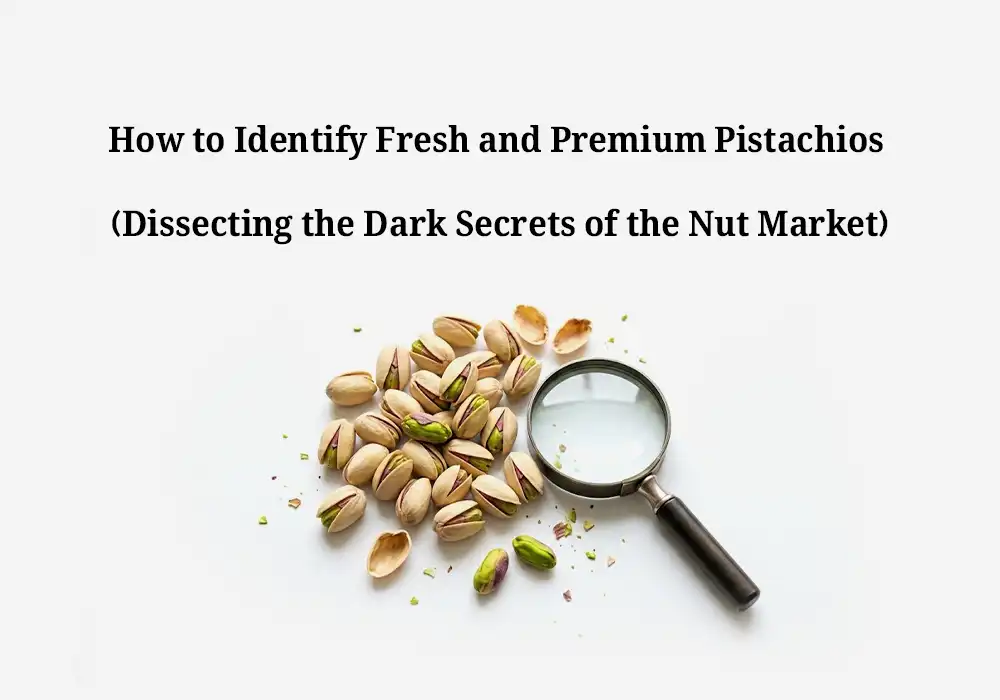
How to Identify Fresh and Premium Pistachios (Dissecting the Dark Secrets of the Nut Market)
Walking into a luxury dry fruit boutique and being confronted by mountains of vibrant, roasted, salted, and saffron-infused pistachios can be an intensely seductive purchasing experience. In this environment, your senses are easily hijacked by glossy displays and carefully engineered aromas. When a merchant confidently presents a handful of nuts as "this year’s premium harvest," how do you genuinely know if you are purchasing an authentic agricultural jewel or a stale, year-old crop cleverly disguised with chemical manipulation?
The international pistachio trade is a ruthless industry governed by millimeters, color gradients, and lipid percentages. Behind the glittering retail displays operate brokers who utilize aggressive thermal shocks, heavy industrial salts, and synthetic citric acids to resurrect closed, empty, or decaying nuts into seemingly premium products. To navigate this commercial minefield without being utterly deceived, you must discard the naive gaze of a casual consumer and adopt the surgical precision of an international quality control inspector.
In this profoundly analytical and comprehensive guide, we will elevate you to an unrivaled expert in pistachio grading. By meticulously dissecting the physical, chemical, and biological architecture of the nut, we will teach you how to employ your five senses to rip away the deceptive masks of inferior pistachios and secure nature’s most flawless green treasures.
1. The Geometry of the Smile: Natural Splits vs. Mechanical Fakes
The absolute foremost indicator defining a pistachio’s commercial and biological value is the fracture along its bony shell, universally referred to as the "smile" or split. However, in the nut industry, not every smile is genuine!
- The Natural Split (Nature’s Masterpiece): A truly premium pistachio is one that has organically ruptured its own bony shell while still hanging on the branch. As the inner kernel matures, swells, and fills with rich lipids, it exerts massive internal pressure against the shell, forcing it to pop open. In a naturally split pistachio, the kernel is fully visible and easily extracted. If you attempt to pinch the two halves of the shell completely closed with your fingers, you will fail; the massive, plump meat of the nut physically prevents the shell from shutting.
- The Mechanical Water-Shock (The Fake Smile): Pistachios harboring weak, underdeveloped kernels fail to split naturally and remain hermetically sealed on the tree. Unscrupulous brokers collect these cheap, closed nuts and submerge them in vats of boiling water, immediately followed by a violent plunge into freezing water. This severe thermal shock fractures the bony shell. A water-shocked pistachio is a dangerous, low-quality product because dirty water seeps inside during the process, drastically accelerating the growth of internal mold. If you pinch the shell of a water-shocked nut, it will close effortlessly because the kernel inside is so pathetically small it occupies virtually no space.
2. The Symphony of Colors: Analyzing the Bony Shell and Kernel Skin
The color palette of a pistachio serves as its unalterable biological passport. A seasoned buyer judges the intrinsic quality of a batch based purely on its color spectrum long before ever tasting a single kernel.
- The Radiant Bony Shell: The hard outer shell must be brilliantly light, uniform in color, and completely devoid of dark stains, brown mottling, or fungal blemishes. Dark stains on the bony shell are a grim indicator that the nut was left languishing inside its moist green hull for too long after harvest, triggering the initial stages of decay. The most elite pistachios possess a blindingly white shell, signaling rapid, highly hygienic processing.
- The Crimson and Purple Pigments: When examining the exposed meat of a premium pistachio, you should immediately notice a paper-thin skin radiating vivid hues of deep purple, dark crimson, or vibrant violet. These pigments are dense concentrations of powerful antioxidants. If the skin covering the kernel looks dull brown, sickly yellow, or washed out, it firmly indicates that the batch is old and its healthy fats have oxidized in a hot warehouse.
3. The Olfactory and Acoustic Tests: Detecting Lipid Oxidation
The pistachio is a highly oleaginous (oil-rich) seed. The molecular integrity of the fats hidden within its kernel is directly correlated to its absolute freshness.
- Authentic Aroma vs. Rancid Stench: Bring a handful of pistachios to your nose and inhale deeply. A freshly harvested batch emits a sweet, earthy, and distinctly green aroma. If the pistachios project even the faintest odor of old oil paint, damp basements, or dried soap, it means the polyunsaturated fats have undergone severe oxidation. The product is definitively rancid and unfit for human consumption.
- The Acoustic Crunch Test: A superior pistachio, whether raw or expertly roasted, must shatter between your teeth with a highly satisfying, audible crunch. Kernels that feel rubbery, doughy, or unpleasantly soft have absorbed atmospheric moisture and are teetering on the edge of developing toxic mold. The flavor profile of a genuine pistachio should be rich, profoundly buttery, and leave absolutely no bitter or burning aftertaste in the back of your throat.
4. The Deceptive Mask: Why You Must Avoid Heavily Salted Nuts
There is a golden, unbreakable rule in the wholesale dry fruit market: The lower the inherent quality of the pistachio, the more salt, citric acid, and artificial food coloring the vendor will dump onto it!
An elite pistachio requires zero heavy makeup. Brokers frequently take last year's stale, woody-tasting inventory, hurl them into commercial roasting ovens, and drown them in aggressively dense saltwater brines to completely camouflage their rancid bitterness. They also utilize synthetic yellow dyes to mask the dull color of the kernels—dyes that will notoriously stain your lips and fingers. To conduct a genuine assessment of a vendor's quality, always demand to sample a completely raw, unroasted pistachio from the exact same harvest. A raw pistachio has no mask; it can never lie about its age or quality.
5. Selecting the King: Which Variety Passes Every Single Test?
When we mercilessly apply all these rigorous filters—the wide natural split, the blindingly white shell, the vibrant purple kernel, and the incredibly fresh lipid profile—onto the diverse spectrum of global varieties, only one specific pistachio emerges as the ultimate symbol of absolute perfection.
The Ahmad Aghaei Pistachio is the undisputed masterpiece of Iranian agricultural engineering. By its very genetic nature, it boasts the whitest bony shell on earth and a 100% natural, incredibly wide smile, allowing its massive kernel to be extracted with zero effort. The exceptionally high percentage of premium healthy fats within the Ahmad Aghaei ensures that its raw flavor is intensely sweet and buttery. When roasted, it achieves a heavenly crunch without requiring any chemical manipulation. Furthermore, due to its precise early harvesting schedule, the risk of fungal contamination in this variety is mathematically reduced to zero.
The Walmondhe engineering and trading group proudly supplies the most immaculate, massive, and authentic Ahmad Aghaei pistachios available globally. Utilizing the world's most precise optical sorting technology, we guarantee cargo that is entirely devoid of blanks, closed-mouth shells, or stale kernels. We promise striking whiteness, natural splits, and unrivaled freshness for the most discerning international buyers.
To secure bulk commercial orders, request trade samples, inquire about real-time export pricing, and receive specialized consultation, connect with our sales department through the official channels below:
- Direct & Fast WhatsApp Communication: +989136667618
- Direct Sales Department Telephone: +989136667618