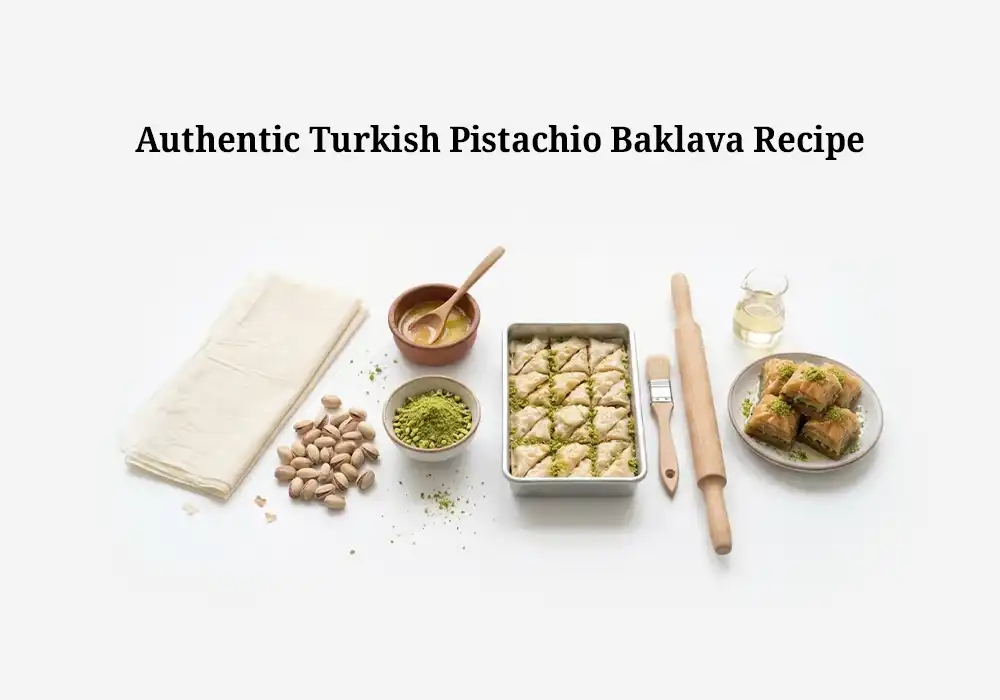
Authentic Turkish Pistachio Baklava Recipe (Engineering the Ultimate Ottoman Pastry Masterpiece)
Baklava is not merely a traditional dessert; it is a structural and biochemical masterpiece of the culinary arts. In this aristocratic pastry, dozens of translucent, paper-thin sheets of phyllo dough are meticulously insulated with liquid clarified butter, wrapped around a dense core of emerald-green pistachios, and finally immortalized in a rich, aromatic sugar syrup. Biting into an authentic slice of Istanbul baklava is a deeply multi-sensory experience: first, the acoustic, shattering crunch of the roasted dough hits your ears, followed by the buttery, earthy richness of the pistachios, culminating in the velvet rush of sweet syrup melting across your palate.
Countless enthusiastic home bakers operate under the illusion that crafting authentic Turkish baklava requires highly complex industrial bakery equipment, often fearing their homemade attempts will yield a soggy, dense, or painfully sugary disaster. In reality, engineering this regal dessert demands zero specialized equipment; it strictly requires a profound scientific understanding of "syrup thermodynamics," "butter purification," and "pistachio lipid quality."
In this comprehensive, analytical culinary masterclass, we will transport you directly into the ancient pastry kitchens of the Ottoman Palace. Rather than offering a simplistic recipe list, we will meticulously dissect the biochemistry behind every single layer. We will teach you how to extract the milk solids from butter to prevent burning, how to perfectly calibrate the viscosity of your syrup, and how to utilize the greenest, most premium pistachios to construct an architectural wonder of flavor.
1. The Architectural Blueprint (Ingredients for a 9x13 Inch Pan)
For the Pastry Structure:
- Premium Phyllo Dough: 1 package (approximately 40 ultra-thin sheets, thawed completely at room temperature)
- Raw, Green Pistachio Kernels: 350 to 400 grams (Never, under any circumstances, utilize roasted or salted nuts)
- High-Quality Unsalted Butter: 300 grams (to be transformed into clarified butter/ghee)
For the Master Syrup:
- White Granulated Sugar: 3 cups
- Purified Water: 3 cups
- Fresh Lemon Juice: 1 tablespoon (crucial for preventing sugar crystallization)
- Fresh Lemon Slice: 1 thick slice
- (Clinical Note: Authentic Turkish baklava absolutely shuns rose water, cardamom, or orange blossom water, allowing the pure, unadulterated flavor of the roasted pistachios and cultured butter to dominate).
2. Phase One: Butter Purification and Emerald Extraction
The single most devastating culinary error committed by amateur bakers is brushing standard, raw butter between the phyllo sheets. Standard butter is composed of 15% to 20% water and suspended milk proteins. If applied directly, the water turns the delicate dough soggy, and the milk proteins burn violently in the hot oven, leaving bitter, black carbon stains throughout your pastry. You must engineer Clarified Butter (Ghee). Melt the butter in a heavy saucepan over the lowest possible heat. Allow it to simmer gently without stirring until a thick white foam (the milk proteins) rises to the surface. Meticulously skim off and discard this foam with a spoon. The crystal-clear, golden liquid remaining is pure butterfat. Pour it through a fine-mesh strainer to guarantee zero milk solids remain.
Preparing the Pistachio Core: The pistachio is the beating heart of the baklava. To achieve that highly sought-after, luxurious emerald-green cross-section, your kernels must be completely stripped of their purple skins. To master this advanced culinary prep, rigorously follow our guide on how to peel fresh pistachios using the thermal blanching technique. Place your naked, green kernels into a food processor. Execute short, precise pulses. The pistachios must not turn into a fine, oily powder; they must be chopped into uniform, lentil-sized fragments to ensure a distinct, earthy crunch in the final bite.
3. Phase Two: Syrup Alchemy (The Law of Thermal Contrast)
The sugar syrup must be engineered first, primarily due to the unbreakable law of baklava thermodynamics: "The baked pastry must be blisteringly hot, and the syrup must be completely cold (room temperature)." If both are hot, the baklava instantly devolves into a mushy porridge. If both are cold, the syrup cannot penetrate the dense cellular layers.
Combine the sugar and water in a saucepan over medium heat. Do not stir it aggressively; allow the sugar to dissolve naturally to prevent aggressive crystallization. Once a rolling boil is achieved, introduce the lemon slice and fresh lemon juice. Reduce the heat and allow the syrup to simmer fiercely for strictly 15 to 20 minutes until it thickens. The final viscosity should mimic warm, runny honey. Remove it entirely from the heat and allow it to cool completely to room temperature.
4. Phase Three: The Layering Architecture (Stacking the Glass)
- Insulating the Foundation: Utilizing a high-quality pastry brush, heavily coat the bottom and rigid walls of your metal baking pan with the warm clarified butter.
- The Base Strata: Phyllo dough dehydrates and cracks within minutes of oxygen exposure. Cover the unused stack tightly with a damp kitchen towel. Lay one single sheet of phyllo into the pan. Generously brush the entire surface with clarified butter. Repeat this exact process, sheet by sheet, for the first 15 to 20 layers (every single layer must be lubricated).
- The Pistachio Injection: Once the foundation is built, distribute your chopped, emerald-green pistachios uniformly across the entire surface. Press down very gently with your palms to compress the nut layer.
- The Crown Strata: Resume the layering process, stacking another 15 to 20 sheets of phyllo directly on top of the pistachio core, meticulously brushing every individual sheet (including the final top sheet) with the remaining clarified butter.
5. Phase Four: Geometric Slicing and the Thermal Bake
Before the baklava enters the oven, it must be surgically sliced. Utilizing a razor-sharp, thin knife, cut the pastry all the way down to the bottom of the pan into classic squares or traditional Ottoman diamonds. These deep incisions serve as vital thermal channels, allowing the oven heat and the final syrup to penetrate directly into the core. Pour any remaining drops of clarified butter directly into these fault lines.
Bake in a preheated oven at 170°C (340°F) for roughly 45 to 55 minutes. The baklava must bake slowly and methodically. A rapid, high-temperature bake will scorch the top layers while leaving the internal dough raw and gummy. Extract the pan when the surface exhibits a breathtaking, deep golden-brown hue.
6. Phase Five: The Syrup Symphony and the Crystallization Rest
The absolute second you extract the scorching hot pan from the oven, utilize a ladle to pour the completely cooled syrup evenly over the entire surface. At this exact moment, a violent, deeply satisfying "hissing and crackling" sound will erupt—this is the physical sound of the dehydrated, hot pastry forcefully absorbing the dense liquid. (Strict Clinical Warning: Do not consume the baklava immediately! It must rest at ambient room temperature for an absolute minimum of 4 to 6 hours. This resting phase allows the cellular structure of the dough and the pistachios to fully absorb the syrup, resulting in the iconic, crystallized crunch).
7. The Ultimate Ottoman Secret: Nut Quality Dictates Authenticity
You can meticulously hand-roll the finest phyllo dough on earth and purify the most expensive butter, but if the pistachios you inject into the core are stale, pale yellow, or lacking in natural lipids, your final pastry will be a highly disappointing, flavorless imitation. It is the emerald-green color and the buttery, lipid-rich profile of the pistachio that forges the true identity of Istanbul baklava. To ensure you never fall victim to fraudulent, stale nuts in the commercial market, mastering our manual on how to identify fresh and high-quality pistachios is a strategic necessity.
Within the global empire of premium dry fruits, the Ahmad Aghaei Pistachio reigns as the undisputed monarch of luxury pastry making. Boasting an incredibly dense, vivid purple and glowing green kernel, it possesses the highest concentration of beneficial unsaturated fats among all global varieties. When you blanch and chop the raw Ahmad Aghaei for baklava, its natural oils are released during the intense heat of the bake, fusing flawlessly with the clarified butter to engineer a heavenly, profoundly sweet, and earthy flavor profile that no synthetic essence can ever replicate.
The Walmondhe engineering and trading group proudly supplies the most massive, pristine, and flawlessly fresh raw Ahmad Aghaei pistachios directly from Iran’s most authentic desert orchards. Processed utilizing world-class laser sorting sensors, we guarantee that our cargo is completely devoid of industrial salts, hidden moisture, and Aflatoxin molds—delivering nature’s purest, greenest, and most fat-dense jewel to serve as the perfect canvas for your world-class pastry creations.
To secure bulk commercial orders for elite pastry kitchens, luxury bakeries, inquire about real-time export pricing, and receive highly specialized consultation, connect with our commercial sales department through the official channels below:
- Direct & Fast WhatsApp Communication: +989136667618
- Direct Sales Department Telephone: +989136667618