
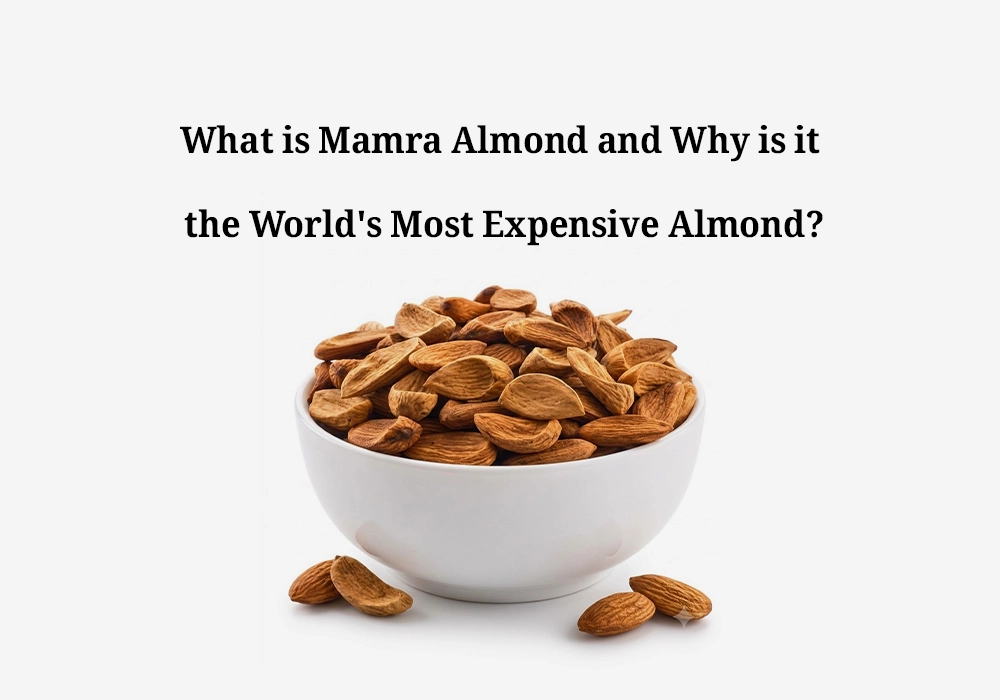
What is Mamra Almond and Why is it the World's Most Expensive Almond? Dissecting a Billion-Dollar Trade
In the world of international dried fruit trade, the name Mamra Almond is intrinsically tied to concepts like "luxury," "scarcity," and "premium pricing." If you visit the wholesale markets of Dubai or the bustling trader alleys of Khari Baoli in Delhi, you will notice a fascinating paradox: while commodity markets are saturated with massive tonnages of low-cost Californian almonds, top-tier merchants are still willing to pay astronomical, multi-fold prices for container loads of Iranian Mamra almonds.
But what exactly is the reason for this massive price discrepancy? Is it merely a price bubble, or does it have a solid scientific and economic foundation?
For a B2B buyer, procurement manager, or trading company, understanding the intrinsic value and fundamental drivers of this pricing is the fine line between a highly profitable venture and a miscalculated investment. In this article, stripping away promotional slogans, we scientifically and logically—yet in simple terms—explore why the Mamra almond is the undisputed king of the global dried fruit market and how you can leverage this product in your export portfolio.
1. The Miracle of Genetics and Terroir: An Exceptional Lipid Profile
The primary and most crucial reason that makes the Mamra almond globally unrivaled is its chemical structure and genetic essence. In the agricultural world, there is a concept called "Terroir," which dictates that a product's quality is directly dependent on the specific soil, water, and climate of a region. The original and unmatched birthplace of the Mamra almond is the Zayanderud river basin (specifically Chaharmahal and Bakhtiari province) in Iran.
The altitude above sea level, combined with cold nights and sunny days in this region, causes this almond to produce an exceptionally high fat percentage. Mamra almonds boast over 50% natural, healthy fats (unsaturated fatty acids).
Compared to American almonds—which are often genetically modified with the sole goal of "increasing harvest tonnage," resulting in a dry taste and woody texture—the Mamra almond possesses an infinitely sweet, buttery flavor and a satisfyingly crunchy texture. This high fat content is exactly what exponentially elevates its medicinal and nutritional value. To review the scientific documentation on this topic, we highly recommend reading our specialized article on why the lipid profile and genetics of the Zayanderud basin Mamra almond dictate the highest valuation.
2. The Economics of Scarcity: When Supply Surrenders to Demand
A basic principle of economics states that whenever demand is high and supply is limited, prices surge. But why don't farmers simply plant more Mamra trees to increase supply?
The answer lies in the nature of the Mamra tree itself. This tree is highly sensitive, late-yielding, and notoriously "stubborn." Unlike the orchards in California, which utilize fully mechanized systems to produce multiple tons of uniform almonds per hectare, the Mamra tree has a lower harvest yield and is highly vulnerable to spring frosts.
- Exclusive and Organic Cultivation: This almond cannot be grown in greenhouses or mass-produced in factory-like farming setups. It relies entirely on traditional, organic farming within a very restricted climate.
- Inelastic Demand: On the flip side, demand for this product in the Indian and Middle Eastern markets increases year over year.
This inherent scarcity naturally keeps the price entrenched in the premium segment. If you are hesitating between different varieties for your trade, the analytical review in our article Mamra Almond vs. Stone Almond: Which is More Profitable for Export Investment? will provide you with a crystal-clear perspective.
3. Cultural and Medical Roots: Why Are Indians Willing to Pay Any Price?
To truly comprehend the price of the Mamra almond, you must understand the Indian market. In Indian culture and traditional Ayurvedic medicine, the Mamra almond is not merely a delicious nut for snacking; it is an "irreplaceable medicine."
Indian families use this almond as an essential supplement to boost the memory of school children, improve the health of pregnant women, and strengthen the immune system. They firmly believe that the high natural fat content of this almond directly impacts brain function. Consequently, the Indian market is hyper-sensitive to this product and follows its market news moment by moment. If you wish to understand the behavior of this complex market, you can read our comprehensive analysis of factors affecting the daily price fluctuations of Mamra almonds in the Indian market.
4. Sizing Architecture and Sorting Sensitivities (Export Grading)
In the Mamra almond trade, the word "mixed" does not exist. The pricing of this product is executed with millimeter precision based on its "Grade" or the count of kernels per 100 grams. Foreign buyers pay the highest premium for larger grades. For instance, understanding the exact difference between Mamra 5A and 4A and their profit margins in India is vital for accurate pricing.
Furthermore, the golden standard of this market is the Mamra almond sizing of 80 to 100 count. However, the critical point is that in exchange for this astronomical price, the buyer expects absolute uniformity and zero sorting errors.
- The Danger of Twins: The presence of even a tiny percentage of bitter almonds, chipped kernels, or joined almonds (twin kernels) in a container can obliterate the value of the entire cargo. For this reason, knowing the impact of the "Twin Kernels" parameter on export profit and loss is an essential piece of knowledge for exporters.
5. The Quality Preservation Challenge: Logistics Packaging Strategies
The very same high fat content that makes the Mamra almond so valuable is its Achilles heel during sea freight. Fat, when exposed to heat and humidity (such as the muggy air in the ports of India or Dubai), oxidizes rapidly, turning the almond's taste rancid and bitter.
Shipping this expensive commodity in standard gunny bags is commercial suicide. Professional buyers require Modified Atmosphere Packaging (MAP) and vacuum sealing to ensure oxygen is completely evacuated. To gain more insight into this, be sure to review our guide on preventing oxidation and bitterness of Mamra almonds in tropical Indian warehouses.
6. Shifting the Playing Field: Moving Toward Ultra-Premium Gulf Markets
While India is the traditional and primary buyer of Mamra almonds, smart traders are discovering new frontiers. In the Arab countries of the Persian Gulf (such as the UAE, Qatar, and Oman), the Mamra almond has secured a special status as an "ultra-luxury commodity" for Corporate Gifting during festivals. Profit margins in these markets are significantly more attractive due to higher purchasing power. If you are looking to expand your market reach, our article investigating whether shifting the Mamra almond export target from India to the Persian Gulf makes economic sense will illuminate a clear path forward.
Why is Walmondhe Your Most Reliable Supply Route?
Sourcing and trading the world's most expensive almond requires a strategic partner capable of eliminating your bulk purchasing risks through stringent guarantees. Walmondhe, with a profound understanding of the expectations of international B2B buyers, has built a technology-driven supply chain:
- Advanced Optical and Laser Sorting: We calibrate the cargo with millimeter precision so the final output is 100% uniform and absolutely free of foreign materials, twin kernels, or bitter almonds.
- Specialized Export Packaging: We utilize cartons equipped with vacuum liners and inert gas injection (MAP) to definitively preserve the buttery taste and crunchy texture of the almond from origin to destination.
- Direct and Engineered Supply: By eliminating middlemen, we offer the capability to supply high tonnages with consistent quality year-round for our commercial partners.
If you intend to enter the trade of this highly valuable product with absolute confidence, our specialized team is ready to provide you with precise technical and commercial consultation.
Contact us to receive the catalog, review quality analysis, and learn about direct sales conditions:
- Get the latest price and request a Proforma Invoice via WhatsApp: 09136667618
- Contact the B2B Export and Sales Department directly: 09136667618 (Phone Call)
- Connect with us on our professional LinkedIn network: Hossein Ebrahimi - Walmondhe