
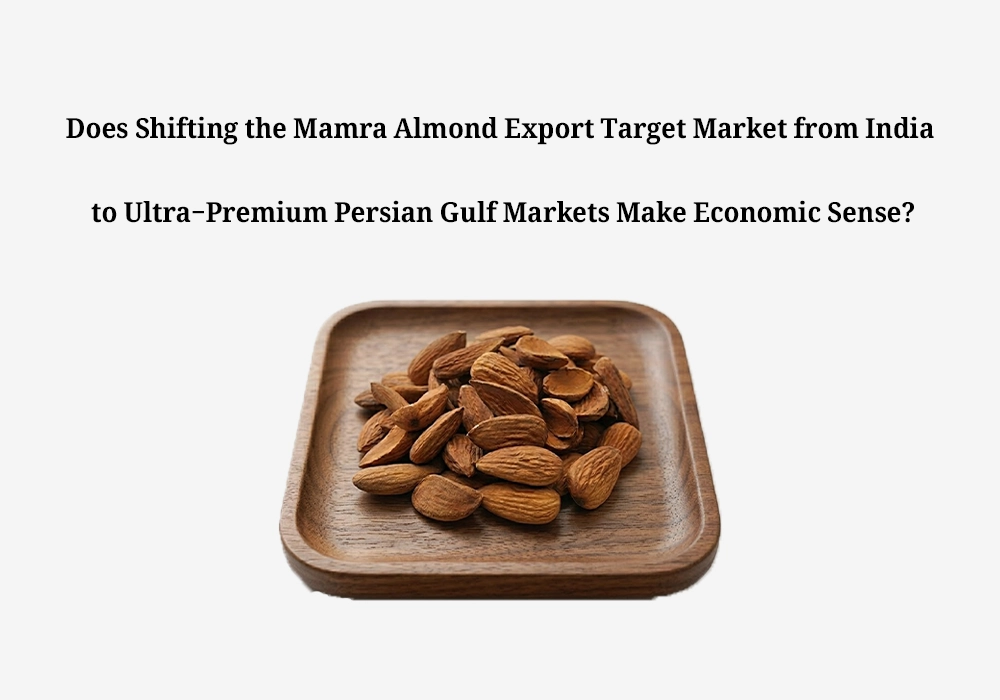
Does Shifting the Mamra Almond Export Target Market from India to Ultra-Premium Persian Gulf Markets Make Economic Sense?
Absolute dependence on a unidimensional market is the greatest strategic error in the international trade of premium commodities. For years, the structural paradigm of the Iranian dried fruit export sector has recognized India as its ultimate and unrivaled destination. However, continuous monitoring of customs data, analysis of B2B buyer behavior, and macroeconomic indicators reveal that this traditional strategy is aggressively swallowing merchants' profit margins. Price-driven competition in Indian wholesale markets, volatile customs tariffs, and harsh storage conditions have severely compressed the net profit of exporters.
Within this highly tense ecosystem, the ultra-premium markets of the Persian Gulf Arab states remain an ignored blue ocean. This comprehensive reference article utilizes a strictly analytical and data-driven approach to dissect the economic justification of shifting from a Volume-Driven business model in India to a Margin-Driven model in the Persian Gulf across all technical, financial, and logistical dimensions.
Anatomy of a Crisis: Why Dependence on the Indian Market Threatens Your Profit Margins
India is undoubtedly the world's largest importer of this product, but the structure of this market is intensely "price-centric" and deeply traditional. In India, even the most luxurious grades ultimately enter bulk distribution channels. This phenomenon causes the commoditization of a product that inherently demands to be priced as a luxury, ultra-premium good.
Exporters are constantly engaged in an exhausting race to the bottom regarding final pricing. This downward price pressure prevents exporters from investing in packaging upgrades or high-level branding. Furthermore, the climatic conditions of the Indian subcontinent pose massive challenges to maintaining cargo quality. High humidity and temperature severely increase the risk of cargo spoilage, elevated acidity, and weight loss. To deeply understand this technical challenge, you can study the architecture of preventing Mamra almond bitterness in tropical Indian warehouses.
Beyond climatic hurdles, biological risks such as the development of fungal toxins during transit to India are exceptionally high. Indian merchants often fabricate strict excuses to deduct payments. Mastering the comprehensive guide to preventing aflatoxin and shipment rejection in almond exports is mandatory for survival in this market, yet the hidden costs of this risk management inevitably diminish the final profit. In this ecosystem, the exporter practically lacks strategic control over pricing and remains merely a subservient supplier within the supply chain.
Ultra-Premium Persian Gulf Markets: A Blue Ocean for High-Margin Exports
The Gulf Cooperation Council (GCC) countries, including the UAE, Qatar, Oman, and Saudi Arabia, possess one of the highest Purchasing Power Parity (PPP) rates globally. Consumer behavior in this economic bloc contrasts starkly with India. Here, commodities are not traded based on sheer weight and bulk; instead, the brand narrative, visual quality, packaging, and exclusivity are the primary determining factors for pricing.
These markets are thirsty for organic, luxury, and health-oriented products. A massive segment of the demand in this region stems from the HORECA sector (luxury hotels, restaurants, and cafes) and first-class flight caterings, where the tolerance for product quality deviation is absolute zero.
Economic Models: Volume-Driven vs. Margin-Driven
To grasp the economic justification of this strategic pivot, we must compare the two business models from a Return on Investment (ROI) perspective:
- The Volume-Driven Model (Indian Market): Your profit relies entirely on moving massive tonnages. The profit margin per kilogram rests at the lowest possible baseline. Capital lock-up periods are long, and sea freight logistics consume a significant portion of the revenue.
- The Margin-Driven Model (Persian Gulf Market): In Dubai or Doha, a B2B buyer is willing to pay a profit margin substantially higher than the bulk standard for premium packaging, uniform optical sorting, and health certifications. In this architecture, by exporting a smaller physical volume, you generate significantly higher Net Profit due to the massive value addition.
Engineered Infrastructure to Penetrate Arab Distribution Networks
Entering the ultra-premium segment of the Persian Gulf states utilizing traditional export methods is destined for failure. This market enforces exceptionally strict customs and health regulations, necessitating the implementation of isolated and modernized infrastructures at the origin facility.
- Laser Sorting and Product Uniformity: Qatari and Emirati buyers do not accept the slightest deviation in kernel size or color. Utilizing cutting-edge technology to eliminate hidden defects is an absolute requirement. Understanding the transformative role of laser and optical sorting in increasing the added value of export almonds is the master key to entering the Gulf's premium markets.
- Food Safety Architecture: Buyers demand standard certifications before even requesting a proforma invoice. The deployment of these standards is a definitive obligation. You can examine the precise details of these protocols in the technical guide for obtaining international certificates (HACCP and ISO 22000).
- Export Packaging Engineering: Jute bags hold zero status in these markets. Packaging must feature Modified Atmosphere Packaging (MAP) to preserve the organoleptic quality of the goods in Dubai's warehouses. It is crucial to study the principles of customs-approved export almond packaging materials.
Risk Management, Logistics, and Financial Security in the Gulf
Shifting to new target markets requires the complete re-engineering of financial and logistical processes. The Persian Gulf countries boast ultra-advanced port infrastructures, but the rules of engagement are meticulous.
- Logistics and the Cold Chain: Transit to Dubai or Jebel Ali requires precise temperature control. Comprehending the types of containers and standard conditions for sea freight of almonds is vital to prevent thermal shock to premium shipments.
- Hedging and Contract Security: Transactions in ultra-premium markets typically close at much higher financial figures per pallet. Mastering the international almond sales contract and hedging commercial risks is essential for safeguarding exporter interests.
- Secure Currency Transfer: A major advantage of the Persian Gulf market is easier access to global financial hubs. However, you must carefully implement secure payment methods and financial transfers for dried fruit exporters to avoid capital blockages.
Why Walmondhe is Your Only Strategic Partner for Conquering the Persian Gulf
Penetrating capillary distribution networks of five-star hotels, luxury flight caterings, and organic retail chains in the UAE and Qatar requires a supplier possessing the capacity to produce perfectly uniform products.
Professional presentation dictates success in these markets. As an exporter, you need robust corporate documentation before sending a single shipment. Having a standard corporate catalog and company profile to build trust with Arab buyers is the first operational step.
By implementing advanced laser sorting lines and multi-layered quality control, Walmondhe has reduced the risk of shipment rejection in strict Arab customs to absolute zero. We guarantee that every kilogram of the delivered product matches the exact technical specifications approved in the initial sample. If you intend to revolutionize your profit margins by entering these blue ocean markets, review Walmondhe's specialized Mamra almond catalog right now and initiate negotiations with our commercial department to secure a sustainable supply.
Conclusion: The End of the Traditional Raw Material Sales Era
Changing the target market from India to the Persian Gulf countries is not merely a geographic shift; it is a structural upgrade in your business class. The economic justification for this shift is fully proven: reduced physical freight volume, minimized hidden customs costs, exponentially increased profit margins due to high added value, and the elevation of your brand identity on an international scale. The time has come to rewrite the rules of the dried fruit trade in favor of your business by equipping packaging infrastructures, acquiring health certificates, and selecting a powerful sourcing partner.
Frequently Asked Questions (FAQ)
Can the Persian Gulf demand replace the massive import volume of India? The objective of this strategic shift is not to replace "tonnage." The Gulf strategy is based on a Margin-Driven model; meaning that by exporting a lower volume of products, due to premium pricing, you will generate a net profit equal to or even greater than high-tonnage exports to India.
What is the biggest barrier to entry in the UAE and Qatar markets? Passing the exceptionally strict health and food safety filters. Without valid international certificates (like HACCP), controlled atmosphere packaging, and precise optical sorting to guarantee the absence of aflatoxin, the possibility of clearing goods through these countries' customs is practically zero.
Which Mamra almond grades hold the highest appeal for Arab buyers? Extremely large grades (e.g., sizes under 100 kernels per 100 grams), featuring a perfectly bright skin color, entirely intact kernels, and lacking even the slightest surface scratches or split halves. These grades are directly absorbed by the HORECA (luxury hotels and restaurants) sector.
Is the payment structure in the Persian Gulf more secure than in India? Yes. Due to the presence of advanced international banking systems in hubs like Dubai and the utilization of standard financial hedging methods, the risk of uncollected receivables—provided standard contracts are executed—is significantly lower than in traditional markets.