
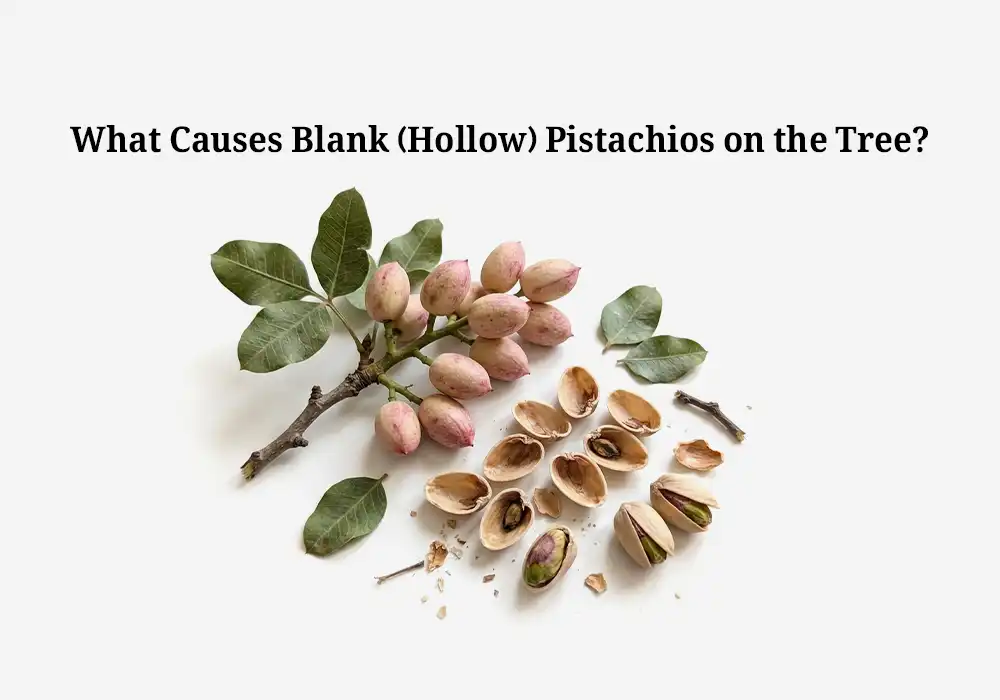
What Causes Blank (Hollow) Pistachios on the Tree? (A Botanical Dissection of Empty Shells in Orchards)
For a pistachio orchardist, few sights are as economically devastating as walking through a grove during harvest that looks deceptively lush—bursting with plump, oversized clusters—only to crack open the bony shells and discover an empty, hollow cavity instead of a rich purple-and-green kernel! The agricultural phenomenon known as "Blanking" (hollow or empty pistachios) represents one of the costliest physiological disorders in global nut production, capable of silently wiping out anywhere from 15% to over 50% of an entire harvest in severe seasons.
Outwardly, a blank pistachio undergoes every developmental milestone of the fleshy outer hull and the hardened bony shell (endocarp) identically to a fully filled nut—yet inside nature's fortress lies nothing at all! How can a pistachio tree invest immense photosynthetic energy into constructing an empty vault while failing to produce the seed within? Is this failure hardwired into the tree's genetics, or is it triggered by pollination collapse, mineral starvation, irrigation stress, and sap-sucking pests?
In this deeply analytical, agricultural-grade article, we will examine the pistachio cluster through the lens of plant physiology and modern agronomy. We will dissect the two biological mechanisms of blanking (parthenocarpy and embryo abortion), map out the exact nutritional and climatic triggers, and reveal how elite commercial sorting guarantees zero-blank premium harvests.
1. The Two Biological Faces of Blanking: Parthenocarpy vs. Embryo Abortion
In plant physiology, a blank pistachio is not a single uniform event; it is the outcome of one of two distinct biological failures occurring at entirely different points in the growing season:
A) Primary Blanking — Parthenocarpy (Pollination Failure)
The pistachio tree (Pistacia vera) is strictly dioecious and wind-pollinated, meaning male pollen-producing trees and female nut-bearing trees are completely separate organisms (a genetic trait we also dissected in our guide on how to grow a pistachio tree in a pot). Uniquely, even when male pollen fails to reach a female flower—resulting in zero fertilization—the pistachio ovary still initiates hormonal fruit development! This phenomenon, called parthenocarpy, yields a full-sized hull and rigid bony shell with absolute emptiness inside.
B) Secondary Blanking — Embryo Abortion (Mid-Season Collapse)
In this scenario, spring pollination and fertilization succeed, and a microscopic embryo forms inside the shell. However, during late spring and early summer (May through July), right as the bony shell hardens and rapid kernel expansion should begin, severe physiological stress, nutrient starvation, or insect attacks kill the developing embryo. When you crack open an aborted nut, you typically find a tiny, shriveled black speck at the base of the hollow chamber—the mummified remains of the dead seed.
2. The Pollination Crisis: The Leading Trigger in Orchards
A massive percentage of blank nuts in commercial orchards traces directly back to pollination mismanagement during the brief spring bloom window:
- Insufficient Male-to-Female Ratio: A scientifically engineered orchard requires a strict ratio of 1 male tree for every 8 to 10 female trees, strategically positioned upwind of prevailing spring breezes. Too few males leave vast canopy sections unpollinated.
- Asynchronous Bloom Timing: Because the female stigma remains receptive to pollen for only a few fleeting days, if the selected male cultivars shed their pollen too early or too late relative to the female bloom, fertilization collapses and parthenocarpic blanking explodes.
- Destructive Spring Weather: Heavy spring rains wash airborne pollen straight to the ground, while sudden hot, dry desert winds or late frosts desiccate the receptive female stigma, preventing pollen germination.
3. Cellular Starvation: Mineral Deficiencies (Boron, Potassium, and Zinc)
Filling thousands of oil-dense kernels demands an uninterrupted metabolic pipeline transferring carbohydrates, amino acids, and trace minerals from the leaves into the developing clusters. Deficiencies in three strategic elements trigger catastrophic blanking:
- Boron Deficiency (The Pollination Catalyst): Boron is indispensable for pollen tube elongation and successful fertilization. Even with abundant male pollen in the air, boron-starved flowers fail to fertilize, skyrocketing primary blanking rates.
- Potassium Deficiency (The Kernel-Filling Engine): Potassium governs the translocation of photosynthetic sugars from leaves into the nut and their biochemical conversion into plant lipids. Potassium starvation during the crucial summer kernel-filling window yields shriveled, underweight, or completely blank nuts.
- Zinc and Calcium Shortages: Zinc regulates vital growth hormones (auxins) while calcium fortifies dividing embryonic cell walls. Shortages trigger early embryo collapse.
- Alternate Bearing Exhaustion: Pistachio trees naturally alternate between heavy "On-Years" and light "Off-Years." During an extreme On-Year, excessive cluster loads outstrip the canopy's carbohydrate reserves, forcing the tree to strategically abort a fraction of its embryos to keep the remaining crop alive.
4. Water Stress and Soil Salinity: Hydraulic Choking During Kernel Fill
Although Pistacia vera is celebrated as a desert survivor, the physiological threshold for surviving drought is vastly different from the water required for filling dense, oily kernels!
The most unforgiving period on the orchard calendar is the kernel-filling phase (late June through early August). If trees endure severe drought stress or excessive soil/water salinity (high EC) during this exact window, the leaves seal their stomata to conserve water. Photosynthesis grinds to a halt, carbohydrate flow to the nut clusters ceases, and developing kernels rapidly abort. Crucially, water stress also prevents shells from splitting naturally—a dual failure we dissected thoroughly in what causes closed-mouth pistachios.
5. Sap-Sucking Pests: The Silent Assassins of the Kernel
Even in meticulously pollinated, fertilized, and irrigated orchards, high blanking rates can suddenly appear if integrated pest management fails:
- Pistachio Stink Bugs and Mirid Bugs: Early in the season, while the shell is still soft and penetrable, piercing-sucking bugs insert their needle-like mouthparts through the hull, injecting digestive enzymes and draining the young embryo. This causes immediate embryo death, dark external epicarp lesions, and 100% blanking.
- Pistachio Psylla (Agonoscena pistaciae): Massive populations of psylla nymphs drain enormous volumes of phloem sap from the leaves while coating foliage in sticky honeydew. Starved of photosynthetic energy, the exhausted tree cannot fill its nuts.
- Pistachio Seed Chalcid (Eurytoma plotnikovi): The tiny wasp lays eggs directly inside young kernels; the hatching larva devours the entire meat, leaving an empty shell behind.
6. Orchard Diagnostic Matrix and Prevention Protocol
To suppress blanking rates down to the commercial gold standard (under 5%), growers must match symptoms to root causes:
| Primary Cause of Blanking | Diagnostic Sign in the Orchard | Definitive Agronomic Fix |
|---|---|---|
| Pollination Failure (Parthenocarpy) | Completely clean, hollow shell with zero dark embryo trace | Maintain 1:9 male-to-female ratio, match bloom timing, apply supplemental artificial pollination |
| Boron, Zinc & Potassium Deficiency | Tiny shriveled embryos aborted uniformly across the canopy | Foliar Boron + Zinc sprays at post-harvest/bud-swell; heavy Potassium dosing during kernel fill |
| Water Stress & High Salinity | Blanking paired with scorched leaf margins and closed shells | Strict regulated irrigation during kernel fill, winter salt leaching, and humic acid application |
| Stink Bugs & Psylla Attacks | External dark resinous lesions on hulls or sticky leaf honeydew | Weekly spring scouting, biological control, and targeted intervention before shell hardening |
7. What Blanking Means for Buyers: Avoiding Empty Nuts in the Market
Because a blank pistachio lacks an expanding internal kernel to exert outward mechanical pressure, it never splits naturally—remaining permanently closed-mouth. In modern industrial processing lines, freshly dehulled pistachios pass through water flotation tanks and precision pneumatic air-separators; because blank nuts are far less dense, they float to the surface or blow away effortlessly, separating cleanly from heavy, kernel-filled nuts.
However, in unregulated wholesale markets, unethical brokers occasionally blend underweight shells or artificially force closed nuts open using thermal water-shocking. To protect yourself from commercial fraud, studying our two critical buyer guides—water-shocked vs. natural pistachio and how to identify fresh and high-quality pistachios—will arm you with professional inspection skills.
8. High-Yield Genetics and Walmondhe’s Zero-Blank Guarantee
Alongside expert orchard management, cultivar genetics and terroir dictate kernel-filling efficiency. To explore Iran's legendary growing regions and commercial varieties, consult our analyses on Rafsanjan vs. Damghan pistachios and which pistachio type is best for export.
Among elite Iranian cultivars, the Ahmad Aghaei Pistachio stands out for its early-ripening cycle (escaping late-season heat stress), remarkable kernel-to-shell weight ratio, and extraordinarily high natural splitting rate.
The Walmondhe engineering and trading group proudly sources its raw Ahmad Aghaei pistachios directly from scientifically managed Iranian orchards. Every single batch undergoes multi-stage pneumatic air-separation, gravity flotation sorting, and hyper-sensitive laser optical inspection—guaranteeing virtually zero blank nuts, maximum kernel density, 100% natural splits, and certified Aflatoxin-free export purity.
To secure bulk commercial or export orders, inquire about real-time pricing, or consult with our trade specialists, connect with our sales department via the official channels below:
- Direct & Fast WhatsApp Communication: +989136667618
- Direct Sales Department Telephone: +989136667618