
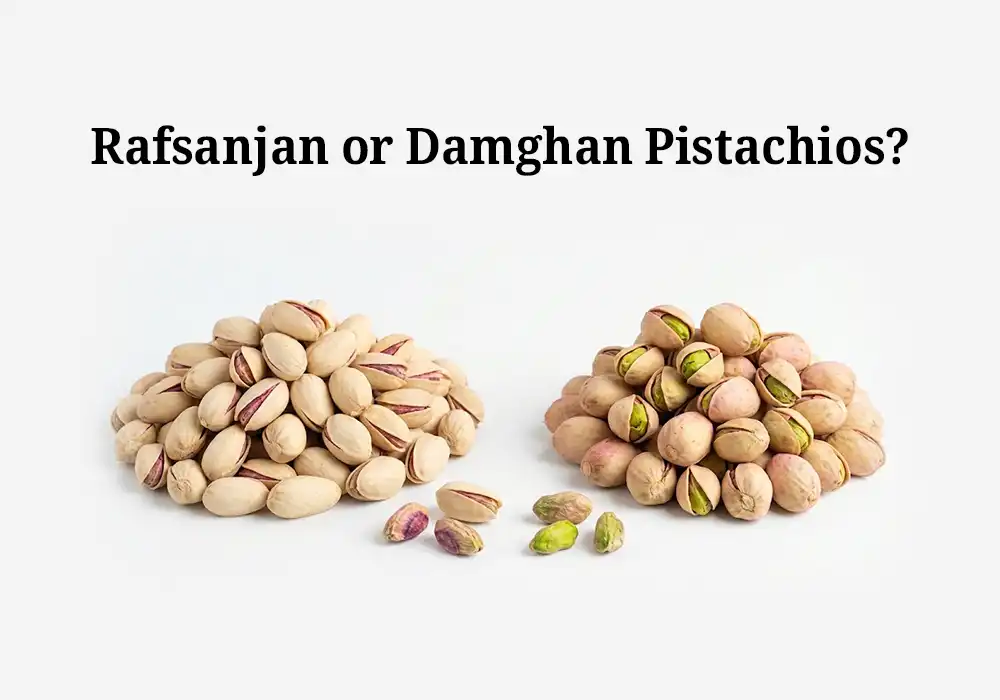
Rafsanjan or Damghan Pistachios? (The Epic Battle of the Two Capitals in the Green Empire)
In the sophisticated world of luxury dry fruit trading, the name of Iran is eternally intertwined with a single green and purple jewel: the pistachio. However, when you enter the domestic market as a professional buyer, merchant, or exporter, you are immediately confronted by a historical and highly debated dichotomy. Vendors from the central desert swear that no nut on earth can match the magical, buttery flavor of the Damghan pistachio. Conversely, merchants from the southeast, armed with global export statistics and breathtaking aesthetics, firmly declare the Rafsanjan pistachio as the undisputed emperor of the globe.
What is the profound truth hidden behind this ancient rivalry? Is the difference between these two pistachios merely a matter of geographical branding, or is it deeply rooted in soil biochemistry, kernel fat content, and ancient tree genetics?
In this highly comprehensive and analytical article, we will place these two powerful agricultural titans onto the commercial examination table. By meticulously dissecting their climate, flavor profiles, and geometric structures, we will reveal exactly why choosing between Rafsanjan and Damghan is ultimately a choice between "commercial aesthetic perfection" and "ancient authentic flavor."
1. Soil and Climate Geopolitics (What Causes the Divergence?)
Every physical attribute of a botanical seed is relentlessly forged by the soil in which it roots. The fundamental differences between Rafsanjan and Damghan pistachios stem directly from their radically distinct micro-climates.
- The Rafsanjan Climate (Nature’s Furnace and Freezer): Rafsanjan boasts one of the most unique desert climates in the world. Summer days are blisteringly hot, while the nights are freezing cold. This extreme diurnal temperature variation (a daily thermal shock) forces the pistachio tree to produce excess botanical sap and resin to protect itself. The result of this environmental stress is a pistachio with a blindingly white bony shell, a highly dense kernel, and a phenomenally wide natural smile.
- The Damghan Climate (The Salt Winds): Situated on the edge of the central desert and directly in the path of mineral-heavy salt winds, Damghan possesses soil that is incredibly rich in potassium and rare minerals. Its summers are hot and dry, but the day-to-night temperature shift is less severe than in Rafsanjan. This rich, salty soil compels the pistachio kernel in Damghan to store an exceptionally high percentage of natural lipids (fats).
2. Dissecting Flavor and Fat Content (The Buttery vs. The Nutty)
If you were to blindfold yourself and taste a kernel from each of these two cities, the stark divergence in their flavor profiles would astonish you.
- The Flavor of Damghan (The Sweet Fat Bomb): If your absolute sole criterion for choosing a pistachio is pure, unadulterated "taste," Damghan wins the battle. Due to its phenomenally high plant fat content, the Damghan pistachio possesses an intensely sweet, rich, and profoundly buttery flavor. When you chew it, it literally melts in your mouth. Native Damghan varieties, such as Shahpasand and Abbasali, are revered among locals as the most delicious pistachios grown in Iran.
- The Flavor of Rafsanjan (The Aristocratic Crunch): The Rafsanjan pistachio contains a much more balanced lipid profile. This lipid equilibrium grants the kernel a significantly crispier, crunchier texture. The flavor of Rafsanjan is a classic, authentic, earthy nuttiness that is never overwhelming, making it remarkably pleasant for high-volume consumption.
3. Thermal Reactions in the Roasting Oven
One of the most critical factors in the nut industry is how a pistachio behaves when subjected to commercial roasting. As we explored deeply in our analytical guide on Raw vs. Salted Pistachios, the intrinsic fat of the nut plays a vital role in thermal processing.
- The Damghan Challenge: Because of its extremely high fat content, the Damghan pistachio is hyper-sensitive to the blistering heat of commercial roasting ovens. If the roasting master lacks precise skill, the dense oils inside the Damghan nut will burn rapidly, turning the kernel dark and imparting a harsh, bitter flavor. Consequently, Damghan pistachios are most commonly consumed entirely raw or very lightly toasted.
- The Rafsanjan Masterpiece: The Rafsanjan pistachio is the undisputed king of roasting. Its dense cellular structure and balanced fat content allow it to withstand intense heat with absolute perfection. When roasted, this pistachio draws the flavors of saffron, sea salt, and lemon deep into its core, emerging from the oven with a breathtakingly crunchy texture and a divine aroma.
4. Genetic Diversity and the Global Export Market
When the conversation shifts to global export volume, currency generation, and international recognition, the scales tip massively in favor of one city.
- Rafsanjan (The Global Capital): Rafsanjan cultivates an unparalleled genetic diversity of elite varieties. To truly understand this magnificent diversity in luxury nuts, one merely needs to examine the Akbari vs. Ahmad Aghaei Pistachio dynamic. Rafsanjan pistachios generally possess a much more elegant, elongated geometry, blindingly white bony shells, and perfectly symmetrical splits. This stunning visual majesty makes Rafsanjan the premier choice for international merchants exporting to the European Union, the Gulf Arab states, and India.
- Damghan (The Domestic Diamond): While Damghan is a powerful secondary production hub, its pistachios typically exhibit a more spherical geometry, slightly darker shells, and asymmetrical splits compared to Rafsanjan. Consequently, the Damghan pistachio is predominantly sold within the Iranian domestic market (prized purely for its exceptional taste) and occupies a smaller footprint in elite luxury export showcases.
5. Conclusion: Which Pistachio Should You Choose?
The definitive answer depends entirely on your ultimate objective. If you are seeking a pistachio for personal raw consumption and crave an intensely sweet, fat-rich, buttery explosion, the Damghan pistachio offers an unrivaled culinary experience. However, if your goal is to assemble a majestic holiday nut bowl, cater to elite luxury events, roast with premium saffron, or execute high-end international exports, the snow-white shell, elongated aristocratic form, and perfect crunch of the Rafsanjan pistachio has absolutely no rival on earth. To ensure you never fall victim to market deception when sourcing your cargo, studying our guide on How to Identify Fresh and High-Quality Pistachios is highly recommended.
Among all these legendary varieties, the Ahmad Aghaei Pistachio, cultivated in authentic premium orchards, offers the ultimate synthesis of blindingly white shells, an elegant almond shape, a vivid purple kernel, and a heavenly flavor that performs flawlessly whether raw or roasted.
The Walmondhe engineering and trading group proudly supplies the most massive, pristine, and flawlessly sorted Ahmad Aghaei pistachios from Iran. Utilizing the world's most advanced laser and optical sorting sensors, we provide nature’s purest gifts—entirely devoid of dark stains, hidden moisture, and Aflatoxin—ready to dominate the most luxurious global markets.
To secure bulk commercial orders, inquire about real-time export pricing, and receive highly specialized consultation, connect with our sales department through the official channels below:
- Direct & Fast WhatsApp Communication: +989136667618
- Direct Sales Department Telephone: +989136667618