
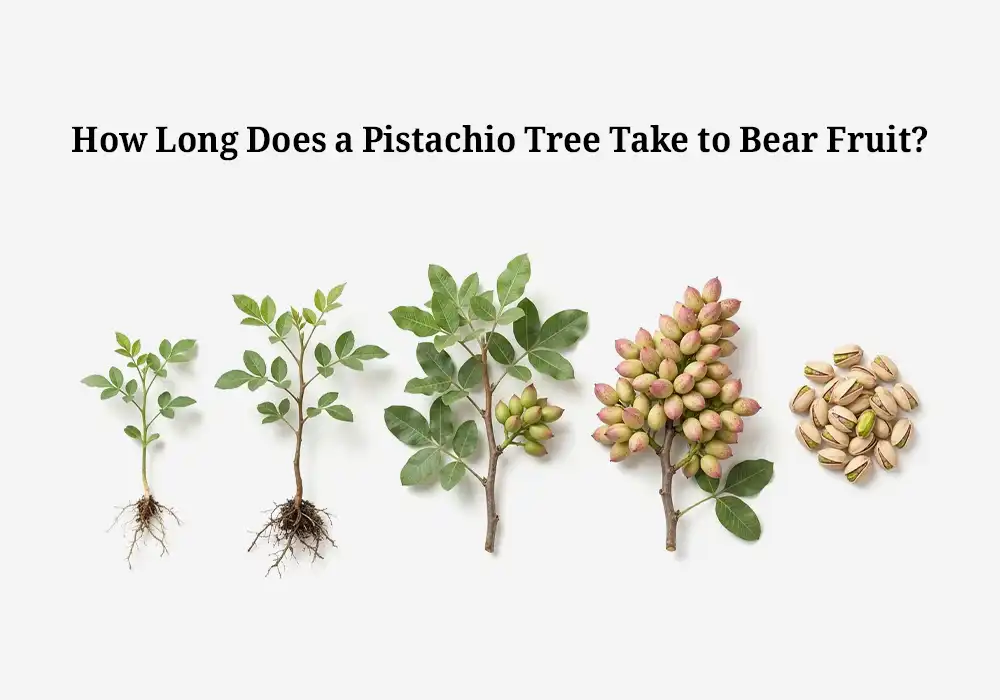
How Long Does a Pistachio Tree Take to Bear Fruit? (A Biological & Economic Timeline of Green Gold)
The pistachio tree (Pistacia vera) is the ultimate botanical emblem of patience, long-term generational investment, and legendary desert resilience. For centuries, veteran Persian orchardists have repeated a timeless proverb: "The father plants the pistachio grove, and the son harvests the gold." Yet in the modern era of precision agronomy, clonal hybrid rootstocks, and targeted fertigation, must an investor still wait decades to witness their first emerald cluster?
The single most critical question confronting every prospective orchard investor and backyard horticulturist is straightforward: "Exactly how many years after planting does a pistachio tree begin to bear fruit, and when does it achieve full commercial profitability?"
Botanical reality dictates that there is no single fixed number. Your waiting period can span anywhere from 4 years to 12 years, governed directly by five decisive variables: propagation method (seed vs. grafted), rootstock genetics, scion cultivar, winter chilling hours, and pruning/nutritional discipline.
In this deeply comprehensive, agronomic-grade guide, we will map out the complete biological lifecycle of Pistacia vera—year by year, from germination to century-long peak production. We will dissect how modern rootstocks cut the return-on-investment timeline nearly in half, expose the five hidden errors that stall fruiting, and highlight why early-bearing cultivars like Ahmad Aghaei dominate modern commercial orchards.
1. The Great Timeline Divide: Seed-Grown vs. Grafted Saplings
The most consequential variable determining your harvest calendar is how the tree begins its life:
A) Grown from Seed (Ungrafted / Backyard Trees)
If you plant a raw pistachio kernel directly into soil without grafting, the tree enters a prolonged phase of biological "juvenility." An ungrafted seedling requires an average of 8 to 12 years simply to produce its very first blossoms! Compounding this delay is the pistachio's strict dioecious genetics (separate male and female trees): after waiting a full decade, there is a 50% statistical probability that your tree will emerge as a male—producing abundant pollen, yet never yielding a single edible nut in its entire lifetime! (For enthusiasts attempting indoor or decorative cultivation, explore our full biological guide on how to grow a pistachio tree in a pot).
B) Grafted / Budded Saplings (The Commercial Gold Standard)
No professional orchardist invests in ungrafted seedlings. Instead, nurseries cultivate a vigorous, disease-resistant rootstock (such as Badami, Qazvini, or UCB-1) and bud/graft a scion cut from a proven, mature, high-yielding female cultivar onto it in year 1 or 2. Because the grafted scion is physiologically "adult," it bypasses prolonged juvenility. Consequently, a commercially grafted tree produces its first light crop 4 to 5 years after grafting (or 4 to 5 years after transplanting a mature grafted nursery sapling into the orchard).
2. The Complete Lifecycle Matrix: From First Cluster to Century-Long Yield
New growers frequently confuse "first fruiting" with "commercial break-even yield." Spotting a handful of clusters in year four does not equate to profitability. Below is the exact agronomic production timeline for a well-managed grafted pistachio orchard:
| Biological Stage | Years Post-Grafting | Expected Dry Nut Yield / Tree | Agronomic & Economic Reality |
|---|---|---|---|
| 1. Establishment & Taproot Phase | Years 1 to 3 | Zero (Vegetative Only) | All metabolic energy fuels deep taproot anchoring and primary scaffold limb architecture. |
| 2. First Trace Bearing | Years 4 to 5 | Minimal (100g – 500g) | First clusters emerge; many agronomists strip year-4 flowers to prioritize canopy vigor. |
| 3. Commercial Bearing (Break-Even) | Years 7 to 10 | Substantial (2 – 5 kg dry) | Orchard covers operational costs and enters consistent financial profitability. |
| 4. Peak Commercial Maturity | Years 15 to 20 | Maximum (8 – 15 kg dry) | Canopy reaches maximum solar interception, delivering peak tonnage per hectare. |
| 5. Enduring Productive Era | Years 20 to 100+ | Sustained High Yield | Exceptionally long-lived; ancient 200-year-old trees in Iran still produce heavy harvests! |
3. Genetic Accelerators: How Rootstocks Speed Up Bearing
In modern pomology, the rootstock functions as the engine beneath the hood, dictating both survival and speed to maturity:
- UCB-1 Rootstock (The Early-Bearing Titan): Bred by the University of California, this hybrid clonal/seedling rootstock exhibits explosive vegetative vigor and elite resistance to Verticillium wilt. Orchards established on UCB-1 routinely reach commercial bearing 1 to 2 years faster than traditional rootstocks, building massive canopies rapidly.
- Badami-e Zarand & Qazvini Rootstocks (Desert Warriors): These historic Iranian rootstocks possess unmatched resilience against severe soil salinity, extreme drought, and high alkalinity. While their early vegetative growth is slightly slower than UCB-1—adding roughly one year to peak maturity—they deliver superior long-term longevity in harsh desert regions like Rafsanjan and Kerman.
4. Cultivar Velocity: Why Ahmad Aghaei Leads Early Commercial Returns
The genetic identity of the grafted scion directly governs both bearing age and harvest timing:
- Ahmad Aghaei & Fandoghi (Early-Bearing Powerhouses): Physiologically, both cultivars transition swiftly into reproductive maturity. Thanks to its early seasonal ripening (late September), balanced canopy architecture, and rapid flower-bud differentiation, the Ahmad Aghaei stands among Iran’s fastest-returning luxury commercial cultivars.
- Akbari (The Late-Maturing Aristocrat): Although Akbari produces the longest and most expensive nuts, it requires higher chilling hours and takes noticeably longer to achieve full commercial tonnage compared to Ahmad Aghaei. To examine the full commercial and export disparities between these two titans, read our breakdown of Akbari vs. Ahmad Aghaei pistachio.
5. Five Hidden Traps That Delay Pistachio Fruiting for Years
Many growers report frustration when 7- or 8-year-old grafted trees stand lush and green yet refuse to set fruit. Plant physiology pinpoints five silent culprits:
- Insufficient Winter Chilling Hours: To break dormancy uniformly and open healthy flower buds in spring, Pistacia vera requires 600 to 1,200 hours below 7°C (45°F) during winter. In overly warm subtropical climates, trees grow vigorous leaves yet remain barren.
- Missing Synchronized Male Pollinators: Pistachios rely exclusively on wind pollination. Without mature male trees blooming simultaneously at a ratio of 1 male per 8–10 females, female flowers drop unfertilized or yield empty shells.
- Aggressive, Incorrect Pruning: Pistachio flower buds develop laterally on one-year-old wood. Heavy, unscientific heading cuts during years 4 to 6 slice off fruiting wood, forcing the tree back into endless vegetative shoot production.
- Excessive Nitrogen Fertilization: Over-dosing urea locks the tree into a "vegetative loop" (lush leaves and weak shoots), biochemically suppressing reproductive flower-bud formation.
- Water Stress & Severe Salinity: Erratic irrigation stunts early canopy expansion and, once fruiting begins, dramatically spikes closed-mouth rates—a physiological breakdown we examined thoroughly in what causes closed-mouth pistachios. Furthermore, pistachios naturally exhibit Alternate Bearing (a heavy "On-Year" followed by a light "Off-Year"), which requires disciplined post-harvest nutrition to stabilize.
6. Seasonal Harvest Window: From Mature Orchards to Fresh Market
Once an orchard conquers its early developmental years and reaches maturity, each late summer delivers the culmination of a full year's desert photosynthesis. Depending on regional microclimate (explored in Rafsanjan vs. Damghan pistachios) and cultivar genetics, harvesting spans from late August through mid-October. To time your procurement perfectly, consult the best time to buy fresh pistachios.
7. Why Wait a Decade? Harvest the Fruits of Mature Iranian Orchards Today
Establishing a pistachio grove and guiding it to its 15-year peak yield is a capital-intensive marathon demanding decades of patience and precision agronomy. Yet securing peak export-grade Iranian pistachios requires zero waiting!
The Ahmad Aghaei Pistachio, celebrated as Iran's premier commercial export champion (see which pistachio type is best for export), delivers blindingly white shells, massive purple-skinned kernels, and an intensely buttery sweetness harvested from mature, fully established desert orchards.
The Walmondhe engineering and trading group proudly supplies Iran’s finest, freshest raw Ahmad Aghaei pistachios directly from mature, scientifically managed groves. Laser-sorted and hermetically packed, every shipment is guaranteed naturally split, current-crop fresh, and certified Aflatoxin-free. To verify commercial quality standards yourself, study our buyer’s manual on how to identify fresh and high-quality pistachios.
To secure bulk commercial or export orders, inquire about real-time pricing, or consult with our trade specialists, connect with our sales department through the official channels below:
- Direct & Fast WhatsApp Communication: +989136667618
- Direct Sales Department Telephone: +989136667618