
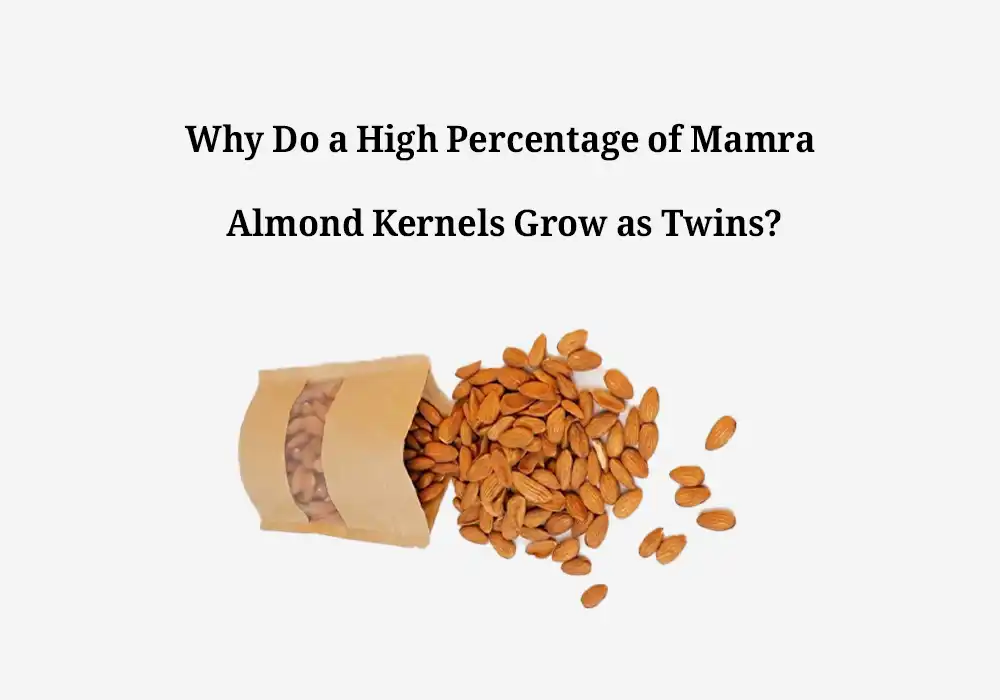
Why Do a High Percentage of Mamra Almond Kernels Grow as Twins? (Scientific & Trade Analysis)
When global nut brokers, dry fruit importers, and traders involved in exporting almonds to India crack open the hard shell of authentic Mamra Almonds, they encounter a striking botanical trait: in 70% to 80% of cases, two kernels grow nested together face-to-face inside a single wooden shell.
In Western industrial cultivars like California or stone almonds, twin kernel rates rarely exceed 5% to 10%. Why is the twin kernel ratio so exceptionally high in Saman Mamra almonds? Is this biological phenomenon a growth anomaly, or is it directly driven by floral genetics, reproductive anatomy, and alpine microclimate?
In this comprehensive B2B guide by the Walmondhe expert sourcing team, we break down the botanical anatomy and genetics behind Mamra's twin kernels, revealing why Indian buyers treat this visual trait as the ultimate proof of authenticity and a driver of premium market pricing.
1. Floral Anatomy & Ovule Genetics (Double Ovule Development)
The primary biological catalyst for Mamra's high twin kernel ratio lies in the reproductive genetics of its flower ovary (ovule morphology):
- Single-Kernel Cultivars (e.g., California / Paper-shell): Standard commercial almond flowers typically develop only one functional ovule per ovary. Following pollination, only one embryo matures into a single, broad kernel.
- Saman Mamra Almonds: As an ancient indigenous cultivar along the Zayandeh Rud river basin, Mamra possesses a genetic predisposition where both ovules within the flower ovary remain active and functional (Double Ovule Development). Upon pollination, both ovules fertilize simultaneously, developing two complete kernels (a twin pair) nestled face-to-face within the hard shell. To learn how this genetic lineage impacts global valuations, read Mamra Almond Lipid Profile, Genetics & Valuation along the Zayandeh Rud.
2. Alpine Terroir & Spring Temperature Fluctuation in Saman
Beyond floral genetics, the mountain microclimate of Saman in Chaharmahal and Bakhtiari province actively stimulates this botanical trait:
- Spring Temperature Fluctuation: During the early spring blooming phase, sharp day-to-night temperature shifts in the high-altitude orchards stimulate plant hormone activity (auxins and cellular division). This thermal stress encourages both ovules to develop simultaneously rather than aborting the weaker embryo.
- Impact on Kernel Geometry: Growing together within a confined shell causes one side of each Mamra kernel to become flat (the interface where the twins touch) while the opposite side becomes convex and grooved. Review this morphological comparison in Difference Between Saman Mamra Almond and Other Iranian Varieties.
3. Why the "Twin Ratio" is the Ultimate Proof of Purity in India
In international nut trade, particularly within India's traditional spice and dry fruit hubs, the twin kernel percentage serves as an irreplaceable benchmark of purity and value:
- Proof Against Adulteration: Cheap imports from California, Spain, or standard stone almond orchards cannot replicate a 70%+ twin ratio. When Indian importers inspect a shipment featuring a high twin percentage, they instantly verify varietal authenticity.
- Correlation with High Oil & Buttery Taste: Biochemical analysis demonstrates that twin Mamra kernels store over 50% to 54% pure natural almond oil, resulting in an intensely sweet, buttery flavor. Review official laboratory benchmarks in Standard Kernel Yield & Oil Content of Mamra Almonds.
- Economic Valuation in B2B Trade: A higher twin ratio directly increases the shipment's grade valuation. For a deep dive into pricing formulas, read our core reference: Impact of Twin Kernels on Export Almond Pricing.
Botanical & Commercial Twin Ratio Comparison
| Botanical & Commercial Feature | Authentic Saman Mamra Almond | California Almond | Iranian Stone Almond |
|---|---|---|---|
| Twin Kernel Ratio (Double Percentage) | 70% to 80% (Exceptionally High) | Under 5% (Uniform single kernels) | ~10% to 15% |
| Reproductive Floral Genetics | Active double ovule development | Bred selectively for single ovules | Mostly single functional ovule |
| Visual Morphology | Flat inner face, convex outer grooved side | Broad, flat, symmetrical kernel | Denser, slightly elongated kernel |
| Market Value in India (Khari Baoli) | Highest premium & proof of origin | Standard commercial commodity price | Economical price (Industrial use) |
The Role of Optical Sorting in Sizing Twin Almonds for Export
In luxury international trade, wholesale B2B buyers require strict adherence to size uniformity and grading standards.
- While a high twin ratio proves authenticity, mechanical cracking can occasionally separate twin pairs or cause minor chipping if not handled with care.
- Modern processing facilities use optical and laser sorting technology to grade Mamra kernels precisely by count per 100 grams (ranging from grades 80 to 100, and 5A to 3A). Explore these global export classifications in Mamra Almond Sizing & Grading Guide and Mamra Almond Grading Standards (80 to 100) for India Export.
Why Walmondhe is Your Trusted Direct Export Partner
As an established grower and specialized direct supplier in Saman, Walmondhe guarantees varietal authenticity, high twin ratios, and current-year freshness for every export container.
- Direct Farm-Gate Sourcing: Zero middlemen, connecting Saman farmers directly to international bulk buyers.
- Nitrogen-Flushed Vacuum Packaging: Shields delicate kernels from breakage, thermal oxidation, and moisture during maritime shipping to Mumbai, Nhava Sheva, Dubai, or Europe.
To check today's direct factory wholesale prices, request consultation, or place an order for premium Mamra Almonds and Iranian Moheb Almonds, contact our B2B sourcing team directly:
- Direct WhatsApp Sales & Supply: 09136667618
- Direct Factory Phone Call: 09136667618
- Why B2B buyers trust us globally: Read Why Walmondhe is the Best Choice for Wholesale Almonds & Exports