
What is the Difference Between Saman Mamra Almonds and Other Iranian Varieties? (Comprehensive B2B Analysis for Bulk Buyers)
In the multi-billion dollar global dried fruit market, the name "Mamra Almond" is consistently synonymous with the most luxurious, expensive, and unrivaled almond in the world. However, at the negotiation tables of professional merchants, another geographical key phrase is frequently heard that adds ultimate prestige to this product: "Saman Mamra".
Saman County and the lush orchards along the Zayanderud basin in Iran's Chaharmahal and Bakhtiari province are the genetic birthplace and the undisputed global capital of this almond variety. Despite this, many foreign buyers, Indian importers, and even novice domestic traders make irreversible mistakes in distinguishing authentic Saman Mamra from other Iranian varieties (such as Rabie, Shahroudi, Sangi, and Moheb).
This lack of precise knowledge opens the door for widespread fraud by brokers, who mix cheaper cargoes with Mamra, effectively destroying the buyer's capital. In this article, acting as an operational and laboratory-grade B2B guide, we dissect the structural, chemical, physical, and commercial differences between Saman Mamra and other Iranian varieties so you can manage your high-tonnage container purchases with engineered precision.
1. The Magic of Terroir: Why Does Only "Saman" Produce True Mamra?
Before examining physical differences, we must understand why a region like Saman produces such an exceptional product. The concept of "Terroir," commonly used in the production of luxury agricultural goods, applies perfectly here.
If a Mamra tree is planted in hot plains or arid regions, it loses its premium quality. However, the orchards of Saman possess three golden characteristics:
- High Altitude: Allows the trees to fully meet their chilling requirements during the winter.
- Extreme Day-to-Night Temperature Variance: This natural thermal shock during the summer traps the oils and beneficial fatty acids deep within the almond kernel's tissue.
- Freshwater Nourishment from Zayanderud: Unlike many regions irrigated with saline water or wells, nourishment from flowing, fresh river water completely purges any bitter or astringent taste from the genetic essence of this almond.
2. Lipid Profile (Oil Content): The Secret Behind Astronomical Valuation in India
The largest, most critical, and uncopyable difference between Saman Mamra and all other almonds in the world lies not in its appearance, but in its chemical structure and "Lipid Profile." In target markets like India, almonds are not merely nuts or snacks; they are a fundamental medicine in traditional Ayurveda and a strategic supplement for memory and health.
- Saman Mamra Almonds: Based on precise laboratory analyses, this almond contains over 50% to 54% (and sometimes up to 56%) healthy unsaturated fats. This massive volume of Oleic acid-rich oil gives it an intensely crunchy texture, an authentic buttery and sweet flavor, and unparalleled therapeutic properties. If you squeeze a Saman Mamra between your fingers, you will clearly feel the oil release.
- Other Varieties (Shahroudi, Sangi, and Californian): The oil content in other Iranian varieties typically ranges from 35% up to a maximum of 45%. Commercial Californian almonds also frequently fall below 40% fat. Therefore, no other almond in the world can replicate the rich taste, medicinal value, and premium pricing of Mamra.
3. The Devastating Trap Called "Rabie Almond": The Most Dangerous Fake in the Bulk Market
For a bulk buyer, the greatest hazard in the traditional Iranian market is an almond called "Rabie". Genetically, the Rabie almond is considered Mamra's cousin and bears a striking visual resemblance to it. To drastically lower the landed cost, many brokers mix Rabie almonds with Mamra in various ratios (e.g., 30 to 70).
How can you, as a professional merchant, detect this fraud?
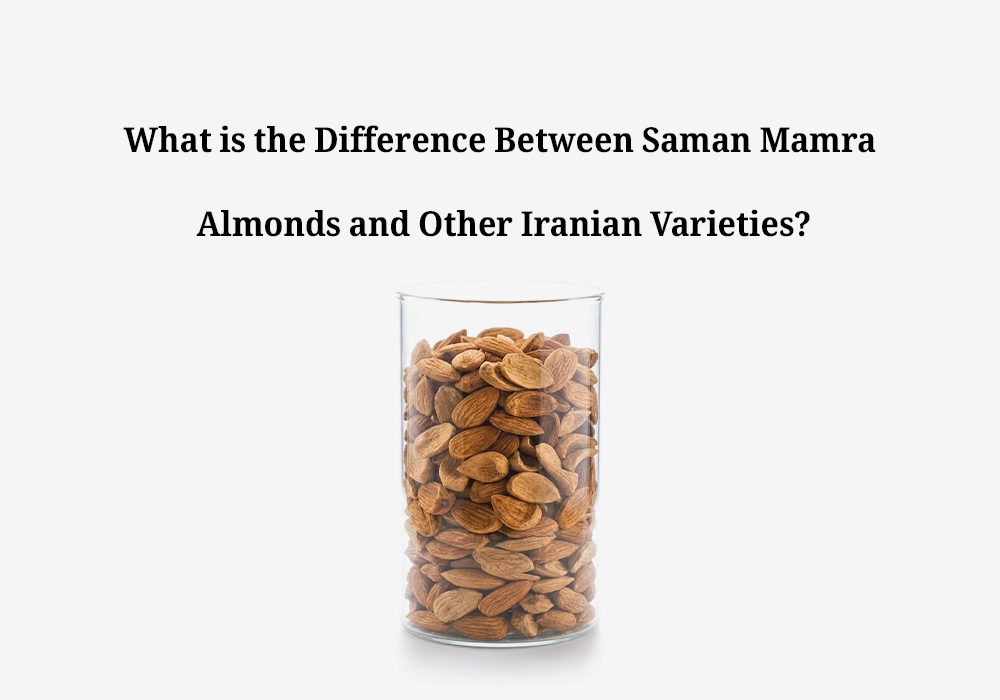
- Surface Grooves and Texture: Authentic Saman Mamra kernels feature very deep grooves, a highly wrinkled texture, and a golden to light brown color. In contrast, the grooves on the Rabie almond are much shallower and smoother, with a slightly duller and more matte color.
- Anatomy and Shape: The Mamra almond has a distinct curvature and a "bellied" shape on one side, whereas the Rabie almond appears more elongated, flatter, and more symmetrical.
- The Crunch Test: Due to Mamra's high fat content, when you bite or crack it, it produces a very crisp, crunchy sound, while Rabie has a drier, woodier texture.
Your reputable supplier must deliver the shipment with a written guarantee of 100% genetic purity and absolutely zero Rabie mix; this standard is the red line and immutable commitment of Walmondhe.
4. Twin Kernels Percentage: A Unique Genetic Signature
Another prominent and inherent trait of the Mamra almond tree is its strong genetic tendency to produce twin kernels.
- Saman Mamra: In unsorted, bulk cargoes, the twin percentage can surprisingly reach up to 30%. While twin kernels are identical to single kernels in taste and fat, luxury export markets (such as corporate gifting in India) demand large, symmetrical, single kernels. Therefore, in premium export grades (like 5A and 6A), the twin percentage must be reduced to under 5% via rigorous laser sorting.
- Shahroudi and Sangi Varieties: These varieties have a very low twin percentage (naturally under 5% at harvest) and their kernels are naturally more uniform. However, as mentioned, their commercial value and flavor are a fraction of Mamra's.
5. Shell Anatomy and Kernel Yield Comparison
If your business strategy involves purchasing in-shell almonds and cracking them at the destination, understanding the difference in shell thickness across varieties is vital:
- Moheb Almond (Paper-Shell): Features a very thin shell that easily breaks with the pressure of two fingers, boasting a kernel yield above 50%. This variety is excellent for domestic nut shops, home consumption, and the Russian market, but it has a low shelf-life and is defenseless against pests.
- Saman Mamra Almond: Possesses a relatively hard yet spongy, multi-layered shell. Its cracking yield is standard, ranging between 28% and 33%. This sturdy shell acts precisely like a "natural safe," protecting the highly fatty and sensitive kernel tissue from oxidation, ocean humidity, and insects during long transits.
- Sangi (Stone) Almond: As the name suggests, it has a severely hard shell (requiring a hammer or heavy machinery to crack) and an extremely low kernel yield (sometimes under 25%).
6. The Definitive Zero Bitterness Guarantee
One of the biggest nightmares for a buyer in the bulk almond trade is discovering bitter kernels within a shipment. A single bitter almond can completely ruin the taste of a luxury nut mix or an expensive pastry.
- Sangi and certain Shahroudi varieties: Due to their genetic nature and seed-based propagation in many traditional orchards, these varieties usually contain a percentage (between 2% to 5%) of bitter almonds in bulk cargoes, making them highly risky for the food, chocolate, and confectionery industries.
- Authentic Saman Mamra Almond: This noble variety, which is exclusively grafted and cultivated in highly engineered orchards, inherently guarantees 0% bitterness in its genetics. Every single Saman Mamra almond you purchase is guaranteed to have a sweet, crunchy, and delightful flavor.
Why is Walmondhe the Ultimate Source for Saman Mamra?
Purchasing high tonnages of Mamra almonds from intermediary markets and brokers means blindly accepting the risk of the cargo being mixed with Rabie or Shahroudi, having a high twin percentage, and suffering a severe drop in oil quality.
By completely eliminating middlemen, Walmondhe has built its industrial supply architecture directly in the heart of the finest orchards of the Zayanderud basin (Saman County and surrounding areas) to provide the highest level of commercial security for B2B buyers:
- 100% Genetic Purity Guarantee: We provide you with written and laboratory guarantees that your Mamra Almond container is absolutely not mixed with any cheaper, similar varieties.
- Flawless Optical Sorting: Walmondhe’s advanced laser sorting lines categorize Saman almonds based on precise millimeter sizing (from 1A to 6A), outputting a cargo with a uniform golden color, strictly free of broken pieces, dust-free, and compliant with India's ruthless and exact standards.
- Preserving Zayanderud's Freshness Across the Ocean with MAP: To ensure that the buttery taste and fatty texture of Saman Mamra are not destroyed in hot, humid destination customs (like Nhava Sheva or Jebel Ali), all our export cartons are secured using MAP technology (absolute industrial vacuum and inert Nitrogen gas flushing).
For secure, scalable, and highly profitable international trade, invest in authenticity, technology, and transparency—not the baseless promises of traditional market brokers.
Contact us to receive the specialized catalog, review quality analysis, and learn about direct sales conditions:
- Get the latest price and request a Proforma Invoice via WhatsApp: 09136667618
- Contact the B2B Export and Sales Department directly: 09136667618 (Phone Call)
- Connect with us on our professional LinkedIn network: Hossein Ebrahimi - Walmondhe