
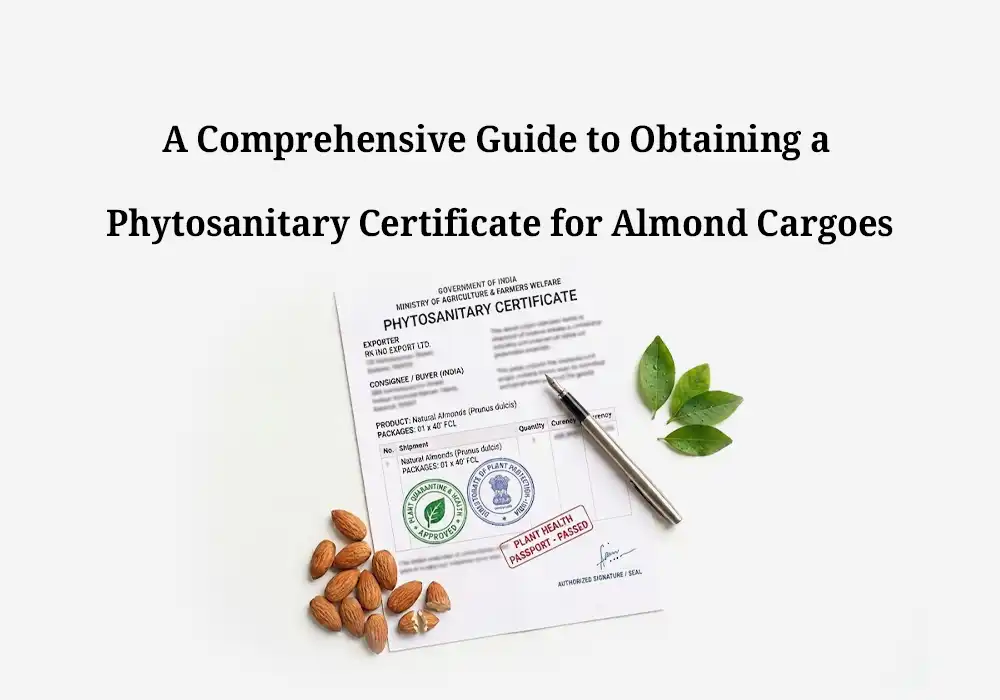
A Comprehensive Guide to Obtaining a Phytosanitary Certificate for Almond Cargoes (The Medical Record of Goods)
Imagine you are planning to travel to a foreign country. You hold your passport and visa in hand, but suddenly at the airport, immigration officers ask to see your "vaccination card" or "medical health certificate" to prove you are not carrying any contagious diseases. In the world of exporting agricultural products and dried fruits, an exact parallel to this law exists!
Many novice traders falsely assume that having a Proforma Invoice and a Certificate of Origin is the end of the customs paperwork. However, when containers packed with premium Mamra Almonds arrive at the borders of strictly regulated countries like India, customs officers look for one crucial, green-colored document above all else: the "Phytosanitary Certificate."
In this highly engaging and readable article, we will act as specialized agricultural doctors examining containers of almonds. We will explore exactly what this certificate is, the meticulous laboratory tests the almonds must pass to earn it, and the catastrophic financial ruin that awaits your cargo if it arrives at Indian customs without this vital "medical record."
1. What Exactly is a Phytosanitary Certificate and Why is it Issued?
The Phytosanitary Certificate is an official, internationally recognized document issued by the Plant Protection Organization (affiliated with the Ministry of Agriculture in the exporting country, such as Iran). This document acts as the definitive "medical file and clean bill of health" for your almond cargo.
When this paper is attached to your shipping documents, the exporting government provides a written, legal guarantee to the importing country (e.g., India) stating: "This almond cargo has been rigorously examined in laboratory conditions. It is entirely free of live insects, pest eggs, fungal diseases, worm damage, and any hazardous agricultural contaminations." This document proves that your almonds are a 100% safe, hygienic, and ready-to-consume product that poses zero environmental threat to the destination country. To familiarize yourself with the quality control processes leading to this certification, do not miss reading: Comprehensive Guide to Almond Quality Control for Bulk Buyers.
2. India's Greatest Fear: Why Are Customs Addicted to This Certificate?
India is a vast nation with an economy heavily reliant on agriculture. Billions of dollars of its national income are generated through its domestic farms and orchards. Now, imagine a container of almonds carrying an unknown foreign insect, larva, or fungal spore entering the country unchecked.
In India's hot and humid climate, this unknown pest could multiply with terrifying speed, attack domestic crops, and trigger a national agricultural catastrophe! Therefore, Indian customs demand the Phytosanitary Certificate to rest assured that you have not smuggled a "biological pest" alongside your almonds. In addition to live pests, there is another massive invisible threat: toxic fungi. To gain a deeper understanding of the global sensitivity toward these invisible dangers, you must study the specialized article: A Comprehensive Guide to Preventing Aflatoxin and Shipment Rejection in Almond Exports.
3. Step-by-Step Process of Obtaining the Certificate (From Factory to Lab)
Acquiring this certificate is not an overnight process accomplished by merely filling out a few forms. It is a precise, scientific procedure:
- Step One (Sampling by the Inspector): Once the cargo is sorted and packed at the factory, an official expert from the Ministry of Agriculture visits the warehouse. They take random samples from various bags across the shipment.
- Step Two (Pathology Laboratory): The samples are dispatched to equipped agricultural laboratories. There, the almond kernels are scrutinized under microscopes to ensure absolutely no traces of insect eggs, larvae, or moths exist.
- Step Three (Fumigation and Disinfection): If required by the destination country's regulations, the cargo is placed in a sealed environment and fumigated using approved, food-safe gases (like Methyl Bromide or safe tablets) prior to sealing the container. This eradicates any potential microscopic living organisms.
- Step Four (Issuing the Golden Paper): Upon complete approval from the laboratory, the Phytosanitary Certificate is issued, complete with embossed seals and holograms, and legally attached to the cargo's customs dossier.
4. The Quarantine Nightmare: What Happens Without a Health Certificate?
If, for any reason, you forget to send this crucial document alongside the cargo, Indian customs laws operate with ruthless efficiency:
- Transfer to the Quarantine Zone: Your container is immediately isolated from all other cargoes and moved to a highly restricted quarantine zone to prevent potential pests from spreading to other shipments.
- Re-Testing with Dollar Expenses: Indian customs will initiate their own sampling and laboratory testing protocols. The heavy costs for these laboratory tests are billed in dollars and must be fully paid by the importing merchant.
- Prolonged Paralysis in Port Heat: While waiting for lab results from Mumbai or Delhi, your cargo sits paralyzed under the blazing sun of the port. This prolonged halt causes the valuable almond oil to spoil and go rancid. To understand port storage realities, read Customs Warehouse Storage Conditions for Mamra Almonds.
- The Threat of Incineration: If Indian customs discover even the slightest contamination, fungus, or pest in the cargo, they will not simply return it. To prevent an outbreak, the entire container will be incinerated in specialized furnaces, leaving the trader facing absolute bankruptcy.
Comparative Table: The Importance of a Phytosanitary Certificate at Indian Customs
| Cargo Status Upon Arrival in India | Cargo WITH a Phytosanitary Certificate | Cargo WITHOUT a Health Certificate |
|---|---|---|
| Initial Customs Reaction | Immediate health approval & entry to clearance | Instant seizure & transfer to quarantine warehouse |
| Risk of Contamination/Rejection | Zero (Pre-tested and fumigated in Iran) | Extremely high (Risk of hidden pests found at destination) |
| Hidden Costs and Fines | No additional costs | Heavy payments for Indian lab tests & demurrage |
| Risk of Destruction in Humidity | Swift clearance, preserving almond crunch & quality | One-month delay causing total spoilage of almond oils |
5. The Walmondhe Guarantee for Safe Border Crossings
Securing a Phytosanitary Certificate requires possessing an impeccably clean product sourced from professionally managed orchards. Almonds stored in the unsanitary, unventilated warehouses of street brokers will never survive the scrutiny of the Ministry of Agriculture's microscopes.
The Walmondhe engineering and trading group, as the primary reference for almond processing in the Zayandeh Rud basin, prepares its products using the highest hygienic standards globally available.
- We source our almonds directly from farmers who utilize approved, standard pest control methods. Subsequently, at our factory, advanced optical sorting machines isolate and remove any suspicious or defective seeds.
- All our export cargoes are dispatched with official Phytosanitary Certificates, approved fumigation reports, and within isolated vacuum packaging. Consequently, Walmondhe shipments are recognized as "Green & Safe Cargoes" at Indian customs and are cleared with unprecedented speed. To understand our transparent supply chain, review the article: Is Walmondhe a Direct Supplier from Saman Farmers?.
To receive free customs consultation, guidance on obtaining health documents, and daily pricing for the safest export-grade varieties including Mamra Almonds and Iranian Moheb Almonds, connect with our experts via the official channels below:
- Direct & Fast WhatsApp Communication: +989136667618
- Direct Sales Department Telephone: +989136667618
- Why Global Buyers Choose Us: Read the article Why Walmondhe is the Best Choice for Wholesale Almonds & Exports