
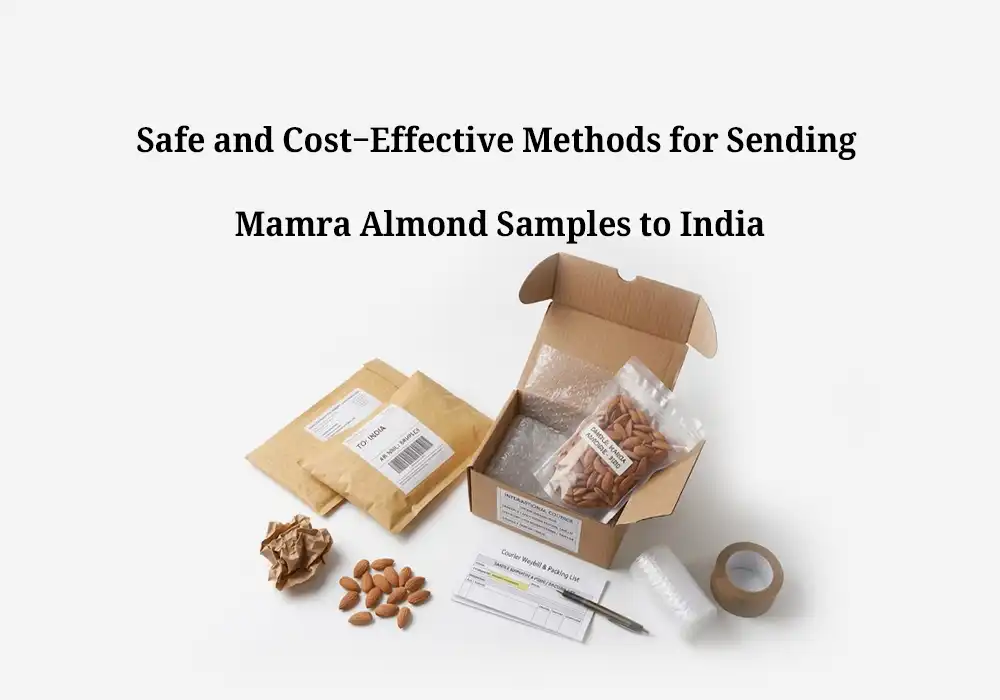
Safe and Cost-Effective Methods for Sending Mamra Almond Samples to India (The Golden Guide for Exporters)
There is a breathtaking moment in international trade: you have negotiated for months with a major Indian merchant in Mumbai or Delhi, the prices are agreed upon, and the buyer is thoroughly impressed with your corporate portfolio. However, right before signing the final contract for a 20-ton shipment, the buyer drops a crucial sentence: "Please send me 2 kilograms of the cargo as a physical sample so I can closely inspect the quality, size, and taste."
At this exact moment, you face a monumental challenge. Sending a small package of food to a country with immensely strict customs regulations like India is absolutely nothing like mailing a letter! If this sample gets trapped in Indian customs, or if it spoils and turns bitter during transit due to poor packaging, the Indian merchant will immediately assume your entire 20-ton cargo is of abysmal quality, completely destroying a multi-million-dollar deal forever.
In this analytical and story-driven article, we will dissect the critical mission of sending commercial samples. Together, we will explore exactly how to place this "tiny commercial ambassador" safely onto the Indian merchant's desk with minimum cost, maximum security, and without drowning in the swamp of customs bureaucracy.
1. The Weight of a Sample: Why is it the Most Critical Aspect of Exporting?
Your commercial sample acts as the supreme ambassador of your entire factory. When the Indian buyer slices open that box, the very first thing they evaluate is your level of professionalism. Many novice exporters make the fatal mistake of handpicking only their absolute largest, perfect almonds, dumping them in an ordinary plastic bag, and shipping them off. This is commercial suicide!
- The Law of 100% Conformity: The sent sample must match the final bulk cargo that will be loaded into the container down to the exact millimeter. If the sample you send is a Grade 3A, but the final container holds Grade 4A, the buyer in India will ruthlessly reject the entire shipment upon arrival. To truly understand grading and quality differences, reviewing the article Difference Between Saman Mamra Almond and Other Iranian Varieties is essential.
2. Indian Customs Traps for Mailed Food Packages
Shipping edible goods (even a mere 1 kilogram) into India triggers specific, rigid laws. The Food Safety and Standards Authority of India (FSSAI) and the Plant Quarantine Department are fiercely sensitive, even toward tiny parcels. If you send the sample using standard government postal services, there is a very high probability the package will be paralyzed at Indian postal customs. The customs officer will demand a Phytosanitary certificate and an import license from the receiver (the Indian buyer)—documents that are completely illogical to prepare for a 1-kg box. Consequently, the package will languish for weeks in a sweltering postal warehouse, the valuable almond oil will go rancid, and the package will ultimately be destroyed. To grasp the critical importance of health documents, reading A Comprehensive Guide to Obtaining a Phytosanitary Certificate is highly recommended.
3. Shipping Methods: A Comparison of Security, Speed, and Cost
To bypass these bureaucratic nightmares and deliver the sample swiftly, international traders rely on three primary methods. Let us compare them:
A) International Express Couriers (e.g., Aramex, DHL)
This is the most professional and fastest route. Global express couriers possess their own streamlined customs clearance mechanisms.
- Pros: Blistering speed (3 to 5 business days), Door-to-Door delivery directly to the buyer's desk, real-time online tracking, and highly secure clearance.
- Cons: Exceptionally high costs. Shipping a single kilogram of almonds through this channel can cost dozens of dollars. Furthermore, these companies generally require you to provide a specific commercial invoice marked as a "Free of Charge Sample."
B) Air Freight Cargo
This method is deployed when the Indian buyer requests a substantially larger sample (e.g., 10 to 20 kilograms) to run tests in their roasting or processing machines.
- Pros: For weights exceeding 10 kg, it is vastly more cost-effective than express couriers. Cargo security aboard commercial airlines is absolute.
- Cons: The cargo is NOT delivered door-to-door! The buyer must physically go to the destination airport (e.g., Mumbai International), present full customs documentation, and officially clear the cargo, which is a highly time-consuming procedure.
C) Passenger Transport (The "Flying Carpet" Method)
The oldest, cheapest, and by far the riskiest method! Here, the exporter entrusts the sample package to a traveling acquaintance or a tour guide flying to India, who physically hands it to the buyer.
- Pros: Near-zero cost and arrives the very same day the flight lands.
- Cons: It is glaringly unprofessional and paints a highly amateurish image of your company in the mind of the foreign buyer. Furthermore, there is a severe risk of airport police confiscating the food items due to a lack of health certifications.
4. The Magic of Vacuum Sealing: Preserving Quality During the Journey
Even if you select the fastest courier, the extreme fluctuations in atmospheric pressure inside the aircraft's cargo hold and the intense heat of the journey can trigger a spike in the Peroxide Value (oxidation) of the almond oil. If the Indian buyer tastes the almond and it tastes stale, the deal is dead.
The golden solution is Vacuum Packaging (Total Air Extraction). When you place your 2-kg sample inside a thick, specialized bag and extract 100% of the air using a vacuum machine, you eliminate the oxygen. In this state, the Mamra almond enters a deep biological slumber. Even if the journey takes a month, when the Indian buyer finally opens the package, they will be greeted by the exact fresh, buttery aroma of harvest day. To fully understand this chemical phenomenon, studying the article What is the Peroxide Value (PV) Test in Almonds? will be highly enlightening.
Comparison Table: Methods for Sending Almond Samples to India
| Shipping Method | Approximate Cost | Delivery Speed | Customs Security | Commercial Prestige |
|---|---|---|---|---|
| Express Courier (Aramex/DHL) | Very High | 3 to 5 Days | Highly Secure (Cleared by courier) | Maximum (Professional) |
| Air Freight Cargo | Medium (Best for heavy weights) | 5 to 7 Days | Requires formal airport customs clearance | High |
| Passenger (Luggage) | Extremely Low | 1 Day (Flight dependent) | High Risk (Possible airport confiscation) | Poor (Amateur) |
5. Sending Ultra-Professional Samples with Walmondhe
Sending a sample is the absolute genesis of a multi-million-dollar trust. The Walmondhe engineering and trading group, functioning as the ultimate authority for Saman almond exports, executes a flawless strategy for dispatching samples to its global clientele.
- Flawless Sample-to-Bulk Conformity: We provide an ironclad guarantee that the sample you receive is extracted directly from the exact same batch and sorting line that will fill your final container. We engage in absolutely zero deceptive "cherry-picking" of samples. To familiarize yourself with the integrity of our supply chain, read Is Walmondhe a Direct Supplier from Saman Farmers?.
- Isolated, Professional Packaging: All Walmondhe samples are dispatched in completely vacuum-sealed packaging, adorned with official corporate labels detailing the exact chemical and physical analysis (size, moisture percentage, and grade). This represents the pinnacle of commercial respect toward our international buyers.
To request an official commercial sample, receive specialized logistics consultation, and obtain daily pricing for premium export varieties including Mamra Almonds and Iranian Moheb Almonds, communicate with our sales department experts through the official paths below:
- Direct & Fast WhatsApp Communication: +989136667618
- Direct Sales Department Telephone: +989136667618