
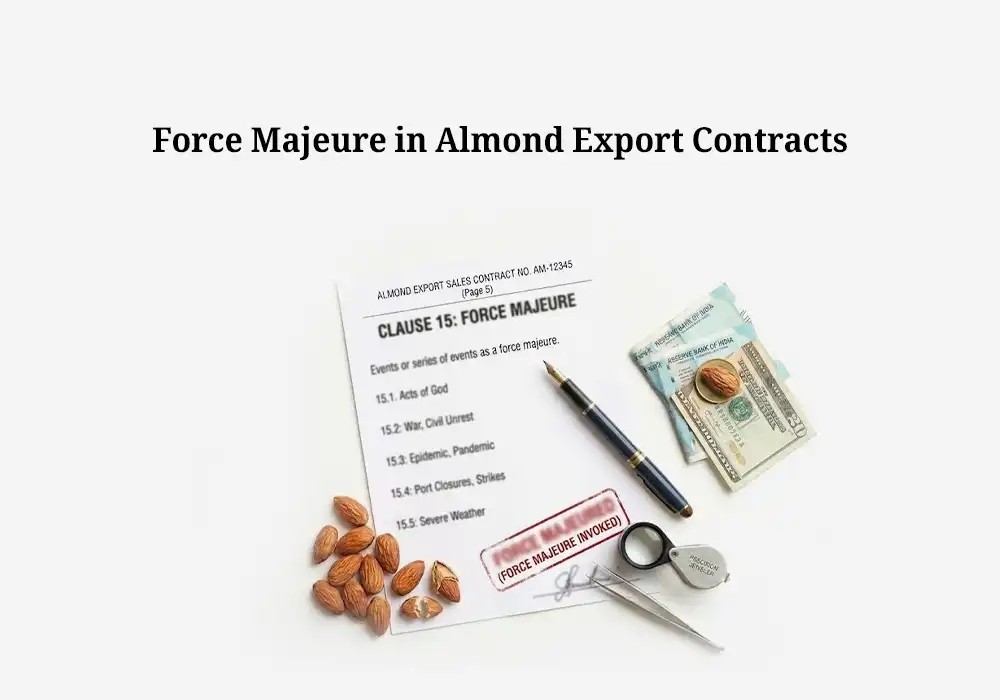
Force Majeure in Almond Export Contracts: Your Ultimate Defensive Shield Against Astronomical Penalties
Imagine you have successfully loaded a container packed with premium Mamra Almonds onto a cargo ship. According to your tightly negotiated contract, you are legally bound to deliver the cargo to Nhava Sheva port (Mumbai) by the 20th of the month. For every single day of delay, a staggering dollar penalty (Liquidated Damages) is stipulated in the contract. Suddenly, an unprecedented monsoon cyclone tears through the Indian Ocean, or the destination port's customs workers unexpectedly launch a massive labor strike!
Your ship finally docks with a catastrophic two-week delay. The furious Indian buyer calls you, claiming he has lost his domestic clients due to this delay, and aggressively demands to deduct the massive penalty fees directly from your principal payment! You desperately shout, "It wasn't my fault! There was a cyclone!" But the buyer coldly replies, "The contract states delivery on the 20th. A cyclone is not my problem!"
In this terrifying, heart-stopping moment, there is only one magical phrase in international trade law that can rescue your capital from absolute annihilation: The Force Majeure Clause. In this analytical legal article, we will dissect this critical yet frequently overlooked contract clause. We will discover exactly how embedding a simple legal paragraph at the bottom of your Proforma Invoice can act as an impenetrable fortress, protecting you from illogical financial penalties during global crises.
1. What Exactly is Force Majeure?
Force Majeure is a French legal term literally translating to "superior force." In the realm of international trade, Force Majeure refers to extraordinary events and circumstances that are unpredictable, unavoidable, and entirely beyond the control of both contracting parties (buyer and seller).
When this clause is present in your commercial contract and such an event occurs, the legal obligations of both parties are temporarily suspended. Crucially, neither party possesses the legal right to claim damages or penalties from the other for delivery delays or payment disruptions. These crises generally fall into two broad categories:
- Acts of God (Natural Disasters): Devastating earthquakes, catastrophic floods, oceanic cyclones, tsunamis, and volcanic eruptions.
- Acts of Man (Political/Human Crises): Wars, sudden international embargoes, nationwide port or customs strikes, unexpected border closures, and global pandemics (e.g., COVID-19).
2. Why is the Force Majeure Clause Vital for the Indian Market?
Exporting dry fruits to the Indian subcontinent is pregnant with unpredictable logistical hazards. If you ignore this clause in your almond export contracts, you are essentially sitting on a financial time bomb:
- Monsoon Cyclones: During specific months, Indian seaports endure savage monsoon rains and cyclonic storms that can paralyze cargo unloading operations for days. Prolonged container detention in such humidity can cause cargo spoilage. To understand these specific risks, read Customs Warehouse Storage Conditions for Mamra Almonds.
- Bureaucracy and Port Strikes: Indian ports have historically experienced sudden, unannounced labor strikes by transport unions, or overnight regulatory shifts enforced by the Food Safety and Standards Authority of India (FSSAI).
3. The Legal Red Lines: What is NOT Force Majeure?
Many novice traders labor under the dangerous illusion that any commercial hardship can be blamed on Force Majeure. International courts and Chambers of Commerce are ruthlessly strict regarding this definition. The following scenarios are absolutely NOT Force Majeure:
- Severe Almond Price Fluctuations: If global almond prices suddenly plummet and the Indian buyer attempts to cancel the contract citing "Force Majeure," this is blatant commercial fraud. Price volatility is a standard commercial risk, not an Act of God!
- Currency Devaluation: Extreme fluctuations in USD or Rupee exchange rates.
- Factory Machinery Breakdown: If your optical sorting machine breaks down and you fail to deliver the cargo on time, this is purely your operational failure, and you must pay the delay penalties.
- Failure to Secure Health Certificates: If Indian customs seizes your cargo due to the presence of Aflatoxin, this is not Force Majeure; it is your failure in quality control. To prevent this catastrophe, strictly review Analyzing the Almond COA: What Do Indian Buyers Scrutinize?.
Comparison Table: Genuine Force Majeure vs. Commercial Risk (Negligence)
| Event During the Export Process | Is it Legally Force Majeure? | Legal Consequence for Exporter / Importer |
|---|---|---|
| Mumbai Port closure due to a Tsunami | Yes (Absolutely) | Complete exemption from paying late delivery penalties. |
| Cargo seizure due to missing Phytosanitary doc | No (Seller's Negligence) | Seller must pay full damages and port demurrage to the buyer. |
| Nationwide Indian transport workers strike | Yes | Contractual obligations suspended until the official strike ends. |
| Global almond prices crash upon delivery | No (Standard Commercial Risk) | Buyer is legally obligated to pay full value via the L/C. |
4. How to Draft a Bulletproof Force Majeure Clause
Merely typing the words "Force Majeure" at the bottom of a contract is legally insufficient. A standard, bulletproof clause must contain the following architecture:
- Explicit Listing of Events: Specific terms such as earthquakes, floods, wars, pandemics, and customs strikes must be explicitly written.
- Strict Notice Period: The clause must dictate that the affected party is legally bound to notify the other party in writing (official email) within a strict timeframe (e.g., 3 to 5 business days) of the event occurring. If a hurricane hits and you wait two weeks to inform the buyer, international courts will reject your defense!
- The Right to Terminate: It must be stipulated that if the Force Majeure conditions persist beyond a specific duration (for example, 60 days), both parties possess the right to completely terminate the contract without facing any financial penalties. To understand secure payment methods under such conditions, read Bank Guarantee vs. Letter of Credit: Which is Safer in India?.
5. Smart, Secure Contracting with Walmondhe
In international B2B commerce, supplying a premium product is not enough to guarantee success; mastering international export laws (Incoterms and trade law) is what ultimately protects your capital.
The Walmondhe engineering and trading group, reigning as the most reputable almond exporter in Saman, anchors all its international export contracts on the most transparent, fair, and legally impenetrable frameworks. Our corporate legal department meticulously engineers all risk-mitigation clauses (including Force Majeure, third-party inspection terms, and quality guarantees) to ensure both parties (buyer and seller) are entirely legally insulated against unpredictable global crises. We do not merely supply the finest Mamra Almonds; we actively guarantee the psychological and legal security of our international partners.
To receive free consultation on international trade law, drafting secure export contracts, and to secure daily pricing on elite export varieties like Iranian Moheb Almonds, communicate with our experts through the official paths below:
- Direct & Fast WhatsApp Communication: +989136667618
- Direct Sales Department Telephone: +989136667618