
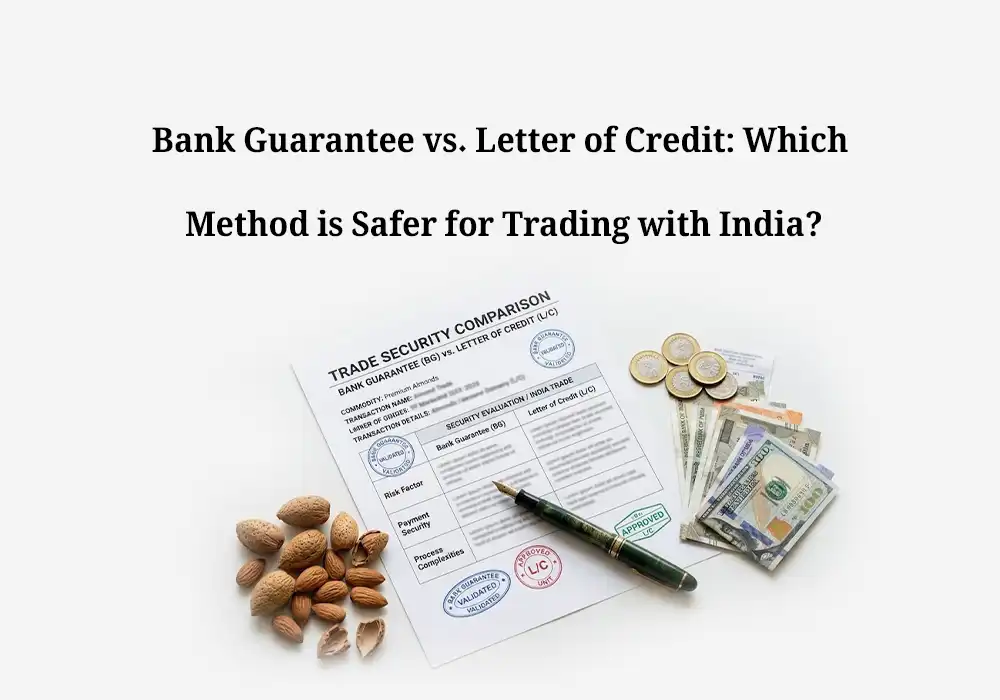
Bank Guarantee vs. Letter of Credit (L/C): Which Method is Safer for Trading with India? (Dissecting a Crucial Decision)
Imagine that after months of exhausting negotiations, you have finally reached a monumental agreement with a major buyer in India to export a five-million-dollar consignment of premium Mamra Almonds. You have issued the Proforma Invoice, and now the critical moment has arrived: deciding exactly how this massive sum of money will be paid and secured.
At this sensitive juncture, the Indian merchant presents you with two options: "I can open a 'Letter of Credit' for you, or if you prefer, I will send you a 'Bank Guarantee' from India's most reputable bank." To a novice trader, these two terms might sound like identical twins; both are official documents stamped by a bank that seemingly guarantee your money. However, in the harsh reality of global commerce, the difference between these two pieces of paper is the difference between "receiving guaranteed cash" and "being dragged into a paralyzing, years-long international court battle!"
Countless exporters have lost massive fortunes simply because they did not understand the fundamental mechanics of these two financial instruments. In this highly analytical, story-driven article, we will journey inside the banking system using exceedingly simple language. We will explore exactly what sets these documents apart, and discover which one acts as an impenetrable fortress for your capital when exporting dried fruits to India.
1. What is a Letter of Credit (L/C)? (The Secure Payment Bridge)
To fully comprehend a "Letter of Credit," let us compare it to a "smart, conditional ATM machine." A Letter of Credit is an instrument specifically designed for the direct and definitive payment of funds. When an Indian buyer opens an L/C in your favor, they are essentially locking the purchase money inside their own bank.
The Indian bank then sends a formal letter to you (or your local bank) making a supreme banking promise: "Dear Exporter! If you ship this exact cargo of almonds on time and hand over the correct shipping and customs documents (like the Bill of Lading and Health Certificates) to us, we do not care what the buyer says; we will personally wire the entire sum directly into your account."
- Primary Objective: To guarantee the physical payment of money in a standard commercial transaction.
- The Golden Feature: In this method, you are no longer relying on the buyer's honesty; your transaction is with the buyer's bank. The moment you present flawless documents, your money is released. To grasp the immense importance of flawless documentation, be sure to read What is a Certificate of Origin and Why is it Mandatory in Indian Customs?.
2. What is a Bank Guarantee? (The Emergency Seatbelt)
Now, let us examine the "Bank Guarantee." If the Letter of Credit is a payment machine, the Bank Guarantee is strictly an "insurance policy and an emergency seatbelt." This document is absolutely NOT designed for the routine payment of goods! A Bank Guarantee only steps onto the battlefield when someone "breaks a promise" or "defaults" on a contract.
Suppose you agree to let the buyer pay you later, but for security, you demand a Bank Guarantee. The Indian bank states in this document: "The merchant is supposed to pay you. However, if for any reason they fail to pay, and you can prove to us legally or in court that they defaulted, only then will we step in and compensate your loss."
- Primary Objective: To provide financial compensation solely in the event of a breach of contract or default.
- The Dangerous Feature: The bank has not set aside cash to pay you upon shipping. The bank only pays if you successfully prove the buyer committed fraud—a process that typically demands agonizing legal battles. For insights into the risks of direct payments, review TT Transfers in Almond Exports: Risks, Benefits & Solutions.
3. Core Differences: A Head-to-Head Battle
To ensure you are never confused during commercial meetings, memorize these three key differences:
- The Trigger for Activation (The Main Difference):
- Letter of Credit: Activated by doing the job right (You ship the cargo, submit the documents, and get paid).
- Bank Guarantee: Activated by the job going wrong (You ship the cargo, the buyer refuses to pay, you file a claim, and the bank compensates you).
- Market Application:
- Letters of Credit are used for everyday, routine trading of physical goods (like exporting almonds).
- Bank Guarantees are predominantly used for massive construction projects, government tenders, or long-term service contracts.
- The Bank's Position:
- In an L/C, the bank is the primary entity committed to paying you.
- In a Bank Guarantee, the bank acts merely as a backup or a secondary guarantor.
4. Which is Safer for Exporting Almonds to the Indian Market?
If your goal is exporting almonds to India, the answer is blindingly clear and absolute: The Letter of Credit (L/C) is the undisputed king and the safest method!
The Reserve Bank of India (RBI) enforces extremely strict regulations regarding the outflow of foreign currency.
- If you execute an L/C contract with an Indian buyer, the very second your almond containers are loaded onto the ship and you present the clean shipping and phytosanitary certificates to the bank, your money is 100% guaranteed. The buyer cannot invent excuses to withhold payment.
- However, if you naively accept a Bank Guarantee instead, and the Indian buyer refuses to pay, you will be forced to initiate a complex, exhausting legal and banking dispute in a foreign country (India) just to prove the buyer defaulted. This process can drag on for months, completely freezing your capital. To familiarize yourself with the customs documents India accepts, reading A Comprehensive Guide to Obtaining a Phytosanitary Certificate is highly enlightening.
5. Secure, Stress-Free Trading with Walmondhe
Selecting the correct payment method demands deep experience, knowledge of international law, and a precise understanding of destination banks. A single misplaced word in a banking contract can result in your funds being permanently blocked.
The Walmondhe engineering and trading group, with years of continuous, flawless exporting to India and the Persian Gulf nations, paves the safest financial pathways for its commercial partners.
- Expert Financial Consultation: Before any contract is signed, our legal experts meticulously vet foreign buyers and recommend the absolute safest payment structures (often a hybrid of secure advance payments and robust Letters of Credit).
- Flawless Document Presentation: The entire power of an L/C relies on the accuracy of customs documents. We generate all documents (invoices, health certificates, and bills of lading) without a single typographical error, ensuring the buyer's bank has absolutely no excuse to delay your payment. To learn more about our secure supply chain, read Is Walmondhe a Direct Supplier from Saman Farmers?.
To receive free consultation on export banking affairs, structuring international contracts, and to get the daily pricing for secure export varieties like Mamra Almonds and Iranian Moheb Almonds, reach out to our sales department via the official channels below:
- Direct & Fast WhatsApp Communication: +989136667618
- Direct Sales Department Telephone: +989136667618