
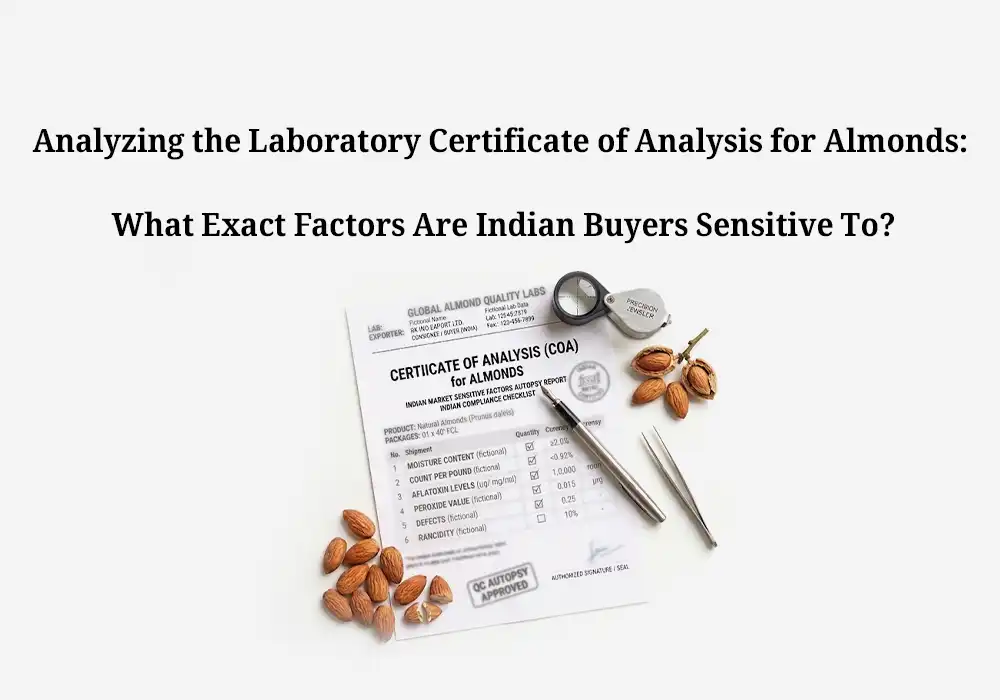
Analyzing the Laboratory Certificate of Analysis (COA) for Almonds: What Exact Factors Are Indian Buyers Sensitive To? (Dissecting Quality)
Imagine you are standing at an international dry fruit expo in Dubai or Mumbai. A prominent Indian wholesale buyer approaches your booth, examines the gorgeous appearance of your Mamra Almonds, tastes one, and smiles in deep satisfaction. You wait eagerly for him to discuss pricing or shipping logistics, but instead, he looks you directly in the eyes and firmly states: "Please show me the COA for this batch."
For novice exporters, this sudden request can feel like a bucket of ice water. Professional buyers in India never risk millions of dollars of their capital based merely on the "beautiful appearance of a handful of almonds." They are acutely aware that Indian Customs and the Food Safety and Standards Authority of India (FSSAI) tolerate absolutely no errors, and the slightest hidden contamination will lead to the brutal rejection of the entire container.
To fully guarantee their investment, these buyers demand a definitive scientific document known as the Certificate of Analysis (COA). In this highly analytical and meticulously detailed article, we will place this document under a microscope. We will explore exactly which numbers and critical red lines an Indian merchant hunts for when scanning this paper, and how a single minor digit can instantly alter the fate of a massive commercial transaction.
1. What is a COA? (The Blood Test of the Commodity)
Just as a physician requests a blood test to understand the hidden, internal health of your body, an international buyer requests a COA to uncover the internal, chemical, and microbiological health of the almonds. This document is a formal, verified report issued by accredited, standardized laboratories (such as globally recognized inspection agencies or government-certified labs). In this report, the physical and chemical structure of the almond is translated into raw data, proving whether the product is biologically safe for human consumption and if it genuinely justifies the premium price the buyer is paying.
2. Aflatoxin: India’s Deadly Red Line
The absolute first, most terrifying word the Indian buyer searches for on the analysis sheet is "Aflatoxin." Aflatoxin is an exceptionally hazardous fungal toxin that is invisible to the naked eye but acts as a potent, deadly carcinogen.
- Buyer Sensitivity: Indian customs will under no circumstances permit the entry of cargo with high aflatoxin levels. If the COA indicates elevated levels of this toxin, the buyer will refuse to pay a single dollar for the shipment.
- Permissible Standard: Under the most rigorous global standards (including Indian FSSAI and European regulations), Total Aflatoxin must strictly remain below 10 to 15 micrograms per kilogram (ppb). If your document reads zero or well below this threshold, the Indian buyer signs the contract with total peace of mind. To fully comprehend this silent threat and the strategies to neutralize it, you must read the article: A Comprehensive Guide to Preventing Aflatoxin and Shipment Rejection.
3. Moisture Content: The Boundary Between Crispness and Decay
The second factor that magnetically draws the Indian buyer's eyes is the moisture percentage of the almond. Why is moisture so incredibly critical? For two distinct commercial and scientific reasons:
- The Risk of Spoilage in Transit: India is a notoriously hot and humid country. If the kernel's moisture content is high during loading, the month-long oceanic voyage will inevitably trigger severe mold growth and cargo suffocation.
- Weight Deception: Moisture is simply water! A buyer paying premium dollar rates for Mamra almonds absolutely refuses to pay for "trapped water" instead of actual almond kernels.
- Permissible Standard: The standard moisture content for export-grade almond kernels must be strictly below 5% to 6%. At this optimal percentage, the almond is exceptionally crisp, crunchy, and bone-dry. To understand how moisture interacts with customs warehousing, read Customs Warehouse Storage Conditions for Mamra Almonds.
4. Peroxide Value (PV) and Free Fatty Acids (FFA)
These two factors directly dictate the "freshness and taste" of the almond. Mamra almonds contain over 50% highly beneficial oils. By inspecting these two numbers, the Indian buyer instantly deduces whether you are selling them a freshly harvested current-year crop, or a stale, aging batch whose oils are rapidly spoiling.
- Free Fatty Acids (FFA): This indicates the initial breakdown of the almond's oil. This number must be exceedingly low (typically under 1.5%).
- Peroxide Value (PV): This measures how much the oil has oxidized (bonded with oxygen), causing rancidity. If the Peroxide Value on the COA climbs above 5, it means the almonds will taste aggressively stale, bitter, and soapy. To thoroughly examine this chemical phenomenon, do not miss the article: What is the Peroxide Value (PV) Test in Almonds?.
5. Physical Purity and Microbiological Safety (E. coli & Salmonella)
At the bottom of the COA, the Indian buyer seeks definitive confirmation of physical and microbiological cleanliness:
- Physical Purity: This measures the percentage of broken kernels, chipped nuts, or the presence of foreign matter (such as wooden shell fragments or dust). In premium Super-Grade batches, this percentage must hover near absolute zero.
- Microbiological Safety: The presence of lethal pathogens like Salmonella or E. coli in food products is an absolute catastrophe, prompting immediate customs seizure and incineration of the cargo. The analysis report must explicitly state the word "Negative" or "Not Detected" adjacent to these specific bacteria.
The Golden Table: Ideal COA Standards for the Indian Market
| Laboratory Factor | Danger Zone (High Risk of Rejection) | Ideal Standard (Approved by Indian Customs) |
|---|---|---|
| Total Aflatoxin | Above 15 ppb (Absolute Rejection) | Below 10 ppb (Preferably near zero) |
| Moisture Content | Above 7% (Risk of mold & weight loss) | Around 4% to 5.5% (Crisp & crunchy) |
| Peroxide Value (PV) | Above 5 meq/kg (Tastes stale & bitter) | Between 0 and 2 meq/kg (Fresh & buttery) |
| Salmonella & E. coli | Positive | Negative / Not Detected |
| Broken Percentage | Above 5% | Less than 1% to 2% (Depending on grade) |
6. The Absolute Guarantee of Analysis with Walmondhe
Presenting a flawless, gleaming COA demands the possession of a rigorously isolated supply chain, highly advanced optical sorting machinery, and strict adherence to global hygienic principles within the factory.
The Walmondhe engineering and trading group, functioning as the premier direct supplier of Mamra almonds in the Saman region, guarantees quality not merely by outward appearance, but deep within the chemical and microbiological architecture of the product.
- Before dispatching to customs, all our export cargoes are rigorously tested by accredited partner laboratories, securing official COA and Phytosanitary certificates.
- Our utilization of heavy-duty Vacuum Packaging guarantees that the moisture and Peroxide Value recorded on the origin COA remain mathematically identical to the condition the cargo is in when delivered to the buyer in India. To familiarize yourself with our primary production infrastructure, read the article Is Walmondhe a Direct Supplier from Saman Farmers?.
To request official sample COAs, check current inventory, and obtain daily pricing for the safest export-grade varieties like Mamra Almonds and Iranian Moheb Almonds, communicate with our sales department experts through the official paths below:
- Direct & Fast WhatsApp Communication: +989136667618
- Direct Sales Department Telephone: +989136667618