
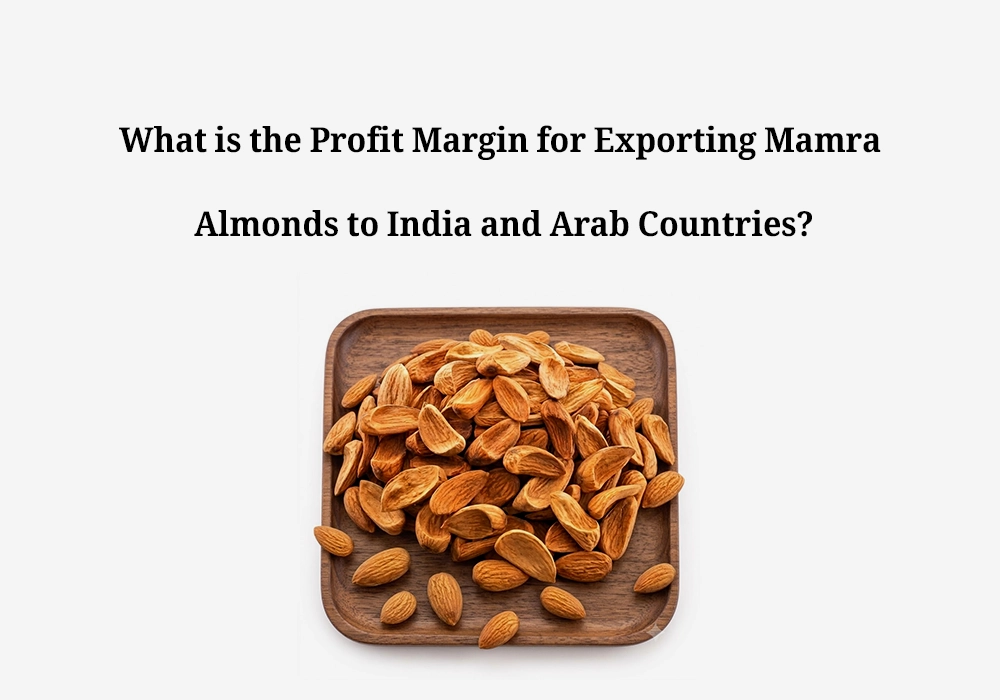
What is the Profit Margin for Exporting Mamra Almonds to India and Arab Countries? (B2B Financial Analysis)
In the world of international trade, Mamra Almonds are known as "Iran's agricultural gold." The high dollar exchange rate, astronomical demand in target markets, and the genetic monopoly of this product in Iran have made it one of the most attractive options for export. However, the main and most critical question for any merchant, investor, or trading company is: What is the actual Profit Margin of this trade on a container scale?
The reality is that the profit from exporting dried fruits is not a fixed number. This margin fluctuates based on the destination country, sorting grade, procurement method, and especially the timing of market entry. In this article, we dissect the financial structure and profit margin of exporting Mamra almonds to two primary destinations: India and the Arab countries of the Persian Gulf.
1. Dissecting the Profit Margin: Gross Profit vs. Net Profit
Before diving into country specifics, we must understand the financial formula of this trade on a B2B scale. Based on the operational data from Walmondhe's supply chain, the profit margin of this product is divided into two sections:
- Gross Profit Margin: When purchasing directly from primary sorting facilities and eliminating middlemen, this usually ranges between 25% to 35%. This figure represents the difference between the bulk purchase price in Iran and the wholesale price in the destination market.
- Net Profit Margin: After deducting all logistics costs, MAP packaging, warehousing, destination customs tariffs, clearance fees, and financial transfer risks, the actual net profit typically falls in the range of 12% to 20%.
A Real-World Example: In a 20-foot container of Mamra almond kernels with an approximate value of $150,000, the actual net profit for the exporter can be between $18,000 and $30,000 per shipment; provided that the logistics are executed flawlessly.
2. India Market Analysis: High Volume, Astronomical Prices, but Strict Tariffs
India is the primary destination and the largest consumer of Mamra almonds globally. Merchants in the "Khari Baoli" market in Delhi and "Vashi" in Mumbai are well aware of the immense value of this product.
Financial Characteristics of the Indian Market:
- Focus on Luxury Grades: The Indian market is the main buyer of large grades such as 4A, 5A, and 6A. The gross profit margin on these luxury grades is significantly higher (sometimes above 30%).
- The Customs Tariff Challenge: To protect its domestic production, India applies a fixed customs tariff based on weight (per kilogram). This tariff is a fixed cost that must be factored into the Landed Cost calculations.
- Actual Net Profit in India: Due to the extremely high selling prices in Indian retail, the net profit for exporters who deliver the cargo directly to primary importers usually ranges between 15% to 22%.
3. Arab Countries Market Analysis (UAE, Qatar, Oman): Fast Transit and Low Risk
The Arab countries of the Persian Gulf, particularly Dubai (Ras Al Khor market), have a different strategy for purchasing Mamra almonds. Dubai serves as both a luxury consumer market and a re-export hub to other parts of the world.
Financial Characteristics of the Arab Market:
- Variety in Grades: Unlike India, which strictly demands luxury shipments, Arab countries purchase mixed batches, medium grades (2A and 3A), and even in-shell Mamra almonds for the confectionery industry and luxury boutiques.
- Very Low Customs Tariffs: The tariff for importing food into the UAE and Qatar is negligible (around 5% or even zero for certain free zones), and the customs clearance process is much faster than in India.
- Lower Logistics Costs: Maritime transit from Bandar Abbas to Jebel Ali is very short (2 to 3 days), which significantly reduces shipping costs and the risk of tied-up capital.
- Actual Net Profit in the Arab Market: Because of more intense competition, the net profit in these markets is slightly more compressed, usually varying between 10% to 15%; however, the speed of capital turnover is much higher on this route.
4. Three Critical Factors That Will Destroy or Double Your Profit Margin
If you fail to observe these three principles, your net profit can quickly turn negative:
- The Demurrage Trap and Customs Seizure (Documentary Risk): If your shipment is seized at Indian customs due to a flaw in the Phytosanitary certificate or FSSAI labeling, daily container demurrage costs will rapidly swallow your entire net profit.
- Oxidation Process and Quality Degradation (Packaging Risk): Mamra almonds are rich in fat. If shipped in a standard container without MAP packaging (vacuum and nitrogen), the cargo absorbs moisture and becomes rancid. The buyer at the destination will either reject the shipment or accept it with a 50% price deduction.
- Buying from Brokers Instead of Primary Sorting Facilities: Purchasing from middlemen in the traditional market instantly wipes out at least 10% to 15% of your gross profit margin right from the start.
How Does Walmondhe Guarantee and Optimize Your Profit Margin?
Walmondhe, as the direct industrial infrastructure for supplying Mamra almonds in Iran, has engineered its B2B transactions to preserve the highest possible profit margin for its buyers and commercial partners:
- Direct Supply from Saman Orchards: By completely eliminating brokers, we deliver the cargo to you at the actual base market price, increasing your gross profit margin by at least 12%.
- Free MAP Packaging Technology: Walmondhe packages all export shipments using industrial vacuuming and nitrogen gas injection. This completely neutralizes the risk of cargo spoilage, mold, and shipment rejection.
- Guaranteed Indian Customs Clearance (FSSAI): Our documentation team issues all health certificates and labeling strictly in accordance with current Indian customs regulations to prevent terrifying demurrage costs.
With Walmondhe, you are not just buying almonds; you are deploying an engineered supply chain that guarantees financial efficiency and the profitability of your capital.
Contact us to receive a price table for different grades, logistics cost analysis, and a Proforma Invoice:
- Direct contact via WhatsApp: 09136667618
- Contact the B2B Export and Sales Department: 09136667618
- Follow us on LinkedIn: Hossein Ebrahimi - Walmondhe