
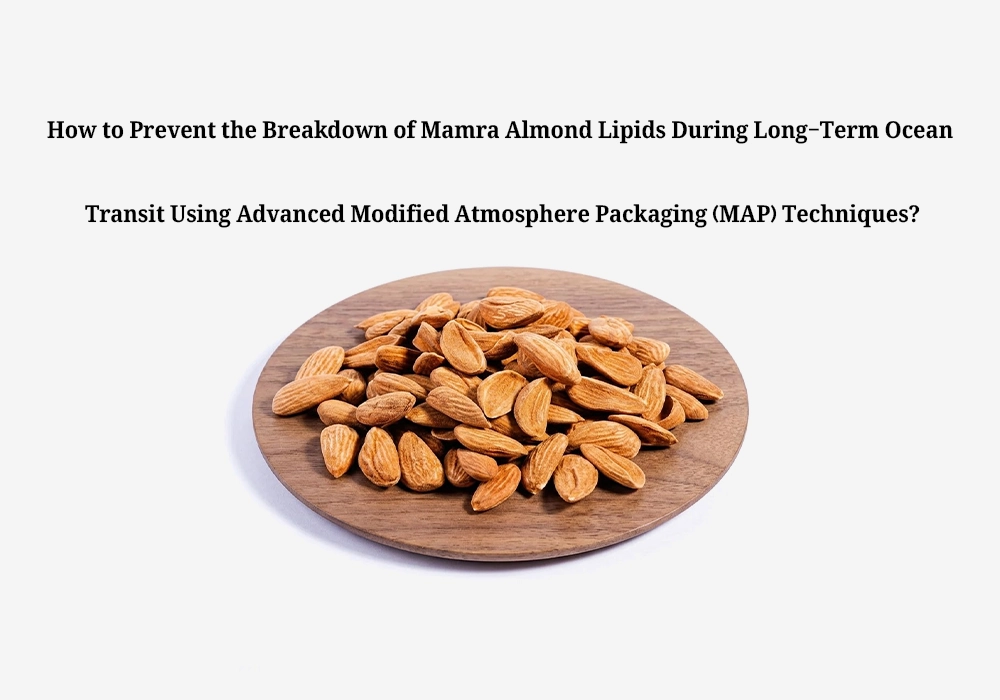
How to Prevent the Breakdown of Mamra Almond Lipids During Long-Term Ocean Transit Using Advanced Modified Atmosphere Packaging (MAP) Techniques?
Exporting high-tonnage Mamra almond shipments via ocean freight to destinations like Indian ports (Nhava Sheva) or European logistics hubs is a brutal war against time, moisture, and oxygen. Authentic Mamra almonds from the Zayanderud basin, possessing an unparalleled lipid density (over 60% fatty acids), are considered the most valuable yet vulnerable dried fruit variety globally.
Placing this expensive cargo in commercial Dry Vans for 15 to 35 days, under extreme temperature fluctuations and humid oceanic conditions, triggers a silent biochemical catastrophe. Many traditional exporters, relying on archaic jute bags or basic plastic vacuum packaging, deliver their premium cargo at the destination as rejected goods characterized by a rancid taste, dull color, and failed chemical parameters.
The only engineered, definitive strategy to halt this structural collapse is implementing the Modified Atmosphere Packaging (MAP) architecture. In this highly specialized, data-driven analysis, we deconstruct the mechanism of lipid degradation during transit, gas engineering in MAP technology, and definitive strategies to preserve the value-added of Mamra almonds.
Biochemical Deconstruction: Why Does the Mamra Almond Lipid Structure Disintegrate During Transit?
To design a defensive system (MAP), we must first understand the enemy at the molecular level. Mamra almond kernels are packed with unsaturated fatty acids, such as oleic acid (Omega-9) and linoleic acid. In the dark, hot, and humid environment of an ocean container, two destructive chemical processes activate simultaneously:
- Oxidative Rancidity: The presence of merely 2% to 3% residual oxygen inside the packaging, catalyzed by the container's heat, initiates a free radical chain reaction. In this reaction, the double bonds of fatty acids are broken, producing volatile compounds like aldehydes and ketones. This is precisely what creates the "foul odor" and "cardboard taste" in oxidized almonds.
- Hydrolytic Rancidity: If moisture penetrates the packaging (increasing Water Activity), lipase enzymes are activated. These enzymes hydrolyze triglycerides, releasing Free Fatty Acids (FFA). An increase in FFA directly leads to severe bitterness in Mamra almond kernels.
Indian customs and regulatory bodies like the FSSAI immediately reject shipments exhibiting high oxidation by measuring Peroxide Value (PV) and FFA, or reclassify them as industrial waste, resulting in the total annihilation of your capital.
MAP Technology Architecture: Beyond Traditional Vacuum Packaging
A fatal cognitive error in the dried fruit packaging industry is equating "Vacuum Packaging" with MAP technology. Vacuum packaging merely extracts the air from the bag. This presents two catastrophic flaws for Mamra almonds:
- The mechanical pressure caused by the vacuum crushes and chips the extremely crisp Mamra kernels, destroying the cargo's commercial value.
- A standard vacuum can never reduce oxygen levels below 2%, leaving the risk of oxidation fully intact.
Conversely, MAP technology creates an "engineered atmosphere" around the product. Advanced MAP machines first extract the oxygen inside the bag to absolute zero, then flush it with an Inert Gas Mix. This gaseous cushion not only halts chemical processes but also protects the kernels from physical impacts (Cushioning Effect) during maritime logistics operations.
Precise Gas Calibration in MAP Systems for Mamra Almonds
The formulation of the injected gas mix is a function of the product type and its fat content. For Mamra almonds with a 65% fat grade, standard calibration in MAP machinery must be strictly set according to the following protocol:
| Gas Type | Composition Percentage | Strategic Role in Preserving Mamra Almond Quality |
|---|---|---|
| Nitrogen (N2N_2N2) | 98% - 99% | A completely inert filler gas that replaces oxygen. It prevents lipid oxidation and maintains the almond's crisp structure. |
| Carbon Dioxide (CO2CO_2CO2) | 0% - 1% | Used in some formulations for its bacteriostatic properties (halting fungal growth and aflatoxin). Overuse in dried fruits is not recommended as it acidifies the taste. |
| Oxygen (O2O_2O2) | Less than 0.5% | The Critical Limit. The presence of more than 1% oxygen will activate lipid peroxidation in voyages exceeding 20 days. |
The Critical Role of Multi-Layer Barrier Films
Injecting 99% nitrogen is entirely useless if the packaging bag cannot retain this atmosphere for 30 days. Utilizing single-layer plastics (like standard polyethylene) in high-tonnage exports is an unforgivable error. Gases easily permeate ordinary plastics at the molecular level.
For successful MAP implementation, you are required to use High-Barrier Films. The engineering metrics for these films include:
- Oxygen Transmission Rate (OTR): This figure must be close to zero (less than 1 cc/m2/day1\ cc/m^2/day1 cc/m2/day). Films incorporating an EVOH (Ethylene Vinyl Alcohol) layer offer the highest performance in completely blocking oxygen permeation into the package.
- Water Vapor Transmission Rate (WVTR): Containers crossing the equator and arriving at Indian ports experience extreme humidity. The packaging film must block moisture ingress to prevent lipase enzyme activation and aflatoxin production.
The Return on Investment (ROI) of MAP Technology in Exports to India
The setup costs of MAP lines and the procurement of EVOH polymer rolls undeniably increase the packaging Cost of Goods Sold (COGS). However, export strategists recognize this not as an expense, but as the most robust lever for Risk Hedging.
When your 20-ton shipment is unloaded at Nhava Sheva port, the Indian buyer or FSSAI inspector immediately conducts a PV (Peroxide Value) test. If your cargo suffered quality degradation due to the use of jute bags or weak plastics, the buyer's Claim (discount) will range between $20,000 and $40,000. However, a shipment sealed under a 99% nitrogen MAP system, even after 40 days of transit, delivers the exact same taste, color, lipid purity, and crispness as the day it exited the optical sorting line. This precise quality retention grants you absolute Pricing Power and the ability to sell at the highest premium on the Indian commodity exchange.
Scientific Validation and Pharmaceutical Grade Quality Standards
What distinguishes Walmondhe platform exporters from market competitors is the pharmaceutical-industrial approach to Mamra almond quality. Since a massive portion of high-fat Mamra almonds enters the sensitive Indian traditional medicine (Ayurveda) sector and premium cosmetics production lines, preserving the absolute purity of the lipid molecular structure is of vital importance.
Designing the MAP packaging process requires precise laboratory validation. In Walmondhe's quality strategies, the validation of the lipid structure and the non-denaturation of unsaturated fatty acids (e.g., the complete preservation of Alpha-tocopherol or Vitamin E) is documented under the scientific supervision and certification of pharmaceutical experts (including Dr. Azadeh Ebrahimi). These scientific documents, provided to the Indian buyer alongside the Bill of Lading (BOL) and Certificate of Origin, legally prove that the almond's biochemical profile has been transferred untouched from origin to destination without any chemical alteration due to transit.
Conclusion: A Paradigm Shift in Dried Fruit Export Logistics
The era of shipping Mamra almonds in bulk jute bags and accepting massive losses at destination ports has officially ended. Modified Atmosphere Packaging (MAP) technology is not merely a packaging method; it is a "biochemical defensive shield" that locks in the intrinsic and genetic value of your cargo against the harshest logistical conditions.
The Walmondhe B2B platform, by integrating advanced 3D laser sorting systems with MAP packing lines equipped with intelligent nitrogen flushing, has reduced maritime transit quality risks to absolute zero. By engineering the atmosphere of export containers and utilizing precise laboratory documentation, we guarantee that the final buyer in India or Europe receives a product with 100% lipid purity, without any flavor degradation or risk of rejection.
Frequently Asked Questions (FAQ)
Does the injected nitrogen gas in the MAP process affect the original taste of the Mamra almond? No. Nitrogen (N2N_2N2) is a completely inert, colorless, and odorless gas. It does not enter into any chemical reaction with the organic lipid compounds of the almond, nor does it alter the organoleptic profile. Its sole application is expelling oxygen (the spoilage agent) and filling the package's void space. The taste and crispness of the Mamra almond are preserved in a nitrogen environment exactly as they were upon exiting the sorting machine.
What is the Shelf Life of Mamra almonds packaged with a MAP system? When properly utilizing multi-layer EVOH films with near-zero OTR and maintaining oxygen below 1% during heat sealing, the Shelf Life of Mamra almonds increases from 3 to 4 months under normal conditions to over 12 to 18 months. This extended longevity allows the Indian buyer to safely stockpile the cargo in their warehouses and sell it at maximum profit during peak demand periods (such as the Diwali festival).
Why are Oxygen Scavengers not a suitable alternative to MAP machinery for bulk exports? Oxygen scavengers (small chemical sachets) are effective only in very low-volume retail packages. In 10-kilogram bulk export bags, the reaction speed of the scavengers is significantly slower than the rapid initiation of lipid peroxidation under high container heat. Furthermore, scavengers cannot create a pressurized gaseous cushion to prevent the physical crushing of almond kernels during container handling at Nhava Sheva port. MAP technology solves both issues simultaneously through instantaneous oxygen removal and structural physical protection.