
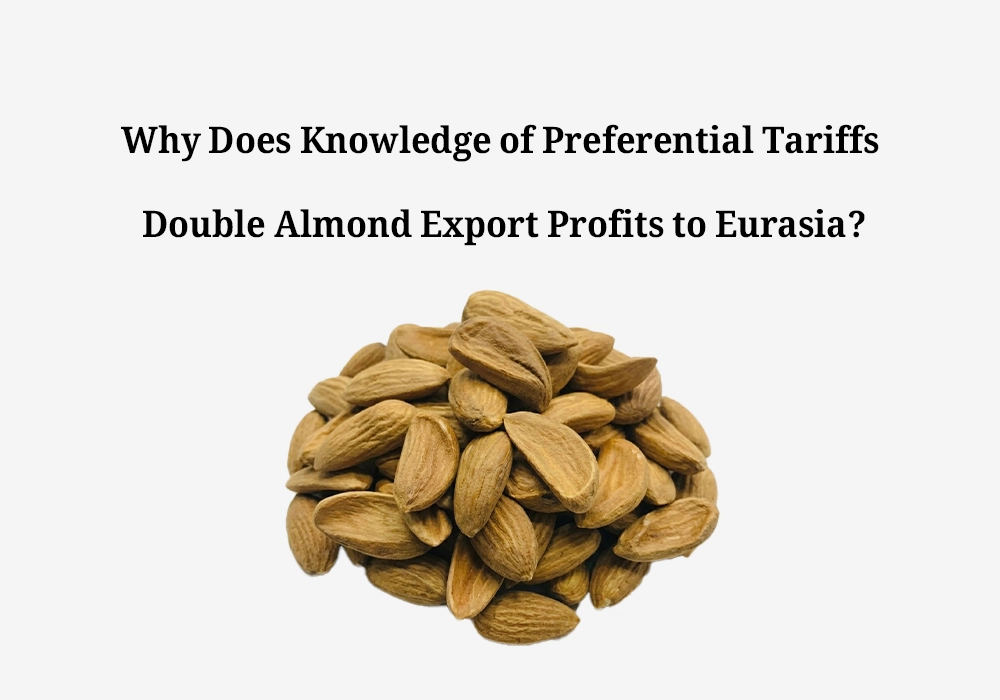
Why Does Knowledge of Preferential Tariffs Double Almond Export Profits to Eurasia?
The Eurasian Economic Union (EAEU) market—comprising Russia, Kazakhstan, Belarus, Armenia, and Kyrgyzstan—with a population of over 180 million, is one of the most lucrative yet highly competitive destinations for dried fruit exports. However, the difference between a highly successful trader generating massive returns and a mediocre exporter fighting for survival boils down to one golden key: mastery of Preferential Tariffs.
Many traders operate under the illusion that export profitability relies solely on buying cheap and selling high. In the reality of B2B commerce with Eurasia, customs and tax overheads dictate the final bottom line. Following the Free Trade Agreement between Iran and the EAEU, understanding these legal frameworks and leveraging customs discounts can exponentially increase your Net Profit Margin, quite literally doubling the profitability of your almond shipments.
What is a Preferential Tariff and How Does It Recoup Customs Fees?
A preferential tariff is a trade policy instrument where member states of a tax agreement drastically reduce or entirely eliminate import duties for goods produced within partner countries.
Under normal circumstances, importing almonds into the Russian Federation or Kazakhstan falls under the Most-Favored-Nation (MFN) standard tariff rate. Depending on the product type (in-shell or almond kernels), a specific percentage of the total cargo value (the customs valuation target) is deducted as an import duty. However, when you utilize the Iran-Eurasia agreement, this customs rate is applied with significant discounts—dropping to absolute zero for certain HS codes. This direct reduction in non-operational costs creates a pricing advantage that flows directly into your net profit.
Unlocking the Customs Discount: Certificate of Origin Form A
Benefiting from EAEU preferential tariffs is not automatic. Without rock-solid legal documentation, Russian or Belarusian customs will aggressively apply the highest tax and duty rates to your buyer. The master key to unlocking this discount is the Certificate of Origin Form A.
- Proof of Authenticity: This certificate formally verifies that the exported almonds are 100% sourced from local orchards and that the primary processing and packaging occurred within the origin country's borders.
- The Risk of Documentation Discrepancies: Even a microscopic error in Form A, or a mismatch between the form, the Commercial Invoice, and the Packing List, will cause destination customs to immediately revoke the preferential tariff. The buyer will be penalized and forced to pay full duties—a scenario that will permanently destroy your B2B relationship.
The Mathematical Formula: How Almond Export Profits Double
Let us analyze the financial impact of this strategy through a simplified hypothetical calculation. Assume a 20-ton container of premium Mamra or Stone almonds with a total commercial value of $100,000 is exported to Russia:
- Without Preferential Tariff (Standard Rate): Assuming the standard import duty for dried fruits sits between 5% to 10%, the Russian buyer must pay an additional $5,000 to $10,000 strictly for customs entry (excluding VAT). To offset this massive overhead, the buyer will aggressively negotiate your selling price downward to preserve their own margins.
- With Preferential Tariff (Form A): By applying the preferential rate, this duty is drastically reduced or eliminated. Erasing this $5,000 to $10,000 burden creates immense pricing flexibility. You can secure a higher FOB or CIF contract price because the buyer's destination clearance costs have plummeted. This financial saved capital directly elevates your Return on Investment (ROI).
Aligning Customs Preferences with Eurasian Conformity (EAC) Standards
Alongside customs benefits, the EAEU enforces draconian sanitary and phytosanitary regulations. A Certificate of Origin alone is insufficient; your cargo must achieve the Eurasian Conformity (EAC) technical standard mark. Rigorous laboratory tests analyzing pesticide residues, Aflatoxin levels, and microbial contamination are conducted at EAEU reference customs labs (such as in Astrakhan or Moscow). Any detected contamination instantly nullifies all tariff discounts and triggers cargo rejection.
Why Walmondhe is Your Ideal Supply Chain for the Eurasian Market
Successfully exporting to Eurasia requires a strategic partner who not only supplies the physical commodity but also possesses absolute command over international trade law and regional customs protocols. Walmondhe, applying a scientific approach to regional markets, provides the exact infrastructure needed to maximize your legal profitability:
- Flawless Customs Documentation: Precise preparation of the Certificate of Origin Form A and EAEU-compliant packing lists to absolutely guarantee the application of preferential tariffs.
- EAC and Sanitary Compliance: Almonds are processed and sorted utilizing state-of-the-art laser technology to eliminate pests and guarantee a 100% pass rate in destination sanitary lab tests.
- Cold-Climate Packaging Architecture: Deployment of specialized, temperature-resistant packaging designed to withstand extreme thermal fluctuations across maritime (Caspian Sea) and overland transit routes, preserving absolute product integrity.
If you are ready to maximize your profitability using EAEU legal instruments, we strongly recommend reviewing the specifications of our export-grade sorted almonds on the Walmondhe website and contacting our sales engineering department for specialized commercial consultation.
Frequently Asked Questions (FAQ)
Is a standard Chamber of Commerce Certificate of Origin sufficient for EAEU tariff discounts? No. To benefit from the Eurasian Economic Union's preferential tariffs, you must exclusively present a formalized "Certificate of Origin Form A," complete with specific authorized stamps and verifiable codes, to destination customs. Standard certificates do not trigger import duty reductions.
Does the EAEU preferential tariff apply to all types of almonds (in-shell and kernels)? Tariff reduction percentages are strictly dictated by the product's 8-digit HS Code. Typically, the discount margins differ significantly between almond kernels and in-shell varieties. Before booking logistics, you must cross-reference your exact HS codes with the latest ratified Iran-Eurasia tariff book.
Can the buyer in Russia apply for the preferential tariff independently? While the Russian buyer (the importer of record) submits the formal discount request to their local customs office, this request is entirely dependent on the documents you supply as the exporter. If your supplied Form A is defective, the buyer has zero leverage at destination customs.
What is the optimal logistics route to Russia to minimize customs risks? For the Russian market, the Caspian Sea maritime route (Northern ports to Astrakhan or Olya) and the overland route via Azerbaijan (Astara border) are the most efficient. The route selection must be coordinated with the specific packaging type and the location of phytosanitary control stations to prevent demurrage and cargo delays.