
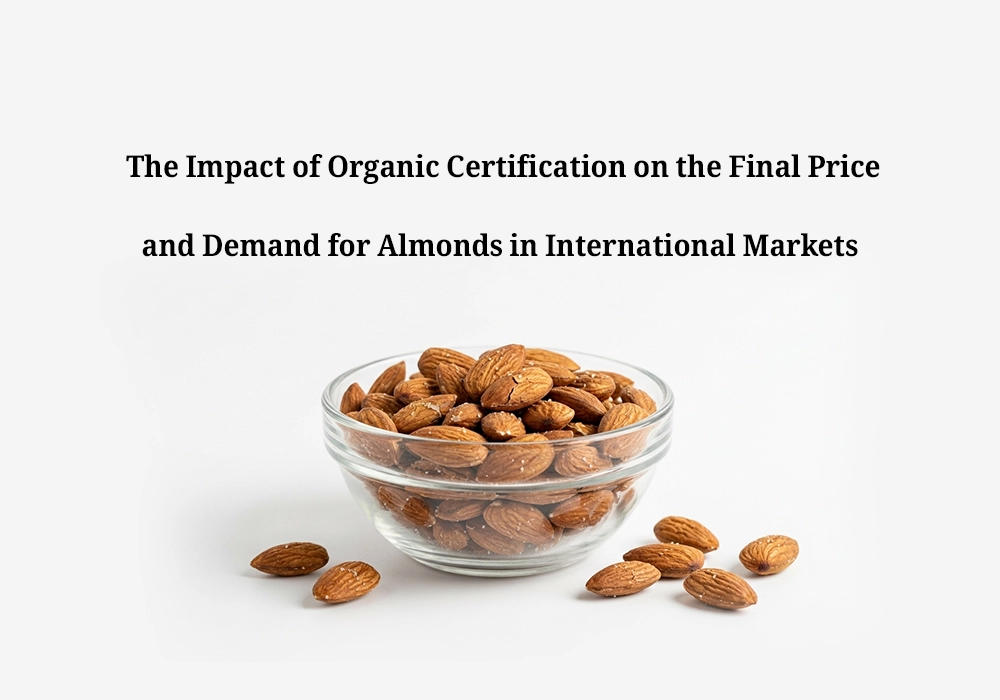
The Impact of Organic Certification on the Final Price and Demand for Almonds in International Markets
With changing lifestyles worldwide and increasing consumer awareness regarding health and the environment, the demand for organic agricultural products is growing at an impressive rate. Meanwhile, almonds, as one of the most popular dried fruits and a global superfood, have found a special place in the organic products market.
In this article, we closely examine the impact of organic certification on the final price of almonds, the level of demand in international markets, and the profit margins for exporters.
1. Paradigm Shift in Global Demand: Why Organic?
Consumers in developed markets (especially Europe, North America, and the luxury segments of the Indian and Arab markets) are actively seeking products grown without the use of synthetic pesticides, chemical fertilizers, and genetic modifications (GMOs).
This shift in consumption patterns has caused the demand for organic almonds to increase with a significant Compound Annual Growth Rate (CAGR) annually. In international markets, the "organic" label is no longer just a luxury feature; for a large segment of the target audience, it is considered a "health necessity."
2. Direct Impact on Final Price (Premium Pricing)
The most significant attraction of producing and exporting organic almonds for farmers and exporters is the ability to apply a "Premium Pricing" strategy.
- Price Value Addition: Typically, organic almonds are sold in global markets at a premium of 20%20% to 40%40% (and in some specific European markets up to 50%50%) more expensive than conventional almonds.
- Covering Production Costs: Although organic production is usually accompanied by a drop in tonnage per hectare and increased pest management costs, this high price difference (Premium) not only covers the additional costs but also sharply increases the exporter's net profit margin.
Read More: Comprehensive Comparison Between Different Almond Grade Sizes in Iran and Their Impact on Price
3. Strategic Target Markets for Organic Iranian Almonds
Due to its unique climatic conditions and traditional agricultural methods still prevalent in many orchards, Iranian almonds have a high potential for obtaining international organic certifications.
- The European Market (Germany, France, and the UK): These countries are pioneers in the consumption of organic products. In these markets, quality and having valid certifications (such as EU Organic) come first, and price is a secondary priority.
- The Indian Market (Premium Segment): Although India is traditionally a bulk importer of conventional almonds, the upper-middle and wealthy classes in major Indian cities are heavily leaning towards organic products. Exporting luxury varieties like Organic Mamra Almonds to this market can yield unparalleled profitability.
Related Product: Buy and Review Mamra Almonds
4. Challenges and Barriers in Exporting Organic Almonds
Despite high profitability, exporting organic almonds faces several technical and legal challenges:
- International Certifications: Obtaining valid organic certifications is a time-consuming (sometimes up to a 3-year transition period) and costly process. International inspectors must approve the soil, water, and the entire production process up to packaging.
- Pest Control: Without the use of chemical pesticides, controlling pests such as the almond seed wasp is very difficult and requires biological methods and Integrated Pest Management (IPM).
- Isolated Supply Chain (Segregation): During processing, sorting, and transportation, the organic product must under no circumstances be mixed with conventional products or stored in unauthorized warehouses.
Conclusion
Investing in the production and export of organic almonds is a transition from "volume-based" trade to "value-based" trade. Considering the inherent quality and superior taste of Iranian almonds, combining this quality with organic certifications can consolidate the Iranian dried fruit brand at the highest level of global niche markets and maximize the foreign exchange profit margins for exporters.