
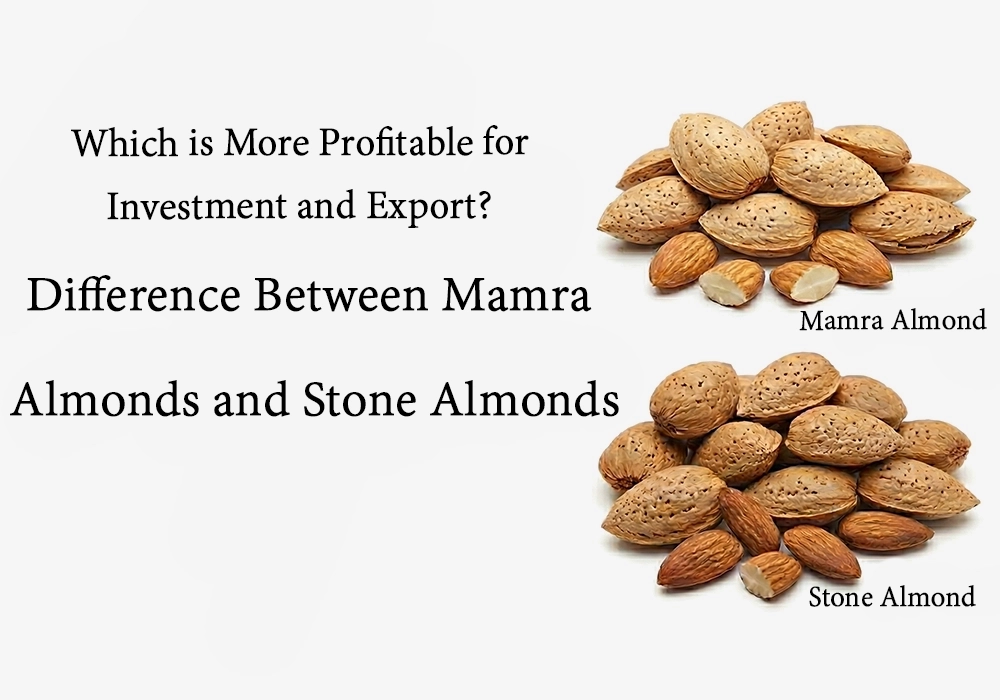
Is Investing in Mamra Almonds More Profitable than Stone Almonds? (Comprehensive Export & Market Analysis)
In the volatile world of the dried fruit trade, where a single miscalculation can lead to stagnant capital or heavy losses, choosing the right product for investment or export is the most critical step. Many novice traders and even seasoned investors often find themselves at a classic crossroads: Should I invest in "Mamra Almond", known as the "Yellow Gold" of Iranian nuts, or "Stone Almond", which offers a stable market with lower risk?
The answer to this question is never a simple "Yes" or "No". This decision depends on complex variables such as "initial capital," "risk tolerance," "access to target markets (e.g., India vs. Russia)," and even "climatic conditions of the cultivation area." In this analytical article by Walmondhe, we place these two popular varieties under our specialized microscope to tell you, through precise technical and economic dissection, which side of the scale weighs heavily in favor of profit.
Why Do Genetic and Physical Differences Impact Profitability?
Before discussing dollars and cents, we must understand exactly what we are selling. In the global market, a "product" is not just a name; it is a set of physicochemical characteristics that the final customer pays for. The fundamental difference between Mamra and Stone almonds starts here.
1. Mamra Almond: The Aristocrat with an Oily Kernel
Mamra is not an ordinary product; it is a High-Ticket Item. The main origin of this almond is the Chaharmahal and Bakhtiari province and the banks of the Zayandeh Rood river.
- Kernel Recovery Rate: One of the most critical factors for traders is the kernel-to-shell ratio. In Mamra Almond, this percentage is exceptionally high (between 36% to 45%). This means when you buy one ton of in-shell almonds, you effectively own 360 to 450 kg of pure, expensive kernels.
- Fat Content & Flavor: With up to 60% beneficial fat content, Mamra is arguably the tastiest and crunchiest almond in the world. This is precisely why niche markets like India are willing to pay a premium for it.
- Appearance: The Mamra kernel is elongated, light in color, and features deep, aesthetic striations. In our standardization, a "Twin Kernel" in this variety is considered a major defect because the Indian customer demands uniform, single kernels.
2. Stone Almond: The Resilient Soldier
On the other side stands the Stone Almond. As the name suggests, it has a very hard, woody shell that is impossible to crack by hand. But is this a weakness? No.
- Natural Storage: The hard shell of Stone almonds (like the famous Shahroudi 12 variety) acts like a natural safe deposit box. This almond can remain in warehouses for years without the kernel suffering from oxidation, staleness, or pest attacks.
- Lower Kernel Percentage: The kernel yield in Stone almonds is usually between 28% to 32%. This means a significant portion of your cargo volume is "wood." However, its lower price point compensates for this issue, making it highly attractive for processing industries.
Expert Note: If you are looking for an option that sits between these two (a shell thinner than Stone but a price more affordable than Mamra), varieties like Paper Shell/Moheb Almonds or Shahroudi 7 can be attractive options for your investment portfolio. To better understand this categorization, we recommend reading the article Paper Shell (Moheb) or Stone Almonds?.
How Does the Grading System Affect the Final Price?
A common mistake among beginners is failing to understand the distinct pricing systems of these two products. You cannot value Stone and Mamra almonds using the same formula. For a precise understanding of size standards, we suggest studying the article Comprehensive Comparison of Almond Grades.
The Anatomy of Mamra Pricing
In the trade of Mamra Almond, the first and last rule is "Size." The unit of measurement is "Count per 100g":
- Grade 80-90 (Super Royal): The largest size, the most expensive price. Customers for this size are Arab Sheikhs and Indian billionaires.
- Grade 90-100 & 100-110: Standard export sizes with high demand volume.
- Mini Grade: Smaller sizes that are cheaper but still more expensive than American almonds. A trader must know that a difference of 10 counts in size can shift the profit margin by up to 20%.
The Logic of Stone Almond Pricing
In Stone Almond (Shahroudi 12), size is a secondary priority. The main priorities are:
- Bitterness Percentage: Even the presence of 2% bitter almonds in a sweet cargo drastically breaks the price.
- Kernel Color: Lighter kernels are more suitable for slicing and command a higher price.
- Physical Integrity: Absence of breakage and chipping during shelling. To ensure the quality of your cargo, be sure to review the article Comprehensive Guide to Almond Quality Control for Bulk Buyers.
Which Export Market is More Lucrative: India or Neighbors?
The export strategy for these two products is entirely different. You cannot sell Stone almonds with a Mamra strategy and vice versa. Let's analyze the Target Markets. For a macro view of financial flows, we suggest reviewing the Comprehensive Analysis of the Global Almond Market.
The Exclusive Indian Market: The Kingdom of Mamra
Let's be blunt: Over 90% of Mamra Almonds produced in Iran find their way to India. Why India?
- Purchasing Power & Culture: In India, Mamra is not just a nut; it is a medicine and a status symbol. The wealthy and upper-middle class in India consume Mamra to boost children's intelligence and daily energy.
- Astronomical Pricing: The Indian customer is the only one in the world willing to pay 5 to 6 times the price of California almonds to secure Mamra.
- Genetic Monopoly: Unlike California almonds found everywhere, the taste and oil content of Iranian Mamra cannot be replicated. The article A Comprehensive Comparison of Persian vs. American California Almonds details this competitive advantage.
The CIS & Middle East Market: The Kingdom of Stone Almonds
Stone and semi-stone almonds (like Shahroudi 7 and Shahroudi 12) have different markets:
- Food Industry: Chocolate factories, confectioneries, and cake powder manufacturers in Russia, Turkey, and Arab countries are major buyers of Stone almond kernels. For them, "Flavor" and "Final Cost" matter more than luxury appearance.
- Budget Nut Market: In many countries, the end consumer looks for nuts with a reasonable price tag. Salted or raw Stone almonds are king in this market segment.
- Volume Trading: In Stone almond exports, the profit margin per kilogram is lower than Mamra, but you can move massive tonnages (multiple containers) in a single contract. Whereas Mamra is usually traded in smaller lots.
Is Investing in Mamra Suitable for Every Agricultural Region? (Risk Analysis)
If you are a farmer or plan to invest in "Production," the story changes completely. Here, the discussion is not just about sales; it is about "Climate" and "Survival."
Is Mamra Almond Suitable for Any Climate?
The answer is definitely NO. The Mamra almond tree is very early-blooming. This means it blossoms in late winter or early spring. If your land is in a mountainous region prone to "Spring Frost," establishing a Mamra orchard is akin to burning capital. A single night of frost can destroy the entire year's harvest.
- Profitability: If the region is climatically safe, the revenue from one hectare of Mamra orchard can equal 5 to 10 hectares of ordinary almonds.
Why Are Shahroudi (Stone) Varieties the Investment Safety Valve?
Modified varieties like Shahroudi 12 and Shahroudi 7 were developed specifically to solve the frost problem.
- Late Blooming: These trees blossom much later than Mamra, escaping the deadly spring frosts.
- Drought Resistance: The roots of Stone varieties are stronger and perform better under water stress conditions.
- Result: If you are risk-averse or your land is in a cold region, choosing Stone Almond is the most rational economic decision. Lower profit, but guaranteed.
What Are the Hidden Technical Challenges: From Shelling Waste to Packaging Sensitivity?
Another key difference that impacts Net Profit is the hidden cost of processing.
Hidden Cost in Stone Almonds: Shelling Waste
You might think Stone almonds are cheap, but converting them to kernels is costly.
- Shelling Technology: The very hard shell leads to a high percentage of "Halved Kernels" and "Chipping" in older machines.
- Weight Loss: When you buy 1 ton of Stone almonds, about 700 kg of it is shell with negligible commercial value. The cost of transporting this shell to the processing factory must be factored into your calculations.
Sensitivities of Mamra Almonds: A War with Time
In Mamra Almond, your biggest enemy is "Oxidation."
- High Fat Content: Mamra contains 55% to 60% fat. This fat reacts quickly with air, changing the almond's flavor (rancidity).
- Expensive Packaging: Exporting Mamra without Vacuum packaging with Nitrogen injection is a huge risk. Any change in flavor at the Indian destination leads to claims and heavy penalties. To avoid this, ensure you follow the Expert Guide to Best Export Packaging Standards.
Final Comparison Table: A Quick Glance for Decision Making
To summarize all points, the table below is a quick guide to comparing the investment potential of these varieties:
| Comparison Criteria | Mamra Almond | Stone Almond (Shahroudi 12) | Paper Shell/Moheb |
|---|---|---|---|
| Main Target Market | India (Luxury) | Domestic, Russia, Iraq (General) | Domestic & Export (Mid-range) |
| Selling Price | Very High (High Ticket) | Medium / Economic | Medium to High |
| Agricultural Risk | High (Frost Risk) | Very Low (Late bloomer) | Medium |
| Liquidity | Specialized (Niche Buyer) | Very High (Daily Commodity) | High |
| Processing Cost | High (Precise Sorting + Vacuum) | Low (Bulk or Sacks) | Medium |
Strategic Conclusion: Which One Should You Choose?
As a final wrap-up, the strategy proposed by the Walmondhe team based on your persona is as follows:
- If you are a "Trader" with significant capital: Enter the game of Mamra Almond. The export profit margin to India is unmatched by any other nut. However, you need a team that performs sorting and packaging with strict standards and guarantees cargo freshness (See How to Determine the Freshness of Almond Kernels).
- If you are an "Agricultural Investor" in a cold region: Do not risk it. Plant late-blooming varieties like Shahroudi 12 or Shahroudi 7. Production stability is your key to long-term success.
- If you seek "Portfolio Diversity": A combination of Paper Shell/Moheb (for the domestic luxury nut market) and Stone almonds (to secure high volumes) creates the best balance between risk and reward.
Ultimately, do not forget that in the global market, "Quality" has the final word. Whether you sell Mamra or Stone, if your cargo is not uniform, fresh, and healthy, you will lose. At Walmondhe, by eliminating middlemen and enforcing strict quality control, we have created a secure path for your trade.
Are you still hesitating on which almond variety to invest in? Contact our experts right now, and we will suggest the most profitable option based on your budget and target market.