
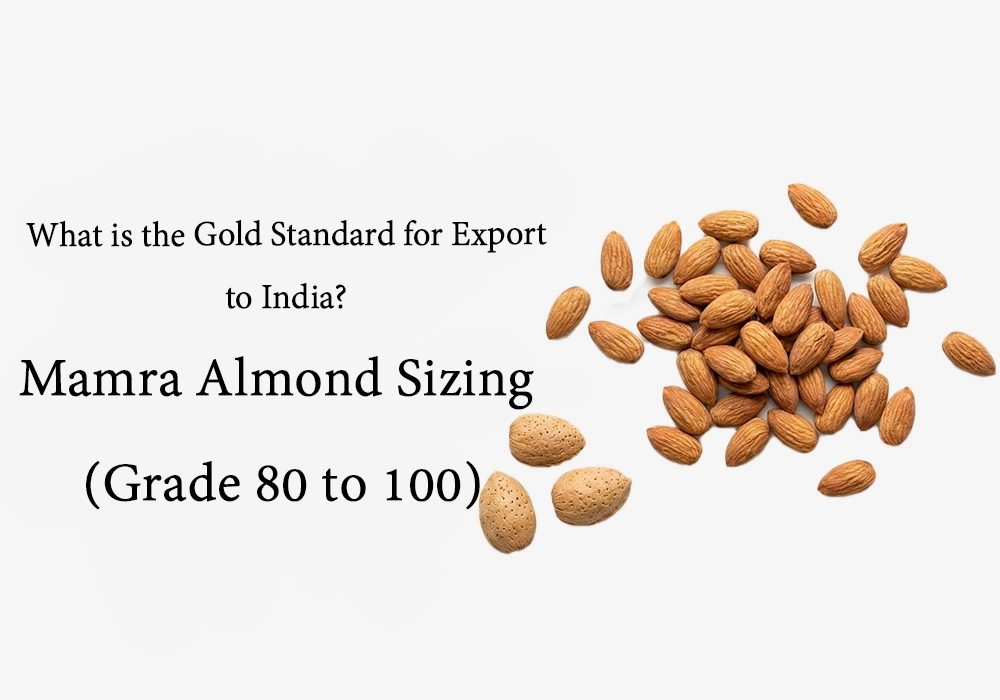
Mamra Almond Grading Standards (Size 80-100): What is the Golden Standard for Export to India?
In the global dried fruit market, few products rival the pricing complexity of Mamra Almond. If you are a novice trader asking for the price of "Mamra Almond," it is akin to walking into a diamond exhibition and asking for the price of a "stone." The seller’s response will likely be a scrutinizing look and a counter-question: "Which size? Which grade? What is the appearance quality?"
For Indian importers, who are the undisputed largest buyers of this "Yellow Gold," the difference between Size 80 (Super Royal) and Size 100 (Mini) is the difference between a luxury showcase item and a standard consumer commodity. In this specialized article by Walmondhe, we reveal the secrets of "Counting" and teach you how to price a cargo exactly like a veteran Indian merchant.
What is the Concept of "Counting" and Why is it Vital in Mamra Trade?
In the international pistachio trade, the "Ounce" is the standard metric. But in the world of Mamra Almond, our unit of measurement is "Count per 100g." This system might seem simple, but it is the foundation upon which billions in turnover revolve in markets like Najafabad, Saman, and Mumbai.
The Calculation Formula (The Walmondhe Method)
To accurately determine your cargo's grade, you cannot rely on visual estimation. At Walmondhe, we strictly adhere to the following protocol:
- Random Sampling: We take samples from 5 different points of the sack (top, middle, bottom, and corners).
- Weighing: We isolate exactly 100 grams (using a precision digital scale).
- Counting: We count the kernels.
- If the count is 85 kernels, your cargo is in the 80-90 range (Super Luxury).
- If the count is 105 kernels, your cargo is in the 100-110 range (Standard).
- If the count is 130 kernels, your cargo is considered Mini.
The Golden Rule: The "smaller" the number, the "larger" and "more expensive" the almond. A decrease of 10 units in the count (e.g., from 100 down to 90) can increase the cargo's value by up to 20%.
What Do the Export Grades Mean: Which Size Suits Which Customer?
India is a country with highly stratified social classes. Every size of Mamra almond has its specific customer in Mumbai or Delhi. Let's dissect these grades. To better understand how these varieties differ from others, we suggest first reading the Types of Almonds Guide.
1. Grade 5A or Super Royal (Size 80-90)
This is the "Rolls Royce" of almonds.
- Count: Between 80 to 90 kernels per 100g.
- Appearance: Very large, elongated, light-colored, and uniform.
- Customer: Arab Sheikhs, Indian billionaires, and high-end boutiques in upscale neighborhoods.
- Usage: Luxury Gifting at lavish Indian weddings.
- Rarity: Less than 5% of a total orchard harvest reaches this size.
2. Grade 4A and 3A (Size 90-100 & 100-110)
These are the "Best Seller" export sizes.
- Count: Between 90 to 110 kernels.
- Balance: An excellent balance between visual grandeur and price.
- Customer: The wealthy and upper-middle class in India.
- Competition: The highest volume of trade transactions occurs in this range. If you plan to invest, this size offers higher Liquidity compared to size 80.
3. Grade Mini (Size 120+)
Is small size valueless? Absolutely not.
- Count: Over 120 kernels per 100g.
- Advantage: The Oil Content in smaller sizes is often equal to larger sizes (around 55-60%). For a scientific study on fats, review A Comprehensive Comparison of Persian vs. American Almonds.
- Customer: Ayurvedic pharmacies, oil extraction industries, and the Indian middle class who prioritize medicinal properties over appearance.
What is "Appearance Quality" and Why is it More Important than Size?
Size is a necessary condition, but not a sufficient one. Your cargo might be Size 90 (very large), but if it lacks "Visual Quality," the Indian buyer won't purchase it even at the price of Size 110. At Walmondhe, visual standards include the following parameters which must be considered during Almond Quality Control:
1. Kernel Color
Mamra almonds must be "Golden" or "Light Brown." Dark or dull almonds indicate staleness or improper irrigation and drastically break the price.
2. Twin Kernel Percentage
Unlike Stone Almonds where twins are common, in luxury Mamra, a twin kernel is considered a "Defect."
- Indian Standard: Super grade cargoes must have less than 3% twins. Twins are oval and chubby, ruining the uniformity of the elongated cargo.
3. Shriveling
The kernel must be "Plump" and full. Shriveled almonds (usually due to severe water stress late in the season) reduce the volumetric weight and weaken the cargo's appearance.
Does Mamra Grading Apply to Other Varieties (Stone & Moheb)?
Many clients ask if this grading system is also applicable to Stone Almonds or Paper Shell/Moheb Almonds.
The answer is NO.
- Stone Almond (Shahroudi 12): Is not usually sold based on precise counting. The main criteria for Stone almonds are "Kernel Recovery Rate" and "Absence of Bitterness." Size is secondary. (Read more: Paper Shell Moheb or Stone Almonds?).
- Paper Shell (Moheb): Here too, "Color" and "Ease of Shelling" are more important than exact kernel counting.
- Conclusion: The "Counting per 100g" system is the exclusive language of the Mamra trade.
Why Do Sorting Challenges Cause Trade Disputes?
In bulk (mixed) cargoes, sizes are jumbled (e.g., ranging from 80 to 140). The main art (and cost) for the exporter is "Unifying" the cargo.
- Mixed Cargo: Cheaper, but the end customer in India demands uniformity.
- Sorted Cargo: At Walmondhe, we use Color Sorters and precision Sieves to separate the cargo.
- The Challenge: If you state "Size 90-100" in the contract but the Indian buyer finds 10% of Size 110 in the shipment, they can file a "Claim" (Compensation request). This highlights the importance of Export Packaging Standards and pre-loading quality checks.
Is Fraud in Grading Possible? (Warning to Buyers)
Unfortunately, yes. Some unreliable sellers use tricks to manipulate the grade:
- Blending: Injecting 10-20% of smaller almonds (or even other varieties like Rabie) into a large-size cargo.
- Moisturizing: Adding artificial moisture to increase the weight of the 100g sample (which reduces the apparent count). This is dangerous and causes mold. To detect this fraud, be sure to read the Guide to Determining Almond Freshness.
Conclusion: How to Choose the Best Size for Your Trade?
Choosing the right size depends entirely on your sales strategy:
- Boutique Strategy: If you have niche, luxury clients, go exclusively for Mamra Almond Size 80-90. The profit per kilo is high, though sales volume is lower.
- Volume Strategy: If you deal with market Wholesalers, Size 100-110 is the best option. Excellent liquidity and competitive pricing.
- Industrial Strategy: If your target is pharmaceutical industries or almond powder, choose Mini size or Stone Almonds which offer greater economic viability.
At Walmondhe, as a specialized reference for almond exports, we guarantee that the "Declared Grade" matches the "Delivered Grade" with absolute precision. In trade with India, credibility means accuracy in counting.
Do you need today's prices for different Mamra sizes? For an updated price list (based on daily Rupee and Dollar rates) and export consultation, contact our commercial team right now.