
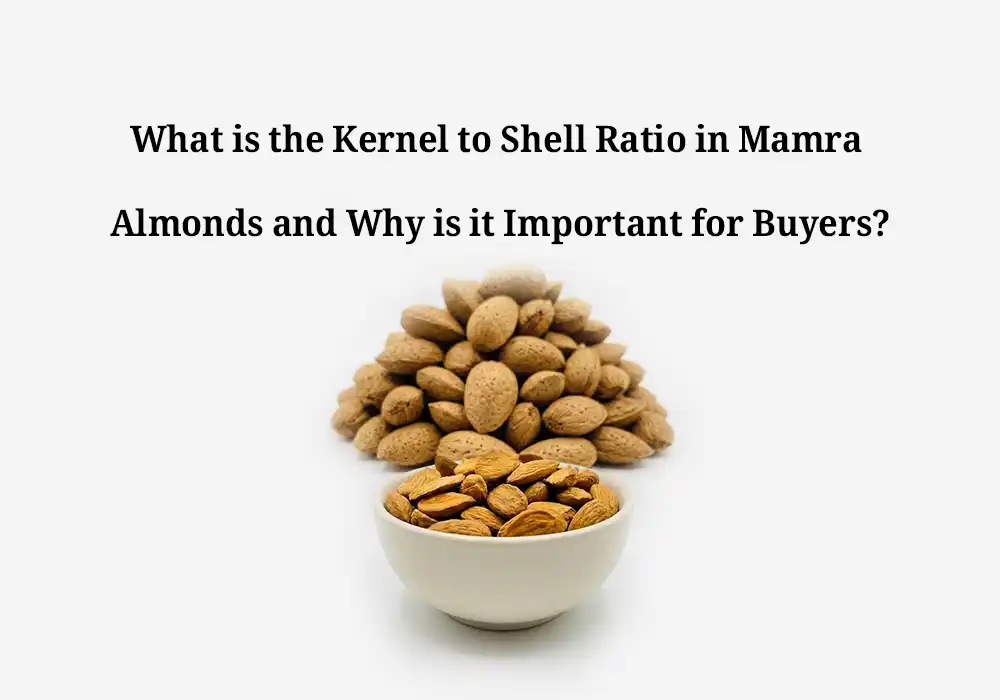
What is the Kernel to Shell Ratio in Mamra Almonds and Why is it Important for Buyers? (A Complete & Very Simple Guide)
When you go to the market to buy nuts for your family's daily use, or if you are a businessman planning on exporting almonds to India, you always face a big dilemma: "Should I buy the almonds with their wooden shells on, or should I buy them already shelled (pure kernels)?"
Many buyers, when they see the price of in-shell Mamra Almonds, are tempted to buy them because they look much cheaper than pure kernels. But when they take the bags home or to their factory and crack the shells, they are shocked by how little kernel comes out. They ask: "Why did so many in-shell almonds give me so little edible kernel? What exactly is the kernel-to-shell ratio in Mamra almonds, and why is this shell so heavy?"
In this detailed and comprehensive article, we want to talk in a very simple, friendly way—like an interesting story. Let's take out our calculators and see what secrets are hidden under the hard wooden shell of the Mamra almond, and why big traders care so deeply about a 1% difference in this ratio.
1. A Simple Calculation: What Does "Kernel to Shell Ratio" Mean?
Let's skip hard technical words like "Yield Index" and speak very simply. The kernel-to-shell ratio means: If you buy 100 kilograms of in-shell almonds and crack all of them, how many kilograms of pure, edible kernels will you get in the end?
- In Paper-Shell (Moheb) Almonds: This almond has a very thin shell that can be cracked by hand. If you crack 100 kg of paper-shell almonds, you get about 50 to 55 kilograms of pure kernels. The rest of the weight is waste shell.
- In Saman Mamra Almonds: The story here is completely different! The shell of the Mamra almond is very hard, thick, and bone-like. When you crack 100 kg of in-shell Mamra almonds using machines, you get somewhere between 30 to 35 kilograms of pure kernels. This means for every 3 kilos of in-shell almonds, you get roughly 1 kilo of pure kernel.
To understand the exact laboratory standards of these percentages, we highly recommend reading Standard Kernel Yield & Oil Content of Mamra Almonds.
2. Why is the Mamra Almond Shell So Heavy and Bone-Like?
You might wonder: "Well, why didn't nature make Mamra almonds with thin shells like the Iranian Moheb Almonds so they would weigh less?"
The answer lies in protecting a highly valuable treasure! Unlike any other almond in the world, the kernel of the Saman Mamra almond holds over 50% natural oil and healthy fats inside. This extremely valuable oil is very sensitive. If air, moisture, hot sun, or bugs reach it, it will spoil and turn bitter very quickly. Therefore, to protect this oily, sweet treasure, nature built a thick, wooden, bone-like, and very heavy shell around it. It acts like a strong military castle! This heavy shell increases the total weight of the in-shell almond, which brings the kernel yield down to 30-35%.
3. Why is This Percentage Crucial for Buyers and Traders? (The Secret of Profit & Loss)
For a family buying one kilo of almonds, this percentage might not be a big deal. But for a pastry factory or an export trader, this ratio is a matter of financial life and death!
- Direct Impact on Final Cost: Imagine a trader buys 10 tons of in-shell Mamra almonds. If the kernel yield of the cargo is 30% instead of 33%, the trader gets 300 kilograms less kernel! That is a huge silent financial loss. To see how exporters calculate this risk, reading How the Kernel Yield Index Shifts the Break-Even Point in Mamra Exports is an amazing guide.
- Smart Choice for Consumers: If you want pure kernels to eat or cook with, buying in-shell Mamra almonds is not a smart choice because you are paying a lot of money for heavy shells that you will throw away. For an economic comparison of buying methods, see Paper-Shell Moheb vs. Stone Almonds: Economic Value Analysis.
4. The Magic of "Twin Kernels" in Mamra!
Another reason the kernel ratio in Mamra is so fascinating is the presence of Twin Kernels. Saman Mamra almonds have a wonderful feature: in more than 70% of cases, when you crack that heavy shell, instead of one kernel, two joined kernels come out!
This feature means that despite the heavy shell, the volume of kernel you get is incredibly high-quality and valuable. In the Indian market, the more twin kernels a cargo has, the higher its price. Be sure to read Impact of Twin Kernels on Export Almond Pricing to understand this better.
Quick Guide Table: Kernel Yield Comparison
| Almond Type (Iranian) | Approximate Kernel to Shell Ratio | Shell Feature | Best Way for You to Buy |
|---|---|---|---|
| Saman Mamra Almond | About 30% to 35% | Very heavy, hard, wood-like (needs machine) | Buy as Pure Shelled Kernels |
| Paper-Shell (Moheb) | About 50% to 55% | Very light, easy to crack by hand | Buy In-Shell (for table snacking) |
| Standard Stone Almond | About 25% to 30% | Hard and bone-like | Buy as Shelled Kernels |
To compare the prices of these models, the article Price Difference Between Mamra, Stone, and Paper Almonds will help you a lot.
Why Walmondhe Delivers Kernels with the Most Exact Ratios
The Walmondhe expert group, as a direct producer in the Saman region, has solved the worry of shell-weight scams forever:
- Selling Pure Laser-Sorted Kernels: Instead of selling you wooden shells, we crack the almonds in our factory, remove the shells using laser machines, and deliver 100% pure, golden, clean kernels to you. You get exactly the amount of edible kernel you pay for!
- Guaranteed Quality & Origin: We guarantee that no cheap or stone almonds are mixed with your Mamra cargo. To see the quality of our work, read Why Walmondhe is the Best Choice for Wholesale Almonds & Exports.
To get today's direct factory price for pure kernels, free export advice, and order premium Mamra Almonds and Iranian Moheb Almonds, easily contact us right now:
- Direct WhatsApp Message: 09136667618
- Direct Phone Call: 09136667618