
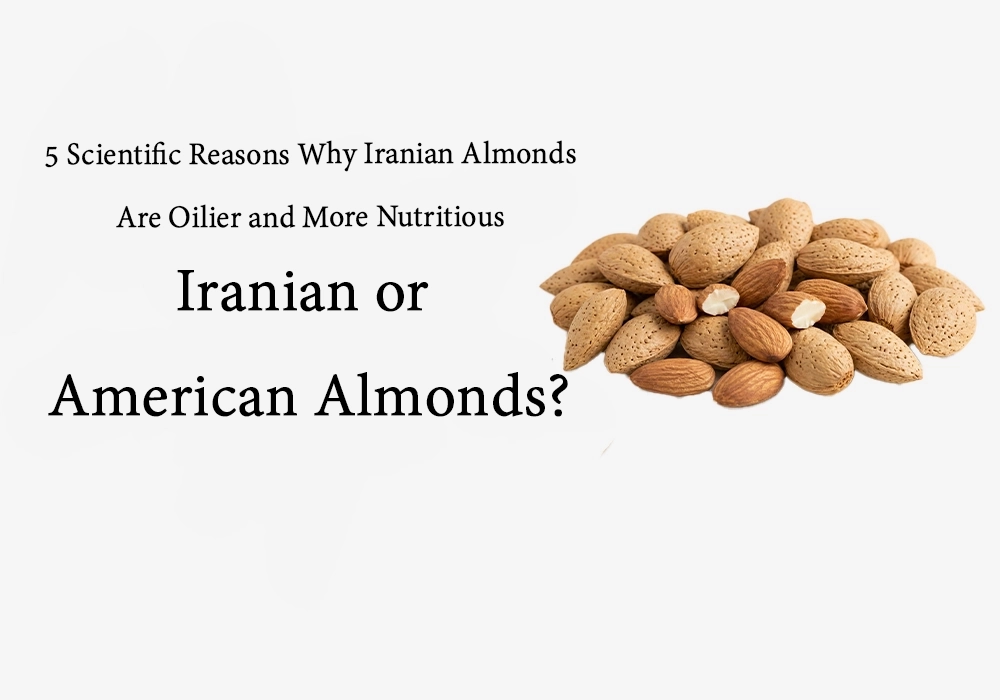
Iranian vs. American Almonds: 5 Scientific Reasons Why Iranian Almonds Have Higher Oil Content
In the global dried fruit market, a silent but eternal battle is raging. In one corner stands the California Almond, with its uniform appearance, flashy packaging, and multi-billion dollar marketing budget. In the other corner stands the Iranian Almond, which may be less flashy in presentation, but when it comes to "Laboratory Analysis" and "Blind Taste Tests," it remains unrivaled.
Many international traders and even expert consumers always ask: "Why does the Iranian almond have a much richer, creamier flavor compared to its foreign counterparts?" or "Why is extracting oil from American almonds economically unfeasible?"
The answer to these questions lies not in "national bias," but in Biochemistry and Agricultural Science. In this specialized article by Walmondhe, we examine 5 purely scientific reasons why varieties like Mamra Almond are leagues ahead of their commercial competitors in terms of Oil Content and nutrient density.
1. Does Tree Genetics Really Affect Kernel Oil Quantity? (The War of Quality vs. Quantity)
The first and most fundamental difference lies in the DNA of the trees. The agricultural strategy in the US and Iran differs from the ground up, and this strategic divergence completely alters the product output.
The American Strategy: Engineering for "Appearance" and "Tonnage"
The US almond industry (primarily based on commercial varieties like Nonpareil and Carmel) has focused on selective breeding over the past 50 years to achieve two goals:
- Paper Shell: For ease of consumption and mechanized cracking.
- Explosive Yield per Hectare: Producing the maximum quantity of fruit. However, in plant physiology, there is an unwritten law called the "Dilution Effect." When a tree is forced to divide its energy among thousands of fruits, its focus shifts from producing complex, dense oils to producing "Cellulose" (wood) and "Carbohydrates" (simple sugars). For this reason, the oil content of California almonds usually stalls between 35% to 45%. For a more precise comparison of these figures, we suggest reading the Comprehensive Comparison of Persian vs. American Almonds.
The Iranian Strategy: Preserving Ancient and Oily Genotypes
In contrast, native Iranian varieties like Mamra Almond or Shahroudi 12 possess wilder, more pristine genetics. These trees are naturally programmed to ensure the survival of their offspring. What is the best way for a seed to survive in nature? Storing concentrated energy (Oil).
- Lab Result: Our analyses at Walmondhe show that the Mamra almond kernel contains 55% to 60% beneficial oil. This means when you buy one kilogram of Iranian almonds, you are effectively receiving 20% more energy and active compounds compared to American samples.
2. How Does "Water Stress" Make Almonds Tastier?
It might seem strange, but the "suffering" of the tree makes the fruit tastier! This phenomenon is known in botany as "Stress Response."
Flood Irrigation in California: The Watery Phenomenon
California orchards are located in the Central Valley and are fully mechanized with heavy irrigation. When a plant has abundant water access, the almond kernel cells enlarge (Hypertrophy) but fill primarily with "Water." This gives the American almond a large appearance, but its taste is "Watery" and diluted.
Dry and Semi-Dry Farming in Iran: The Defense Mechanism
A large portion of Iranian almonds, especially Stone Almond varieties, grow in mountainous, water-scarce regions. When facing water shortage (Controlled Drought Stress), the plant activates its defense mechanism. To prevent water evaporation and preserve seed life, the tree begins to produce "Secondary Metabolites" and concentrate "Unsaturated Oils." These oils are denser and have a much stronger flavor.
- Sensory Result: Iranian almonds have a Crunchy and dense texture, and when chewed, a rich, buttery flavor fills the entire mouth. If you are looking for an almond that balances a thin shell with authentic Iranian flavor, the Paper Shell/Moheb Almond is an exceptional choice.
3. Fatty Acid Profile: Why is Iranian Oil Healthier?
It’s not just the "Quantity" of oil that matters; the "Quality" and "Type" of fatty acids (Fatty Acid Profile) are crucial. This section is vital for industries looking for Sweet Almond Oil Benefits.
Oleic Acid: The Secret to Stability and Health
Gas Chromatography (GC-MS) research has shown that Iranian mountain almonds contain a higher percentage of Monounsaturated Fatty Acids (MUFA). This type of fat:
- Thermal Stability: Has very high resistance to heat and oxidation (spoils very slowly).
- Skin Absorption: In cosmetic industries, it has higher penetration power into skin layers.
- Heart Health: It is exactly the same beneficial fat found in olive oil.
In contrast, some Western commercial varieties contain a higher percentage of Polyunsaturated Fatty Acids (PUFA), which, while beneficial, oxidize quickly upon exposure to air, acquiring a "Rancid" taste. For a deeper analysis, do not miss the specialized article Battle of Fats: Expert Analysis of Almond Fat.
4. The Role of the Hard Shell: Is the Stone Shell Smart Packaging?
We always view the hard shell of almonds like Shahroudi 7 as a nuisance to crack. But scientifically, this shell is the world's best, most advanced packaging designed by nature.
Natural Vault vs. Oxidation
American almonds have paper shells, and in many cases, the seal is open (Non-sealed). This allows Oxygen and UV Light (the two main enemies of oil) to easily reach the kernel and begin destroying Vitamin E. The result? American almonds must be consumed quickly or stored under special cold storage conditions.
However, the woody, hermetic shell of Iranian Stone almonds keeps the kernel in a completely dark, dry, and isolated environment. This means the almond kernel can retain its chemical properties, aroma, and taste for months or even years without any preservatives.
Practical Storage Tip: If you plan to buy in bulk and warehouse, Stone Almond is the lowest-risk investment because its quality degradation is near zero.
5. Mandatory Pasteurization: The Silent Flavor Killer?
This might be the most significant reason for the flavor difference that few are aware of. A federal law in the United States makes a huge difference in the final product.
USDA Mandate for California Almonds
Following several Salmonella outbreaks in the 2000s, the USDA passed a law requiring all raw almonds sold in the North American market (and a large portion of exports) to be "Pasteurized." Common methods include:
- Steam Processing: High temperatures that alter the moisture and texture of the almond and loosen the brown skin.
- Propylene Oxide (PPO) Gas: A volatile chemical used for sterilization.
These processes, while making the almond safe, cause the "Deactivation" of some natural enzymes and slight alterations in the structure of proteins and volatile oils. For this reason, American almonds sometimes taste "Cooked," "Stale," or "Neutral."
Natural Freshness in Iranian Almonds
In Iran, thanks to traditional harvesting and Sun-drying methods, and the absence of mandatory chemical pasteurization laws, the almond reaches the customer Completely Raw and "Alive." The taste of raw Iranian almonds is the true taste of nature, unaltered by thermal or chemical processes. To ensure the cargo you buy is fresh and stored correctly, be sure to study the Guide to Determining Almond Kernel Freshness.
Industrial Applications: Why Should Food Factories Buy Iranian Almonds?
The scientific differences above are not just on paper; they directly impact the factory production line.
1. Almond Milk Production
To produce a thick, creamy almond milk, you need an emulsion of oil and protein. American almonds, due to lower oil content, produce a thinner (watery) milk that requires the addition of Thickeners. However, Iranian almonds yield a thick, natural milk. See the precise recipe in How to Make Homemade Almond Milk.
2. Almond Butter Production
In almond butter production, the goal is to achieve a flowable texture. When using Iranian almonds, due to their 55% oil content, the butter flows easily without the need to add external vegetable oils. With American almonds, the final product tends to be dry and stiff. For a better comparison, check out Homemade Diet Almond Butter.
Conclusion: Which One to Choose for Trade or Consumption?
Science doesn't lie. If your criteria are "Visual Beauty," "Size Uniformity," and "Ease of Consumption," the California almond is engineered to meet these needs. But if your criteria are:
- Higher Oil Percentage (Economic viability in extraction)
- Strong Flavor and Crunchy Texture (Consumer delight)
- Long-term Natural Storage and Freedom from Chemical Processing
- Denser Nutritional Value Then the Iranian almond is the absolute winner.
At Walmondhe, understanding these scientific facts, we have focused our efforts on exporting the best Iranian varieties.
- For the Ultra-Luxury Market: Mamra Almond (The oil and energy bomb).
- For Daily Consumption & Nuts: Paper Shell/Moheb (Balance of flavor and convenience).
- For Industry & Warehousing: Stone Almond (Resilient and economic).
Are you ready to experience the taste of an almond with 60% fat? For lab analysis and product samples, contact our expert team today.