
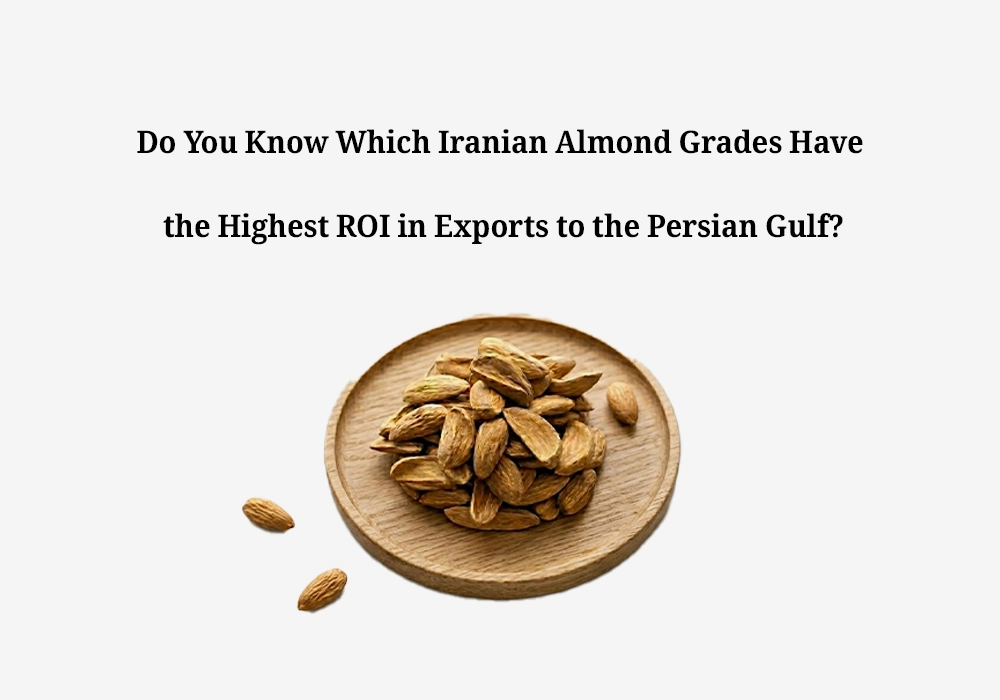
Do You Know Which Iranian Almond Grades Have the Highest ROI in Exports to the Persian Gulf?
In the B2B dried fruit trade atmosphere, the Middle East—specifically the Persian Gulf countries like the UAE, Qatar, and Oman—operates as an entirely different ecosystem compared to volume-driven markets like India. While merchants in Mumbai or Delhi seek a balance between price and quality for high-tonnage distribution, buyers in Dubai and Doha are intensely margin-driven and hungry for ultra-luxury products.
The biggest strategic mistake rookie exporters make is shipping commercial grades or uncalibrated, mixed sizes of Iranian almonds to these markets. This move directly plunges you into a red ocean where you must compete for mere cents against cheap Californian or Australian almonds; a rivalry that ultimately obliterates your Net Profit Margin and Return on Investment (ROI). This reference article, dissecting consumer behavior and pricing architecture in the Persian Gulf, reveals the precise Iranian almond grades that guarantee the highest ROI.
The Anatomy of the Persian Gulf Market: Demand for Absolute Perfection
To understand why certain grades offer exponential profitability, you must first map the DNA of B2B buyers in the UAE and Qatar. In these markets, almonds are not merely a staple food or confectionery raw material; they are distributed across the following segments:
- Luxury Nut Boutiques and Roasters: Where products are presented as high-end corporate gifts or VIP assortments, often in crystal jars and gold-embossed packaging.
- Five-Star Hotels and Ceremonial Catering: Sectors demanding 100% uniformity in size, shape, and flavor.
- Health-Conscious Investors: Demanding the highest levels of beneficial natural fats and organic (non-GMO) integrity.
In such an environment, the slightest visual defect, chipped edge, or size inconsistency results in immediate cargo rejection by premium buyers. The shipment is then downgraded to secondary wholesale markets (like Dubai's Al Aweer), where profit margins are severely compressed. Studying the comprehensive analysis of India vs. Persian Gulf export markets illustrates exactly why your product strategy for Dubai must be a 180-degree pivot from your strategy for India.
The Kings of ROI in the Gulf: Ultra-Premium Mamra Almond Grades
The Mamra Almond, boasting a staggering natural fat content (over 50%), an unparalleled sweet flavor, and a crisp texture, is inherently classified as a luxury commodity. American competitors simply cannot compete on these metrics. However, to extract the maximum ROI, not just any size of Mamra is suitable for the Gulf.
In Mamra almond sorting standards, grading is based on the kernel count per 100 grams. The absolute best options for maximizing profit in the Arab market include:
- Super Special Grade (80 to 85 kernels per 100g): This is the largest and rarest grade of Mamra almond. Buyers in Qatar and the UAE are willing to pay massive Price Premiums for this caliber. Due to the extreme global scarcity of this size, the exporter holds absolute pricing power. The ROI on this grade, due to its exclusive nature, is unrivaled.
- 90 to 95 Kernels Grade: This grade strikes an impeccable balance between a jumbo size, elongated appearance, and a slightly more competitive price point for luxury hotels and high-end restaurants. The Liquidity Rate of this grade in Dubai is exceptionally high, minimizing capital lockup.
Shipping smaller sizes (like 120 or 130 kernels) to the Gulf—although cheaper to source—traps you in a mass-market price war, eliminating any significant ROI or economic justification for a luxury brand positioning.
The Hidden Potential of Moheb (Paper-Shell) Almonds for Niche Segments
Beyond Mamra kernels, the Iranian Moheb almond (featuring a paper-thin, easily crackable shell) is another product that generates substantial ROI in Arab markets. The consumption culture in the Gulf heavily favors the interactive experience of cracking nuts during social gatherings and majlises.
To conquer this market segment, Moheb almonds must possess two critical attributes: a dazzlingly white and flawless outer shell, and a high kernel yield with near-zero empty shells (blanks). Precise sorting to eliminate twin kernels or dark-shelled nuts drastically skyrockets the value-added pricing of this product on Dubai retail shelves.
Precise Calibration: The Fine Line Between Astronomical Profits and Absolute Loss
Even if you select the 80-85 Mamra grade for export, hidden waste will annihilate your ROI. Arab buyers are hyper-sensitive to "100% Calibration."
If a luxury pallet contains even 2% chipped kernels, broken pieces, twins, or hidden pest damage, the buyer will evaluate the entire shipment as a "mixed commercial grade." This is where the critical importance of Machine Vision technology becomes apparent. Traditional, manual sorting simply lacks the capability to separate defects by the millimeter and ensure absolute uniformity. To grasp the engineering formulas behind this, reviewing the role of laser and optical sorting in maximizing almond export value is a mandatory step for your sales department.
Why Walmondhe is Your Key to the VIP Persian Gulf Market
Sourcing 100% pure 80 or 90 Mamra grades requires screening massive tonnages of raw, field-run almonds. For a trading company, buying bulk uncalibrated stock, locking up working capital, and installing advanced optical sorting lines just to extract a few hundred kilograms of super-premium grade destroys Capital Expenditure (CAPEX) efficiency and lacks economic logic.
Walmondhe has shattered this bottleneck by processing massive volumes of fresh Mamra almonds using the most precise multi-spectral sorting machinery available. We provide perfectly calibrated grades (such as 80-85 and 90-95) with a written guarantee of absolute uniformity. Our products are delivered Export-Ready directly to international merchants.
Furthermore, for a market like Dubai—characterized by extreme heat and high humidity—our shipments are delivered in Modified Atmosphere Packaging (MAP). This isolates the cargo, ensuring the maximum freshness and preservation of the almond's volatile natural oils right up to the moment of consumption. If you are ready to extract the highest profit margins from the wealthy Gulf market without getting entangled in production and sorting nightmares, review the specialized Mamra almond catalog on the Walmondhe website today and contact our commercial experts to secure a stable supply chain.
Conclusion
The Persian Gulf market, particularly the UAE and Qatar, is a paradise for exporters who adopt a strict "flawless quality over quantity" strategy. The highest Return on Investment (ROI) in this market is monopolized by Super-Special Mamra grades (sizes 80 to 95) and hand-picked, immaculate paper-shell almonds. However, the theoretical value of these grades only turns into actual cash when laser sorting, millimeter-precise calibration, and isolated packaging protocols are strictly enforced. Outsourcing the procurement of these elite grades to a reference manufacturer like Walmondhe is the safest and most lucrative shortcut to solidifying your brand's dominance in the Middle East's most luxurious distribution networks.
Frequently Asked Questions (FAQ)
Why does the Mamra almond yield a better ROI in Dubai than Californian almonds, despite its much higher cost? Californian almonds are perceived in Dubai as bulk commodities intended for daily or industrial use, where profit margins are squeezed down to mere cents due to fierce price competition. In contrast, Mamra almonds are positioned as exclusive, therapeutic, and luxury items sold in high-end boutiques. This distinct brand positioning allows exporters to command a massive price premium and realize a substantially larger net profit margin.
Are medium-sized Mamra almonds (e.g., 110 to 120 kernels) unsuitable for the Persian Gulf market? These sizes are not unsellable, but they are absolutely not recommended if your goal is the "Highest ROI." Medium sizes are highly popular in volume-centric markets like India. In the Arab states of the Gulf, a Jumbo visual profile is the most critical factor in persuading the luxury buyer to pay top dollar.
What is the acceptable sorting tolerance for premium buyers in Qatar and the UAE? In the VIP segment supplying luxury hotels and premium roasters, the acceptable tolerance for defects (including broken kernels, twins, or irregular sizes) is practically zero (strictly under 1%). Any deviation from this standard gives the buyer leverage to downgrade the entire cargo and file massive claims or discount requests.
How does MAP packaging prevent ROI loss in the humid climate of the Persian Gulf? The intense heat and humidity of Gulf ports and warehouses can trigger rapid oxidation of Mamra’s high fat content, leading to rancidity and even mold growth in just a few weeks. MAP packaging replaces ambient oxygen with inert gases, completely isolating the product from environmental threats. This prevents catastrophic cargo rejection and protects your principal capital from evaporating.