
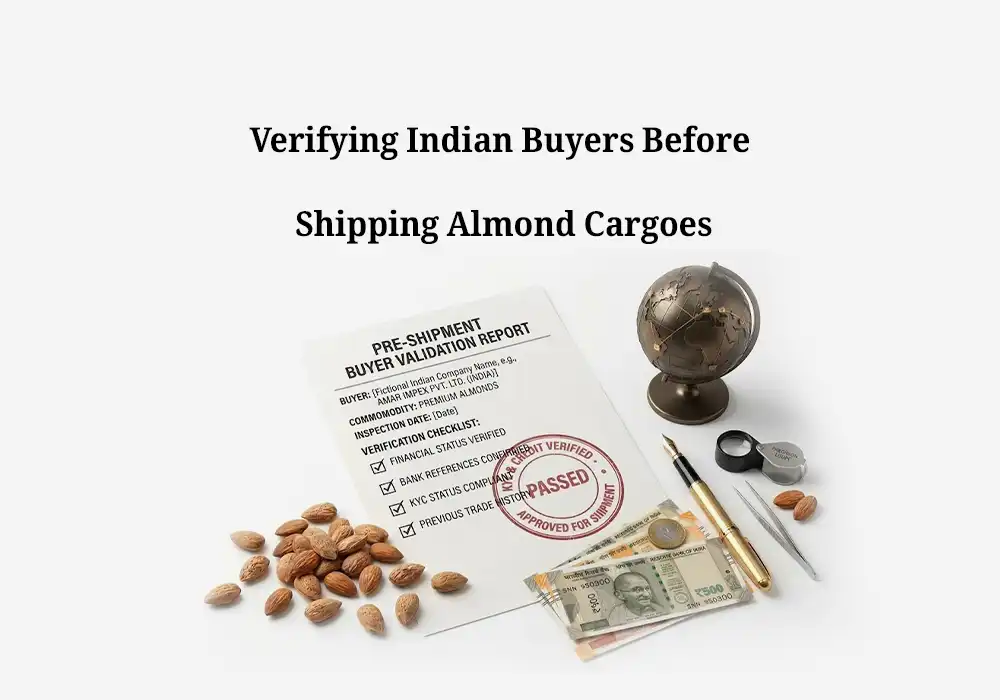
Verifying Indian Buyers Before Shipping Almond Cargoes: How to Avoid Falling into Export Fraud Traps (The Fortress of Secure Trade)
Imagine you are sitting in your corporate office when your phone suddenly lights up with a WhatsApp message from an Indian number. The sender, featuring a highly professional profile picture, introduces himself as the Chief Procurement Officer of a massive retail chain in Mumbai. He reviews your catalog and, without haggling over a single cent of your premium price for Mamra Almonds, immediately demands the urgent dispatch of two full shipping containers (worth hundreds of thousands of dollars). He boldly claims: "Ship the cargo tomorrow. The moment you email me a copy of the Bill of Lading, I will wire 100% of the cash directly into your account."
To a novice exporter, this message feels like winning the commercial lottery. However, to a battle-hardened veteran of global trade, this message sounds a deafening alarm siren—it is the textbook definition of a "Lethal Commercial Trap!"
The 1.4-billion-strong Indian market, while overflowing with golden commercial opportunities, is equally a playground for shadow brokers and shell companies. International fraudsters prey on the excitement of exporters desperate to close lucrative dollar contracts, knowing they will often turn a blind eye to basic due diligence. In this highly analytical and narrative-driven article, we will teach you how to scrutinize the identity of an Indian buyer like an international commercial detective. We will explore the critical "Red Flags" of fraudulent behavior and learn exactly how to mathematically verify a buyer's authenticity before a single almond leaves your factory.
1. The Red Flags: Psychological Markers of a Fake Buyer
Export scammers in the Indian subcontinent generally operate using highly predictable behavioral patterns. If you encounter any of these warning signs during your negotiations, slam the brakes immediately:
- Zero Price Negotiation: No genuine, established merchant in India (even the billionaire tycoons) purchases bulk dry fruits without aggressively negotiating every single cent. If a buyer instantly accepts your initial high quotation without a fight, they absolutely have zero intention of actually paying you.
- Illogical Urgency to Ship: A fraudulent buyer constantly creates artificial pressure: "Put the cargo on the ship tomorrow, I'll send the money while it's in transit." Legitimate international trade requires meticulous inspections, document drafting, and bank approvals. Urgency is the scammer's primary tool to bypass your logical thinking.
- Generic Emails and Ghost Websites: A corporation claiming to import millions of dollars annually should never communicate via free @gmail.com or @yahoo.com addresses. Furthermore, their website should not be a basic, one-page template created a week ago.
- Evading Third-Party Inspection: Genuine buyers are paranoid about quality and always welcome international inspections. If a buyer claims they "trust you completely" and do not need an inspector, be highly suspicious. To understand why genuine buyers demand this, read: The Role of International Inspection Companies in Indian Customs Clearance.
2. Practical Verification Steps: How to Legally Audit an Indian Company
To ensure your buyer is a legally registered corporate entity in India, you do not need to book a flight to New Delhi. The Indian government provides transparent digital gateways for this exact purpose:
A) Verifying the Import Export Code (IEC)
Every individual or corporation attempting to import or export goods in India is legally mandated to possess a unique 10-digit IEC (Import Export Code) issued by the Indian Ministry of Commerce.
- Your Action: Demand a copy of their IEC certificate. Then, navigate to the official Indian DGFT (Directorate General of Foreign Trade) portal and input the code. The system will instantly reveal if the company exists, if their status is active, or if they have been blacklisted.
B) Ministry of Corporate Affairs (MCA) Audit
All reputable incorporated entities in India must be registered with the Ministry of Corporate Affairs and possess a Corporate Identification Number (CIN). By searching the company's name on the Indian MCA portal, you can view their date of incorporation, the legal names of the directors, and their financial filing status. A company that was registered barely a month ago asking for a million-dollar container is an absolute red zone!
C) Joint Chambers of Commerce
One of the most secure verification methods is corresponding with the Joint Indo-Iranian Chamber of Commerce. You can request a background check on the specific Indian merchant to ensure they do not have a documented history of defaulting on payments with other exporters.
3. Payment Security: Where the Fraud Stops Dead
Even if the buyer passes all legal audits and is a fully registered company, you must never dispatch your cargo without an impenetrable financial guarantee. Many "legal" companies exploit logistical vulnerabilities to extort massive discounts once the cargo arrives at the destination port.
- The Advance Payment Shield: Never, under any circumstances, release cargo from your factory without securing a minimum of 30% to 40% Advance TT payment. A buyer who refuses to pay an advance is almost certainly planning to hijack your cargo at the destination customs.
- Letters of Credit (L/C) from Top-Tier Banks: If the buyer proposes an L/C, you must mandate that the issuing bank is a globally recognized, reputable financial institution—not an obscure, unverified local cooperative. To master the mechanics of secure payments, reading Bank Guarantee vs. Letter of Credit: Which is Safer in India? is highly recommended.
The Golden Table: Buyer Verification Checklist Before Signing
| Audit Parameter | Danger Zone (Reject the Deal) | Secure Zone (Approve the Deal) |
|---|---|---|
| Corporate Identity | Refuses to provide IEC / Uses Gmail addresses | Provides valid IEC / Uses official corporate domain emails |
| Negotiation Behavior | Instantly accepts high prices & demands urgent shipping | Negotiates ruthlessly on price & demands physical samples |
| Payment Terms | Insists on 100% CAD (Cash Against Documents) at destination | Accepts 30% Advance TT or opens a confirmed, irrevocable L/C |
| Attitude Toward Quality | Shows zero interest in COA or customs compliance | Strictly demands an official COA and SGS inspection |
4. The Impenetrable Wall of Trade with Walmondhe
In the turbulent ocean of global commerce, swimming without a life jacket is an unrecoverable error. Countless traditional producers have witnessed their life's work vanish overnight due to a single, poorly vetted transaction.
The Walmondhe engineering and trading group, standing as the ultimate authority for Saman almond exports, has constructed an impenetrable legal and intelligence network to relentlessly audit its commercial partners.
- We strictly refuse to engage with shadow brokers or shell companies. Our corporate legal department rigorously verifies the identity, financial history, and credit rating of all Indian and international buyers through global banking channels before a single kilogram of cargo is dispatched.
- Our export contracts are meticulously drafted based on the ironclad laws of the International Chamber of Commerce (ICC) and Incoterms, ensuring absolutely zero legal loopholes exist for extortion. To understand the sheer precision of our commercial standards, review Comprehensive Guide to Almond Quality Control for Bulk Buyers.
To receive expert consultation on vetting target markets, structuring hyper-secure export contracts, and to secure daily pricing on elite export varieties like Mamra Almonds and Iranian Moheb Almonds, communicate with our experts via the official paths below:
- Direct & Fast WhatsApp Communication: +989136667618
- Direct Sales Department Telephone: +989136667618