
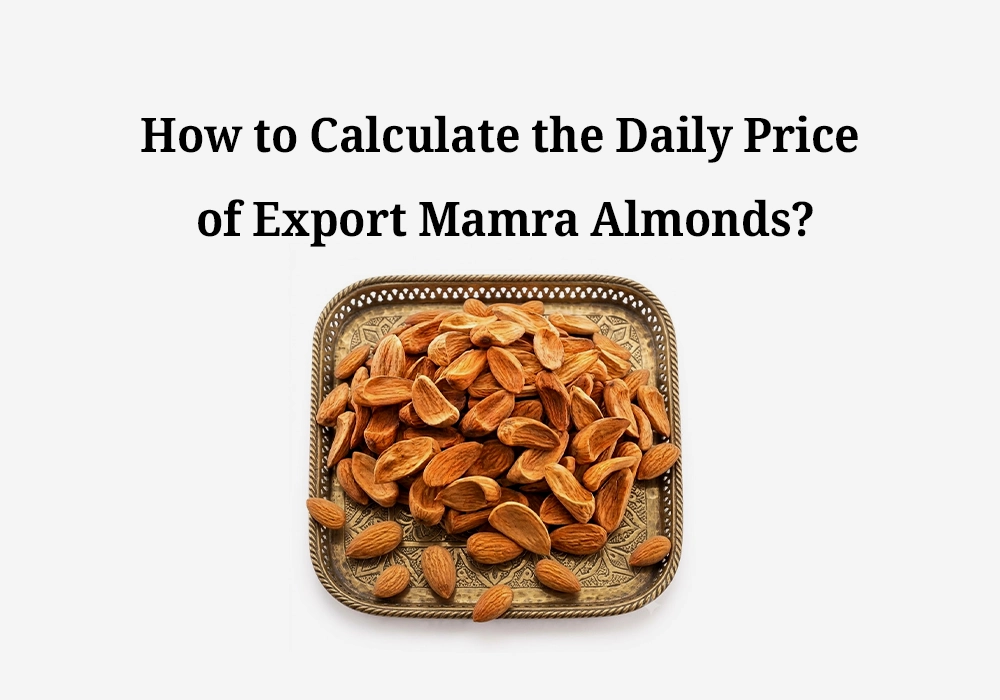
How to Calculate the Daily Price of Export Mamra Almonds? (A Comprehensive Breakdown of the B2B Pricing Formula)
In the literature of the international dried fruit trade, especially when dealing with a super-luxury, strategic, and expensive product like Mamra Almonds, there is no such thing as a "fixed, flat, and permanent price." If you encounter a supplier in the market offering you a fixed price list for the next six months, you can be absolutely certain you are negotiating with a broker or middleman who has added a massive hidden profit margin to the cargo, not a first-hand factory or exporter.
For a professional importer in Mumbai (Vashi market), Delhi (Khari Baoli), Dubai, or Hamburg, a deep understanding of the "pricing mechanism and formula" is far more critical than the price figure itself. Knowing exactly how and based on what variables the final price of each kilogram of almonds is calculated gives you engineered bargaining power and protects your capital against hidden costs.
In this comprehensive article, we dissect the precise, layer-by-layer, and operational formula for calculating the daily price of export Mamra almonds at Walmondhe, empowering you to predict and manage the Landed Cost of your container shipment with the highest accuracy.
1. Raw Material Base Price (From Zayanderud Orchards to the Factory)
The first and most fundamental variable in the pricing formula is the base purchase price of in-shell almonds in the product's region of origin, namely the Zayanderud basin and Saman County. This base price is heavily influenced by three essential factors:
- Climate Shocks (Spring Frost): Because it blossoms early, the Mamra almond tree is highly vulnerable to spring frost. If the orchards in Saman suffer from frost in a given year, the supply drops drastically, and the base price increases exponentially.
- Seasonal Supply and Demand: During late summer and early autumn (the golden harvest season), the massive injection of cargo into the market usually pushes the base price to its most competitive and logical level. As we move towards winter and spring, prices trend upwards due to depleting warehouse inventories.
- Kernel Yield: To obtain one kilogram of pure Mamra almond kernels, approximately 3 to 3.5 kilograms of in-shell almonds must be cracked (a yield of 28% to 33%). The purchase price of in-shell almonds, the labor/operational costs of the primary sorting lines for cracking, and the deduction of the waste percentage (wooden shells) constitute the base price of the "unsorted, mixed kernels."
2. Grading, Calibration, and Twin Ratio (Dissecting the Sizes)
The biggest factor causing price discrepancies across different batches of Mamra almonds is the "sorting grade and sizing." After cracking, Mamra almonds are an irregular mix of small, large, broken, and twin kernels.
- Super-Luxury and Prestige Grades (5A and 6A): These grades contain the largest, heaviest, most elongated, and most symmetrical kernels (for instance, 80 to 90 kernels per 100 grams). Since the percentage of these large sizes in the natural cargo is very low, and separating them requires advanced laser sorting lines and the complete removal of twin kernels, their price is significantly higher than other grades. These grades are exclusively meant for Diwali gift boxes in India or luxury boutiques in Dubai.
- Medium, Commercial, and Economic Grades (2A, 3A, and 4A): These sizes are much more abundant in the natural harvest. Their price is considered the standard or "market average," and the highest volume of container transactions for general consumption and confectioneries is executed on these sizes.
- The Impact of Twin Ratio: Mamra almonds inherently yield up to 30% twins. Batches with absolute zero twins (Single Kernels) command a much higher price than batches containing twins because the separation process is complex, and the twins are sold at a lower price to the food industry.
Golden Strategic Tip: When requesting price quotes from different suppliers, you must request the exact grade and the "Count per 100g" in writing. Comparing Supplier A's price with Supplier B's price without strictly aligning the grade is a devastating miscalculation in this trade.
3. Hidden Processing and MAP Packaging Costs
Mamra almonds are not dry, lifeless commodities; they are living products heavily rich in unsaturated fats. A broker or traditional supplier might try to lower the paper price by dumping the cargo into standard plastic bags or single-ply cartons, where the packaging cost is near zero. However, this cargo will oxidize in the middle of the ocean or in the humid customs of the destination, taking on a rancid smell.
In Walmondhe's industrial structure, the final price includes the following essential qualitative infrastructure costs:
- Optical and Laser Sorting: The cost of passing the cargo through Color Sorters and X-ray machines to eliminate 100% of foreign matter, wooden shells, pebbles, and bitter or broken kernels.
- MAP (Modified Atmosphere Packaging): The cost of thick 5-ply export cartons, absolute industrial vacuuming, and sequential inert Nitrogen gas injection. This amount (which is only a few cents per kilogram on a container scale) is not an extra expense; it is the cheapest and most reliable "insurance policy" for your multi-hundred-thousand-dollar cargo against sea moisture, oil oxidation, and pest infestation.
4. The Logistics, Regulatory, and Customs Cost Matrix (FOB vs. CIF)
The price of almonds is heavily dependent on where and under what obligations you receive the goods (Incoterms):
- EXW (Ex Works) Price: The net price of the goods delivered at Walmondhe's factory doors. All shipping and clearance costs are borne by the buyer.
- FOB (Free On Board - Bandar Abbas) Price: This price includes:
- Domestic transit costs from the Saman factory to Bandar Abbas customs.
- Strict laboratory costs (such as SGS and Aflatoxin testing).
- Issuance of international certificates like the Certificate of Origin (COO) and Phytosanitary certificate.
- Origin customs clearance formalities and Terminal Handling Charges (THC) for loading onto the vessel.
- CIF (Cost, Insurance, and Freight - e.g., Nhava Sheva, India) Price: In this scenario, the cost of marine Insurance and international Ocean Freight is added to the total price and then amortized over the total cargo tonnage to determine the price per kilogram. Purchasing in a Full Container Load (FCL) drastically amortizes these logistics costs and lowers the Landed Cost.
5. Exchange Rate Fluctuations and Hedging Strategy
Iran's economy and its agricultural/labor costs are based on the Rial (IRR), but export transactions are exclusively conducted in US Dollars (USD) or UAE Dirhams (AED).
The daily price of Mamra almonds is instantly tied to exchange rates. If the origin's national currency depreciates, the foreign currency price of the cargo becomes more attractive to foreign buyers. Due to these daily fluctuations, valid Proforma Invoices (PI) in the dried fruit trade usually have a short validity period (e.g., 3 to 5 business days).
How Does Walmondhe Guarantee and Lock in the Best Price for You?
Walmondhe, by architecting and operating an integrated industrial supply chain, has optimized the pricing mechanism in favor of the B2B buyer and its commercial partners:
- Eliminating Local Brokers and Middlemen: We purchase the cargo directly from contracted farmers and orchards under our supervision in Saman County, transferring it straight to our advanced processing lines without any intermediaries. This supply architecture cuts out brokers and brings the base price down to the absolute market floor.
- Forward Contracts: For major importers and container buyers, we offer an exceptional opportunity to "reserve and lock in the price" during the golden harvest season (which offers the lowest price of the year). We store your cargo at the base price in standard cold storage facilities, ensuring you remain completely shielded from seasonal inflation during high-demand months (like Diwali or Ramadan).
- Absolute Transparency and Invoice Dissection: In the Proforma Invoice (PI) issued by Walmondhe's commercial team, all costs—including the net kernel price, MAP packaging cost, documentary fees, and logistics—are listed with absolute transparency and itemized breakdown, so you know exactly what added value you are paying for as a merchant.
Contact our sales department to receive a precise pricing analysis for your desired grade and get an instant daily quote (FOB Bandar Abbas or CIF target ports):
- Get a Proforma Invoice (PI) and instant pricing via WhatsApp: 09136667618
- Direct Phone Call to the B2B Export Department: 09136667618
- Professional networking and market news on LinkedIn: Hossein Ebrahimi - Walmondhe