
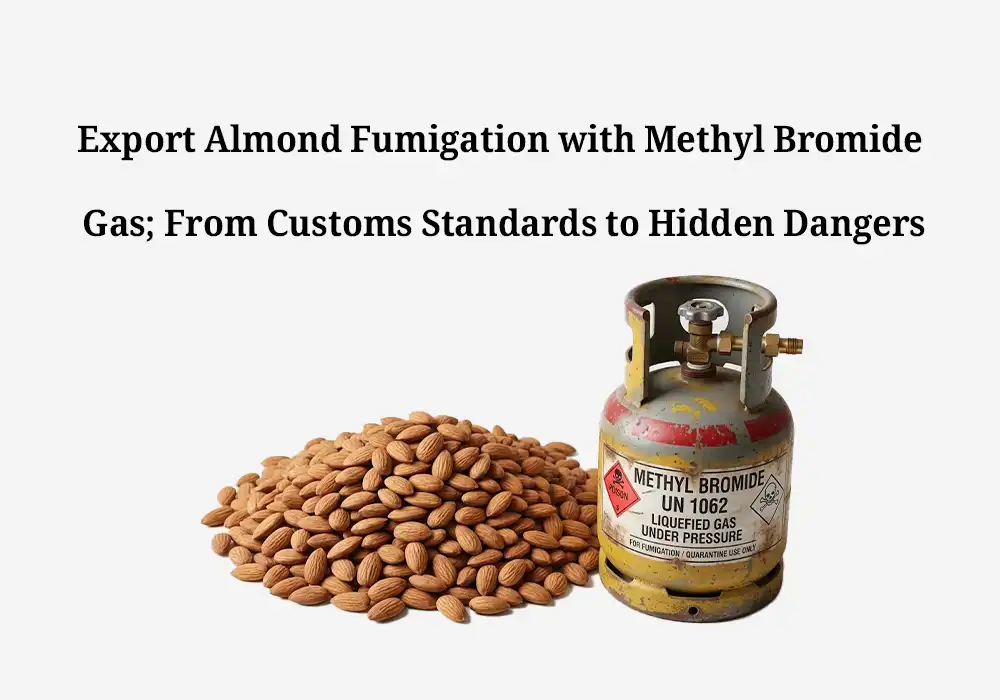
Export Almond Fumigation with Methyl Bromide Gas; From Customs Standards to Hidden Dangers (A Complete Analysis)
Imagine that after months of exhaustive, round-the-clock labor, you have successfully prepared a massive consignment of premium Mamra Almonds from the Saman region, and the containers are actively loading for export to India. Everything seems perfect until an unyielding international regulation blocks your path. The destination country's customs require an official certificate proving that absolutely no live insects, larvae, or pest eggs are hiding among the almond kernels, or even within the crevices of the wooden pallets securing the cargo!
In the global dry fruit trade, a single tiny insect can lead to the annihilation of millions of dollars in capital. Consequently, nations enforce ruthless quarantine laws to protect their domestic agriculture. For decades, the most powerful weapon traders possessed to blast through these customs barriers was a magical yet hazardous gas known as "Methyl Bromide." The industrial process of gassing and disinfecting the cargo with this chemical is globally referred to as "Fumigation."
In this comprehensive article, we will step inside the isolated, sealed containers to see exactly how this invisible gas operates. Why are international customs so addicted to it? What lethal dangers does it pose to humans and nature, and why are pioneering companies rapidly shifting toward green alternatives?
1. What is Methyl Bromide Fumigation and How Does It Work?
Methyl Bromide is an odorless, colorless chemical compound that transitions into a highly penetrating gas at room temperature. For decades, this gas reigned as the undisputed king of pest control in warehouses and ports worldwide.
When your container of almonds is sealed for export, specialized fumigation teams envelop the entire container with heavy-duty, gas-tight tarpaulins and pump the Methyl Bromide gas inside.
- Extraordinary Penetration: The magical property of Methyl Bromide is its sheer physical ability to penetrate the microscopic pores of jute bags, sacks, and even deep into the grains of the wooden pallets upon which the almonds are stacked.
- Absolute Eradication: Within a mere 4 to 8 hours (depending on vacuum conditions and oxygen displacement), this gas suffocates and annihilates all adult insects, larvae, microscopic eggs, and even nematodes (roundworms). Following the process, the container is safely aerated, and the cargo is granted a "Fumigation Certificate," allowing it to set sail. To grasp the critical importance of this sterilization for tropical sea routes, study the article: Preventing Mamra Almond Bitterness in Tropical Indian Warehouses.
2. Why Do Global Customs Love Methyl Bromide?
The primary reason strict customs authorities (like those in India or the United States) still demand Methyl Bromide in emergency quarantine holds boils down to its sheer speed and reliability.
- ISPM 15 Standard for Wooden Pallets: In international shipping, almond bags are stacked on wooden pallets. Global regulations (ISPM 15) strictly dictate that this wood must harbor no living pests. Methyl Bromide is the fastest, most cost-effective method to simultaneously sterilize both the almonds and the wooden pallets beneath them.
- Unrivaled Clearance Speed: In crowded seaports, every hour a container is detained incurs massive penalty fees (demurrage). Time is literally money. Fumigation with Methyl Bromide can be executed and aerated in under 24 hours, whereas alternative methods might paralyze the cargo for an entire week.
3. The Dark Side of Methyl Bromide: Why the World is Banning It
Despite its brilliant commercial advantages, Methyl Bromide harbors a remarkably dark and perilous side. In recent years, international environmental treaties (such as the Montreal Protocol) have severely restricted, and in many nations outright banned, the use of this gas. What triggered this global prohibition?
- Ozone Layer Destruction: Scientists discovered that once the fumigation process concludes and the Methyl Bromide gas is vented into the open air, it ascends directly into the stratosphere, aggressively destroying the Earth's protective ozone layer. Its destructive capability surpasses many known greenhouse gases.
- Extreme Human Toxicity: If the gas is improperly aerated from the container or if operators make a critical error, inhaling it is devastatingly toxic to human lungs, the nervous system, and skin, and can easily be fatal.
- Chemical Residues in Oil-Rich Seeds: Mamra almonds, boasting a natural fat content exceeding 50%, behave like biological sponges. Unprofessional application of chemical gases can cause toxic particles to dissolve directly into the almond's oil. If the Maximum Residue Limits (MRL) are exceeded, the entire shipment will face immediate rejection at the destination port. To review the exact oil standards required for export, read Standard Kernel Yield & Oil Content of Mamra Almonds.
4. Modern and Alternative Methods: Green and Safe Trade
Today, with the widespread phasing out of Methyl Bromide, industry leaders are adopting methodologies that protect the ozone layer while entirely preserving the natural taste and health of the almond:
- Phosphine Fumigation (Aluminum Phosphide): A highly common alternative. While inexpensive, it requires a significantly longer exposure time (up to a week) to be effective. If the container is not perfectly sealed, pests may survive.
- Controlled Atmosphere (Carbon Dioxide): A 100% organic and risk-free method. In this system, the oxygen within the storage room is purged and replaced with CO2. Insects suffocate naturally due to oxygen deprivation, without a single chemical ever touching the almonds.
- Gamma Irradiation: A highly advanced technique that destroys the genetic structure of pests without utilizing chemical toxins, delivering a perfectly sterile product.
5. The Walmondhe Commitment to Safe, Export-Ready Cargoes
In the intricate labyrinth of the export market, delivering a cargo that flawlessly passes customs regulations while remaining 100% free of hazardous chemical residues is an act of engineering artistry.
The Walmondhe engineering and trading group, functioning as the premier export authority in the Saman region, prepares its almond cargoes using the most modern, legal, and safest warehouse pest control and fumigation protocols available worldwide.
- By meticulously monitoring our optical sorting processes and utilizing isolated cold-storage facilities, we prevent the initial growth of any pests in our products.
- Our export shipments to India and the Arab states are dispatched with fully valid, globally recognized Phytosanitary and Fumigation certificates. Our airtight vacuum packaging guarantees that once sterilized, the cargo will never suffer re-contamination during its oceanic voyage. To intimately understand our quality control workflow, review the article: Comprehensive Guide to Almond Quality Control for Bulk Buyers.
To receive free expert consultation on customs affairs, health documentation, and daily pricing for the safest export-grade varieties including Mamra Almonds and Iranian Moheb Almonds, please connect with our experts via the official channels below:
- Direct & Fast WhatsApp Communication: +989136667618
- Direct Sales Department Telephone: +989136667618