
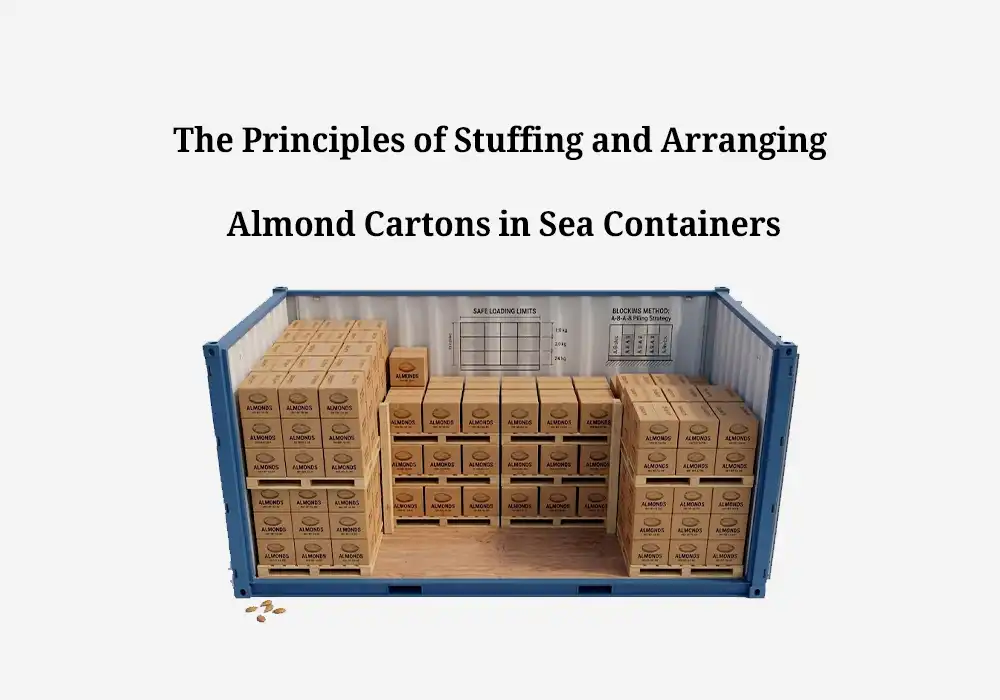
The Principles of Stuffing and Arranging Almond Cartons in Sea Containers (Engineering an Oceanic Voyage)
Imagine you have meticulously handpicked the absolute finest, largest Mamra Almonds from the Saman region. All phytosanitary and customs certificates are flawless, and your cargo is beautifully packed in premium cartons. Now, a gigantic metal sea container sits in your factory yard, waiting to swallow this million-dollar consignment and embark across the ocean. At this highly critical juncture, many traders make a catastrophic error: they simply order the workers to toss the cartons inside, stacking them all the way to the metal roof, and lock the doors.
This fatal mistake is the exact genesis of a silent disaster. A sea container, sitting on the deck of a cargo ship under the scorching sun of the Indian Ocean, transforms into a terrifying metal oven. If the cartons are loaded without adhering to precise engineering principles (an operation known globally in logistics as "Stuffing"), your cargo will literally suffocate before reaching the destination port. The almond oil will spoil due to a devastating phenomenon called "Container Rain," and the bottom cartons will be utterly crushed under the immense, poorly distributed weight.
In this deeply analytical and narrative article, we will step inside the dark, confined space of a 20-foot shipping container. We will explore the precise architecture of cargo arrangement, the secrets of airflow, and cargo securing techniques, discovering exactly how to navigate a highly sensitive dry fruit cargo safely through ocean storms and blistering heat.
1. Dissecting the Container: The Threat of Suffocation and Container Rain
Before mastering the rules of stuffing, we must understand the physical behavior of the container. During a 20 to 30-day maritime voyage to the ports of India or the UAE, the exterior temperature of the container might surge past 40°C (104°F) during the day and plummet sharply at night.
This extreme diurnal temperature fluctuation causes the trapped humidity inside the container to condense on the metal ceiling and rain down heavily upon the almond cartons! This destructive phenomenon is aptly named "Container Rain." If the almond cartons are stacked tightly against the ceiling, this moisture instantly penetrates the packaging, creating the perfect breeding ground for deadly Aflatoxin fungi. To thoroughly understand the massive risks associated with this fungus, reading the article A Comprehensive Guide to Preventing Aflatoxin and Shipment Rejection in Almond Exports is essential.
2. The Golden Rules of Stuffing (Engineered Arrangement)
Stuffing is not merely about filling an empty space; it is about constructing a functional respiratory system for the container. To prevent cargo crushing and the rancidity of the almond oil, adhering to these rules during loading is mandatory:
A) Utilizing Standard Pallets (The ISPM 15 Law)
Almond cartons must never be stacked directly on the metal or wooden floor of the container. The floor is the primary gathering point for moisture and contamination. The cartons must be geometrically stacked on standard wooden pallets and tightly wrapped with thick stretch film (shrink wrap). Furthermore, these wooden pallets must bear the international ISPM 15 stamp, proving they have been fumigated with methyl bromide or heat-treated and are entirely free of live pests. Ignoring this rule will lead to immediate cargo seizure at Indian customs.
B) Maintaining Breathing Space (Ventilation)
The most common amateur mistake in stuffing is filling the container all the way to the ceiling.
- There must be a minimum of 15 to 20 centimeters of empty clearance between the top row of cartons and the container's ceiling. This gap allows trapped hot air to circulate.
- Additionally, cartons must not be pressed directly against the metal sidewalls. These walls become blistering hot during the day. If a carton touches them, the 50% fat content of the Mamra almond essentially "cooks" and turns bitter. To understand the chemistry of fat oxidation in heat, review the article: What is the Peroxide Value (PV) Test in Almonds?.
C) Symmetrical Weight Distribution (Preventing Rollovers)
If you place all the heavy almond pallets at the very back of the container or entirely on one side, you destroy the container's center of gravity. When massive port cranes attempt to lift an unbalanced container, it can swing violently, crash, or severely damage the crane. The weight of the cargo must be distributed perfectly evenly across the length and width of the container floor.
3. Securing the Cargo (Lashing): Battling the Ocean Waves
The ocean is rarely peaceful. Cargo ships encounter violent storms and aggressive turbulence during their voyage. If the almond pallets are not firmly secured inside the container, they will smash into each other like matchboxes.
Once the stuffing is complete, the logistics team must deploy specialized polyester strapping bands and inflatable Dunnage Bags. These heavy-duty air bags are inserted into the voids between pallets and inflated to lock the load in place. The pallets are then securely lashed to the metal D-rings on the container walls. This precise operation, known as "Lashing," guarantees that your cargo arrives at its destination at a perfect zero-degree shift, without a single crushed carton.
4. Moisture Control in a Sealed Environment
Even with proper ventilation, the humid, salty sea air will inevitably find its way inside. To neutralize this silent threat, high-capacity industrial desiccants (moisture-absorbing bags) must be strategically hung from the container's ceiling hooks or placed between the pallets. Moreover, the almonds themselves must be sealed inside thick, vacuum-pumped plastic bags. This ensures that even if severe condensation drips from the ceiling, the internal integrity of the almond remains utterly untouched. To grasp the vital importance of these protective layers, studying the article Preventing Mamra Almond Bitterness in Tropical Indian Warehouses is highly enlightening.
Comparison Table: Amateur vs. Engineered Stuffing
| Performance Indicator | Traditional / Amateur Stuffing | Engineered Stuffing (Standard) |
|---|---|---|
| Carton Arrangement | Tossed directly on the container floor | Neatly stacked on ISPM 15 certified pallets |
| Ceiling Clearance | Stuffed to the roof (Cargo suffocation) | 20 cm breathing gap for air circulation |
| Cargo Securing | Cartons left loose inside | Locked with lashing straps and dunnage bags |
| Moisture Protection | No desiccants used | Hanging industrial desiccants & vacuum bags |
| Result at Destination | Crushed cartons, damp & rancid almonds | Intact cartons, perfectly crisp & sweet kernels |
5. The Art of Loading in Walmondhe's Powerful Logistics
Procuring a premium almond constitutes only 50% of the export process; the remaining 50% is the logistical art of delivering that cargo flawlessly across the oceans. A weak, amateurish stuffing operation can transform the absolute best product of the Saman orchards into a worthless mass of rancid oil.
The Walmondhe engineering and trading group, possessing a profound mastery over the physics of sea containers and the climatic conditions of export destinations, has elevated its stuffing operations into a precise science.
- Following meticulous optical sorting, all our cargoes are placed into isolated, vacuum-sealed packaging.
- Our stuffing operations are executed under the direct, physical supervision of quality control engineers. Symmetrical weight distribution, the use of certified pallets, the strategic placement of industrial desiccants, and professional lashing ensure that your cargo—even after a month at sea—arrives at your warehouse as safe, pristine, and secure as the day it left our factory. To familiarize yourself with our transparent supply chain, read Is Walmondhe a Direct Supplier from Saman Farmers?.
To receive specialized consultation on logistics, loading procedures, and daily pricing for secure export varieties like Mamra Almonds and Iranian Moheb Almonds, communicate with our sales department experts through the official channels below:
- Direct & Fast WhatsApp Communication: +989136667618
- Direct Sales Department Telephone: +989136667618