
How to Definitively Detect Mamra Almond Adulteration in Bulk B2B Exports?
Procuring and exporting a twenty-foot container of premium Mamra almonds requires mobilizing hundreds of thousands of dollars in working capital. Operating at this tier of B2B international trade while relying on "traditional trust" in local suppliers—without enforcing draconian quality control protocols—is financial suicide. One of the most prevalent and destructive violations within the Iranian dried fruit supply chain is the technique of "Variety Adulteration." Opportunistic brokers systematically blend premium Mamra almonds with cheaper, visually deceptive counterparts, primarily the "Rabie" or "Moheb" varieties, often in ratios ranging from 10% to 30%.
The Indian buyer network at strategic ports like Nhava Sheva is extraordinarily specialized and entirely ruthless. Discovering a mere 5% trace of Rabie almonds within a Mamra consignment grants the buyer ultimate leverage. They will immediately declare a Discrepancy, paralyze the Letter of Credit (LC), or demand devastating 30% price dumping to compensate for the "breach of trust." In this analytical architecture, we systematically deconstruct the morphological indicators, biochemical testing methodologies, and definitive technological solutions required to expose adulteration in high-tonnage acquisitions.
The Anatomy of a Scam: Why the Rabie Variety?
The primary catalyst driving variety adulteration is the massive Price Arbitrage existing between specific almond cultivars. Mamra almonds, due to their monopolized production, exceptionally high lipid content, and aggressive demand from the Indian market, rank as the most expensive almonds globally. Conversely, the Rabie variety, despite possessing deceptive visual similarities, commands a drastically lower valuation in the domestic market.
When an unverified supplier covertly blends a portion of Rabie into a multi-ton Mamra shipment, they instantly synthesize tens of thousands of dollars in illicit, hidden profit margins. This artificial profit is violently extracted directly from the capital of the exporter, who financed the cargo at the pure Mamra Cost of Goods Sold (COGS), only to face severe penalties, brand degradation, and legal disputes upon arrival in India.
Morphological Indicators for Absolute Differentiation
In bulk procurement, executing a manual visual inspection of every individual kernel is logistically impossible. However, implementing rigorous Random Sampling based on the following morphological indicators constitutes your primary defensive barrier. Mamra and Rabie almonds exhibit profound structural divergences across several physical parameters:
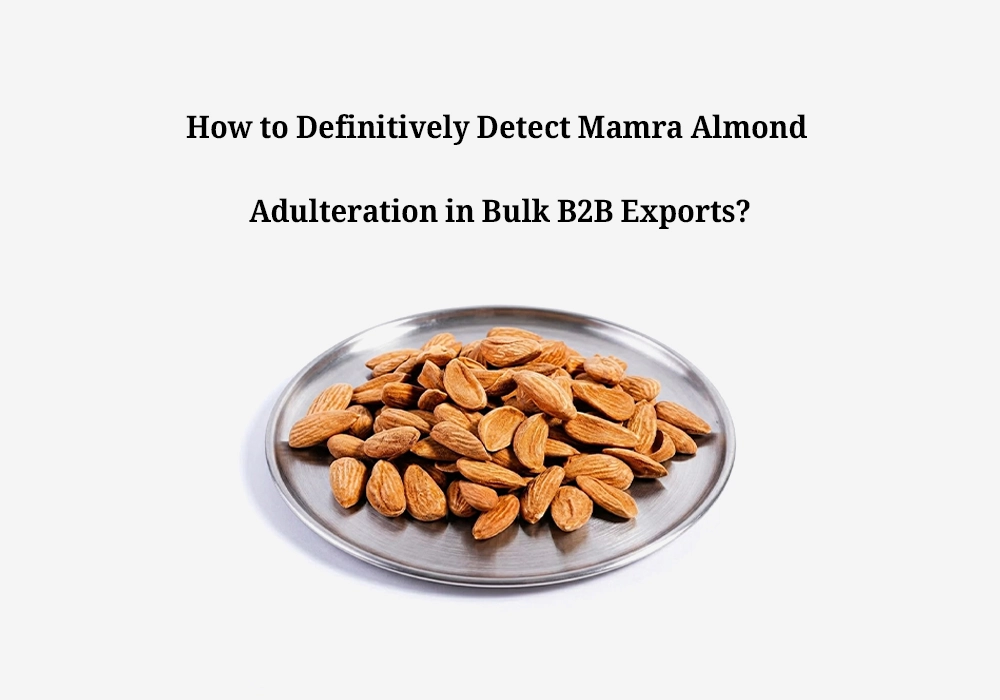
- Shape and Geometric Curvature: The most defining characteristic of the Mamra kernel is its elongated form and aggressive curvature. One side of the Mamra kernel is deeply concave, while the opposing side is convex, culminating in a distinctive "Hooked Tip." Conversely, the Rabie almond is noticeably flatter, broader, possesses minimal curvature, and rarely terminates in a hooked structure.
- Surface Texture and Topography: The brown pellicle (skin) of the Mamra kernel features deep, harsh, and parallel striations or wrinkles. While the Rabie almond is also wrinkled, its striations are significantly shallower, presenting a relatively smoother tactile surface compared to the rugged topography of Mamra.
- Color Profile: Authentic, high-grade Mamra (e.g., Grades 4A or 5A) exhibits a bright, golden, and translucent coloration. The Rabie variety is typically a shade darker, leaning towards dull brown or brick-red hues. Detecting a dual-tone color profile within a single batch is an immediate Red Flag for any professional buyer.
- Bulk Density and Sizing Matrix: Although Rabie kernels can be artificially sorted to match the geometric sizing of Mamra, their Bulk Density diverges significantly. Due to its superior lipid content, the Mamra kernel is denser and heavier. To precisely comprehend sizing metrics and volume-to-weight ratios, auditing the Comprehensive Global Almond Sorting and Sizing Standards provides the exact calibration tools required.
Biochemical Analysis and Qualitative Testing
Human visual error is mathematically inevitable when attempting to detect low-percentage adulteration (under 5%) across massive tonnages. In high-volume trade, relying exclusively on accredited laboratory documentation (such as SGS or Bureau Veritas reports) prior to container stuffing is a non-negotiable strategic imperative.
- Oil Content Yield Validation: This specific metric acts as the unforgeable biochemical fingerprint of the Mamra almond. Pure Mamra boasts a minimum lipid concentration of 55% to 65%. The Rabie variety yields a significantly lower lipid profile, typically hovering between 40% to 45%. Executing randomized laboratory sampling to determine the aggregate oil content of the batch instantly exposes large-scale adulteration.
- Crispness and Flavor Profiling: Mamra possesses an intensely crisp structural matrix and a rich, sweet flavor profile; upon mastication, the high oil content is immediately detectable. Rabie features a notably drier texture and a highly neutral flavor profile.
- Latent Phytosanitary Risks: Adulterated cargo is typically aggregated from highly fragmented, unverified sources. This radically elevates the risk of latent moisture, fungal growth, and Aflatoxin contamination. To immunize your shipment against these fatal biological threats, strictly implementing the protocols detailed in the Comprehensive Guide to Preventing Aflatoxin and Shipment Rejection is mandatory.
The Transformative Role of Technology: Optical and Laser Sorting
Traditional manual sorting methodologies are completely defenseless against modern adulteration techniques. When an opportunistic supplier blends Rabie almonds that have been meticulously pre-sorted to identically match the size and color of your Mamra shipment, human labor cannot physically isolate the fraudulent kernels across a ten-ton volume.
The only definitive, scientifically robust strategy to guarantee 100% genetic purity is processing the entire cargo through advanced Optical Sorting lines equipped with Near-Infrared (NIR) spectroscopy sensors. These hyper-advanced machines execute decisions in milliseconds—not merely based on RGB color profiles and sizing, but by analyzing the chemical structure, sub-surface lipid density, and 3D geometric topography of each individual kernel. NIR sensors instantaneously identify and eject the flatter, lower-fat Rabie kernels from among thousands of Mamra almonds. The precise mechanics of this technological value-addition are comprehensively analyzed in The Transformative Role of Laser and Optical Sorting in Value-Added Almond Exports, a critical read for engineering your supply chain.
Sales Contract Engineering for Adulteration Hedging
If, as a market strategist, you are procuring bulk tonnages from domestic suppliers, you must legally hedge the risk of variety adulteration before initiating any capital transfer. Relying on basic commercial invoices is a catastrophic commercial error.
Within your B2B procurement contracts, an explicit clause titled "Genetic and Variety Purity" must be firmly embedded. This clause must legally stipulate that the detection of anything greater than a 0% presence (or an absolute maximum 1% tolerance) of alternative varieties such as Rabie or Moheb constitutes a Material Breach of contract. This grants the buyer the irrevocable right to reject the entire consignment and claim severe financial damages. Furthermore, the Final Payment must be legally contingent upon purity validation by an independent, third-party inspection agency simultaneously with the container Stuffing process. To architect a legal defensive shield that meets global standards, the tools outlined in the International Almond Sales Contract and Risk Hedging will finalize your strategic perimeter.
Conclusion: Transcending Obsolete Procurement Traps
Exporting Mamra almonds to the Indian subcontinent is an arena that permits zero trial and error. Blending visually similar cultivars like the Rabie almond is not an accidental logistical oversight; it is a highly engineered, deliberate scam explicitly targeting your Brand Equity and profit margins in global markets. Relying on rudimentary visual inspections and archaic trust systems renders you entirely vulnerable to highly intelligent Indian buyers and ruthless customs regulations.
The integrated Walmondhe platform, by orchestrating a paradigm shift from "traditional sourcing" to "technology-driven procurement," has reduced the risk of these adulterations to absolute zero. By leveraging 3D optical sorting infrastructure, rigorous laboratory monitoring of lipid profiles, and providing transparent, immutable quality documentation, we guarantee that your premium Mamra consignments reach the final Indian buyer with 100% purity, operating strictly at the apex of global B2B standards.
Frequently Asked Questions (FAQ)
Are Indian wholesale buyers genuinely capable of detecting Rabie almonds mixed into a Mamra shipment? Absolutely. Brokers and high-volume buyers in primary Indian markets, such as APMC in Mumbai, possess elite expertise in almond morphological evaluation. By randomly fracturing kernels and physically analyzing the thickness, geometric curvature, and lipid texture, they instantly identify adulterated batches. They weaponize this discovery as leverage to block payments or extort massive price discounts.
Are standard RGB Color Sorters sufficient to isolate Rabie almonds from a Mamra batch? No. Traditional RGB color sorters exclusively detect variations within the visible color spectrum. Because the exterior pellicle color of Rabie can perfectly mimic certain grades of Mamra, these machines are functionally obsolete for this specific task. Absolute differentiation requires NIR (Near-Infrared) technology and 3D form-recognition sensors capable of scanning the kernel's total volume, curvature, and internal density.
What is the globally accepted tolerance level for "Mixed Varieties" in premium dried fruit exports? In standard, low-tier commodity exports, a tolerance of 1% to a maximum of 2% for mixed varieties is occasionally overlooked. However, for a hyper-premium, Veblen good like the Mamra almond, tier-1 Indian buyers demand a strict Zero Tolerance standard for purity. Any intentional blending with cheaper cultivars is universally prosecuted as a blatant act of commercial fraud.