
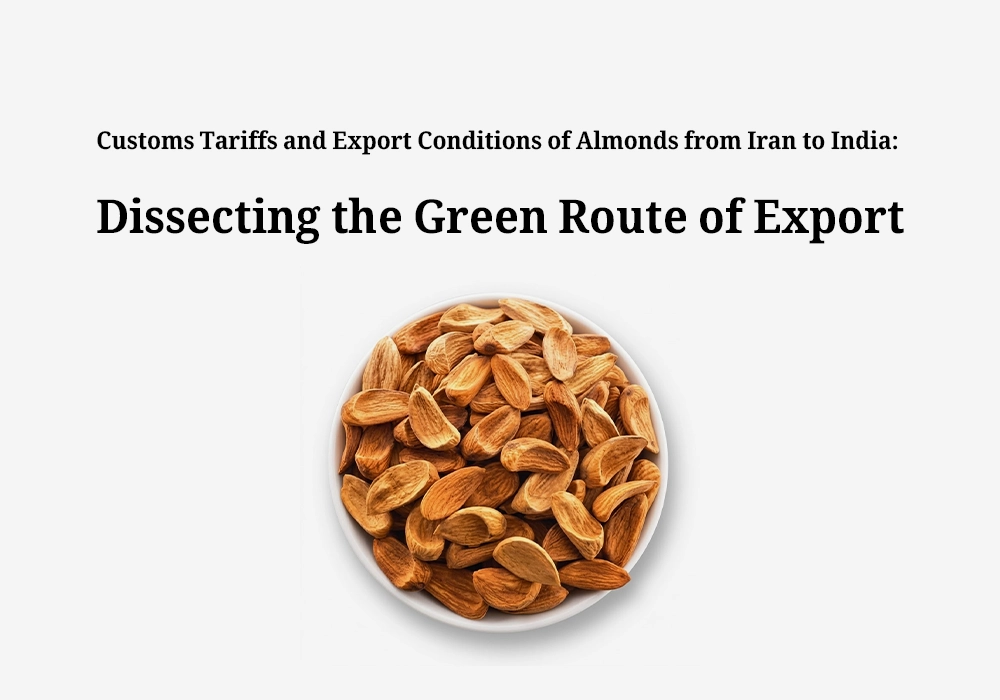
Customs Tariffs and Export Conditions of Almonds from Iran to India: Dissecting the Green Route of Export
The Indian market, with its billion-dollar turnover in the dried fruit sector, is the ultimate dream destination for exporting premium Iranian varieties, particularly Mamra Almonds, Shahroudi, and Stone (Sangi) almonds. However, getting your containers to Indian ports is only half the commercial journey; the hidden, more challenging half is navigating the formidable barrier of Indian customs, import tariffs, and ruthless food safety standards.
Due to a lack of mastery over HS Codes, documentary requirements, and quarantine laws, many novice exporters find their shipments seized at Indian customs. This scenario equates to the complete destruction of profit margins and the imposition of crippling demurrage costs.
In this article, acting as an operational B2B guide, we expertly examine all legal stages, customs tariffs, health standards, and the logistics of exporting almonds from Iran to India, empowering you to deliver your cargo to Indian buyers with the lowest possible risk.
1. HS Code and Import Duty Structure in India
The first step in exporting is accurately identifying the product's Harmonized System (HS) Code. India maintains a highly protectionist tariff structure. Unlike many countries that calculate duties as a percentage of the total cargo value (Ad Valorem), the Indian government often applies a fixed tariff based on weight (Rupees per Kg) for almonds.
- In-shell Almonds: Classified under HS Code 080211. The importation of this product typically incurs a fixed base duty per kilogram, combined with India's infrastructure taxes.
- Shelled Almonds (Kernels): Classified under HS Code 080212. Due to their higher added value, almond kernels face a different calculative structure and require far greater precision in the customs declaration.
Strategic Point: Providing an accurate "Certificate of Origin" (COO) from the Iranian Chamber of Commerce is absolutely critical, as any discrepancy in the documents can subject the shipment to punitive tariffs. To master the clearance process at major ports, studying our Comprehensive guide to Iranian almond customs clearance at Nhava Sheva and Mundra ports is a commercial necessity.
2. Crossing the Firewall: Food Safety and Standards Authority of India (FSSAI)
The greatest nightmare for almond exporters to India is having their cargo rejected by the laboratories of the FSSAI (Food Safety and Standards Authority of India). Before clearing any edible shipment, Indian customs send samples to the lab for rigorous testing.
The FSSAI is hyper-sensitive to three primary factors:
- Aflatoxin: The level of aflatoxin toxins must be strictly controlled and remain below the permissible limit defined by the Indian government. Even a minute trace beyond the standard leads to deportation orders or the incineration of the cargo.
- Moisture and Fungus: If the shipment absorbs moisture during the sea voyage due to inadequate packaging, the presence of any mold or insect larvae means immediate seizure.
- Labeling Requirements: Every carton or gunny bag must feature precise information, including the exporter's name, net weight, packaging date, expiration date, and the phrase "Product of Iran," formatted exactly to FSSAI typography standards.
To prevent such a commercial disaster, be sure to read our Comprehensive analysis of India's food safety standards (FSSAI) for definitive, risk-free almond imports.
3. Mandatory Documents for Exporting Almonds to India
For your Indian buyer to clear the cargo without costly delays, your Shipping Documents package must be flawless. The slightest discrepancy between documents halts the customs process. The vital documents include:
- Commercial Invoice: Detailing the buyer, seller, delivery term (e.g., FOB or CIF), and the true value of the cargo.
- Packing List: Including the exact number of cartons/bags, Net Weight, and Gross Weight.
- Bill of Lading (B/L): The document issued by the shipping line representing ownership of the cargo.
- Phytosanitary Certificate: Issued by Iran's Plant Protection Organization, confirming the cargo is free of pests and diseases.
- Certificate of Origin (COO): Verifying that the goods are a product of Iran.
4. Logistics Engineering: The Bandar Abbas to Nhava Sheva Route
The maritime route from Bandar Abbas to major Indian ports (such as Nhava Sheva in Mumbai and Mundra in Gujarat) is the beating heart of this trade. Transit Time on this route usually ranges between 5 to 10 days. However, the primary challenge is the extreme heat and high humidity of Indian ports. If almonds (especially high-fat Mamra kernels) are shipped in standard containers without insulated packaging, they will suffer from "Container Rain," leading to severe quality degradation. Using cartons equipped with moisture-barrier liners and Modified Atmosphere Packaging (MAP) is an absolute must here. To meticulously plan your logistics, review our guide: How to safely deliver export almond shipments from Bandar Abbas to Nhava Sheva?.
5. Currency Transfer Strategies Under Sanctions
One of the most complex aspects of exporting from Iran to India is bypassing global banking restrictions (SWIFT) to securely receive payment for goods. Professional traders rarely rely on high-risk methods. Today, the most common and secure financial architecture for settlement involves using barter mechanisms, reputable exchange offices, and converting Rupees (INR) to UAE Dirhams (AED), then transferring it to Iran. Major Indian buyers in "Khari Baoli" have financial clearing offices in Dubai to facilitate this process. To master these complex mechanisms, studying Advanced currency transfer strategies in export to India: Settlement architecture (INR/AED) will help you 100% secure the financial safety of your transactions.
Why Walmondhe is Your Key to Success at Indian Customs
Exporting high tonnages of almonds to India is not a solo endeavor; it requires a powerful infrastructure that reduces all qualitative and documentary risks to zero. Walmondhe, with years of continuous experience trading with Indian buyers, has engineered this exact path for you:
- 100% FSSAI Passage Guarantee: We analyze the cargo in accredited laboratories prior to shipment to ensure the absence of aflatoxins and precisely adjust moisture levels (under 5%).
- Flawless Export Sorting: Utilizing laser sensors to eliminate any foreign materials, shell fragments, or defective kernels—the primary causes of cargo rejection at Indian customs.
- Specialized MAP Packaging: Injecting inert gases and utilizing industrial vacuum sealing in export cartons completely insures the cargo's quality against the heat of Nhava Sheva port.
- Full Documentary Support: We meticulously issue all Phytosanitary certificates and specialized labeling strictly in accordance with Indian customs standards for your shipment.
By choosing Walmondhe as your supply chain partner, you can forget about the anxieties related to Indian customs and regulations, focusing all your energy on sales negotiations and market expansion.
Contact us to receive the catalog, review quality analysis, and learn about direct sales conditions:
- Get the latest price and request a Proforma Invoice via WhatsApp: 09136667618
- Contact the B2B Export and Sales Department directly: 09136667618 (Phone Call)
- Connect with us on our professional LinkedIn network: Hossein Ebrahimi - Walmondhe