
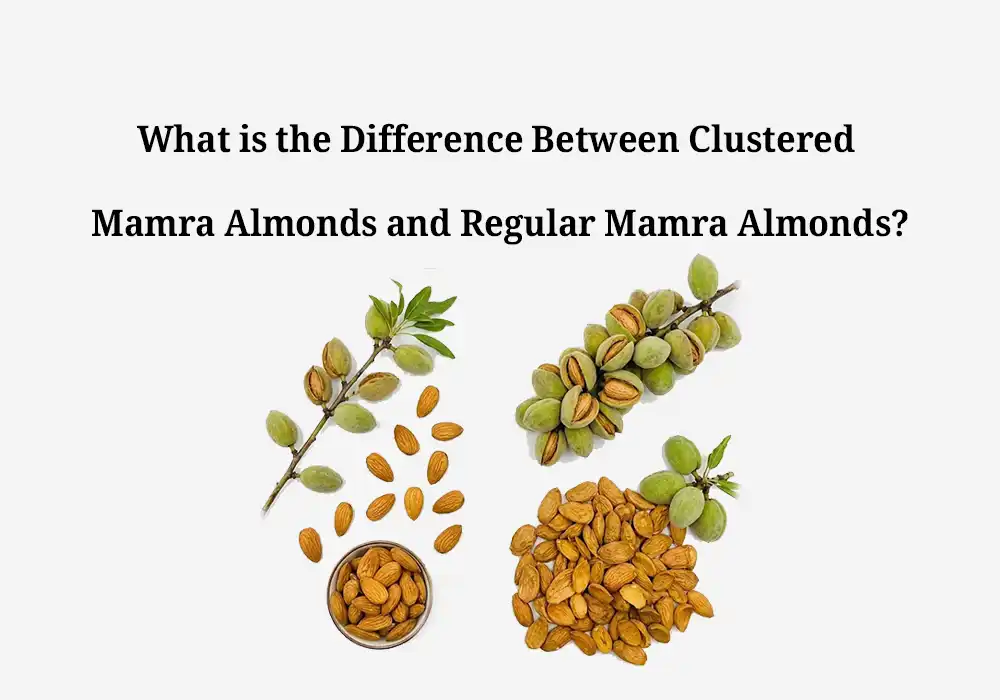
What is the Difference Between Clustered Mamra Almonds and Regular Mamra Almonds? (Biological and Commercial Analysis)
In the dry fruit production and trading industry, particularly within the Zayandeh Rud basin and Saman region, the term "Clustered Mamra Almond" is frequently encountered alongside standard Mamra Almonds. For wholesale buyers, workshop owners, and exporters, recognizing the structural, biological, and economic differences between these two product types is crucial for making strategic purchasing and investment decisions.
This article provides a specialized breakdown of the genetic differences, lipid profiles, calibration (grading), and commercial applications of clustered Mamra almonds versus regular varieties, paving the way for investors to choose their optimal supply.
1. Botanical Structure and Genetic Growth Differences
The fundamental difference between these two products lies in the tree's genetic behavior during blossoming and fruit formation. In standard Mamra almond varieties, blossoms are positioned singly or in pairs at specific intervals along the branches.
However, in the clustered variety, a favorable genetic trait causes biological density at the vegetative nodes. In this state, between 3 to 7 almond nuts grow tightly packed in a single location, mimicking a bunch of grapes. This physical density significantly increases the tree's yield tonnage per hectare. To study the scientific roots of this biodiversity, the article Mamra Almond Lipid Profile, Genetics & Valuation is an excellent reference.
2. Lipid Profile Analysis and Intrinsic Kernel Quality
A primary concern for traders is whether the high density of fruit on a single cluster causes a decline in kernel quality. Laboratory evaluations confirm that the intrinsic quality, fat structure, and flavor remain identical in both types, meaning vegetative density does not dilute the lipid profile.
- Preservation of Authenticity and Flavor: The clustered almond feeds from the same root system and mountainous climate of Saman; consequently, it fully retains the sweet, buttery taste specific to Mamra varieties.
- Fatty Acid Content: Analyses confirm that clustered kernels also possess over 50% natural oil and unsaturated fats. To thoroughly review the standards in this area, reading Standard Kernel Yield & Oil Content of Mamra Almonds is essential.
3. Differences in Calibration (Sizing) and Twin Kernel Ratio
The primary impact of clustered growth manifests in the physical dimensions and geometry of the almond kernel. Based on plant physiology principles, the simultaneous distribution of a branch's nutrients to multiple packed nuts alters the final calibration:
- Grading Variations: In regular Mamra almonds, the tree's energy concentration on fewer nuts results in the production of giant sizes (Grades 5A and 4A). Conversely, energy distribution in the clustered almond produces kernels with a medium, uniform calibration (Grades 3A, 2A, and Mini).
- Natural Decline in Twin Ratio: Regular Mamra varieties are renowned for having the highest twin kernel ratio, exceeding 70%. In clustered almonds, due to physical crowding during the growth of the wooden shell, there is less space for two kernels to develop within one shell, thereby reducing the twin percentage. To understand the impact of this index on international pricing, examine Impact of Twin Kernels on Export Almond Pricing.
4. Economic Viability and Commercial Market Strategies
Which variety offers greater economic viability for fulfilling commercial needs? The answer directly depends on the target market and the product's intended application:
- Premium and Luxury Exports: For shipping consignments to international festivals in India (like Diwali) or ultra-luxury markets in Arab states, where large calibration and high twin ratios are vital, the regular Mamra almond (single-growth) is the core strategy.
- Processing Industries and Economical Packaging: For production workshops, almond sliver and powder manufacturers, and the preparation of economical mixed nuts, the clustered almond creates a very high profit margin due to its medium size and significantly lower price. In this context, reading Comprehensive Comparison Between the Sizes of Different Almond Grades in Iran will be highly instructive.
Comparative Analysis Table: Clustered vs. Standard Mamra Almond
| Evaluation Parameter | Standard Mamra Almond (Single/Pair) | Clustered Mamra Almond |
|---|---|---|
| Growth Morphology | Distributed regularly with spacing | High density on one node (3-7 nuts) |
| Lipid Profile & Fat | Over 50% natural oil | Over 50% natural oil (No quality loss) |
| Calibration (Dominant Size) | Large and super sizes (5A and 4A) | Medium and uniform grades (3A, 2A, 1A) |
| Twin Ratio Index | Very high (Usually over 70%) | Medium to low |
| Primary Target Market | Ultra-premium export markets | Processing industries & economical packing |
5. The Advantage of Direct Supply from Walmondhe Processing Networks
For commercial buyers, accurately identifying the source of the cargo and guaranteeing calibration purity is a fundamental challenge. The Walmondhe engineering and trading company has resolved this challenge by deploying advanced sorting systems in the heart of the Saman orchards.
Through precise optical separation, we supply almond consignments (whether clustered medium sizes or giant varieties) with 100% uniformity and in isolated vacuum packaging to prevent the oxidation of valuable lipids. To familiarize yourself with our supply structure, read Is Walmondhe a Direct Supplier from Saman Farmers?.
To receive daily factory pricing analysis and place commercial orders, contact our sales department through official channels:
- Direct WhatsApp Line: 09136667618
- Sales Department Phone: 09136667618