
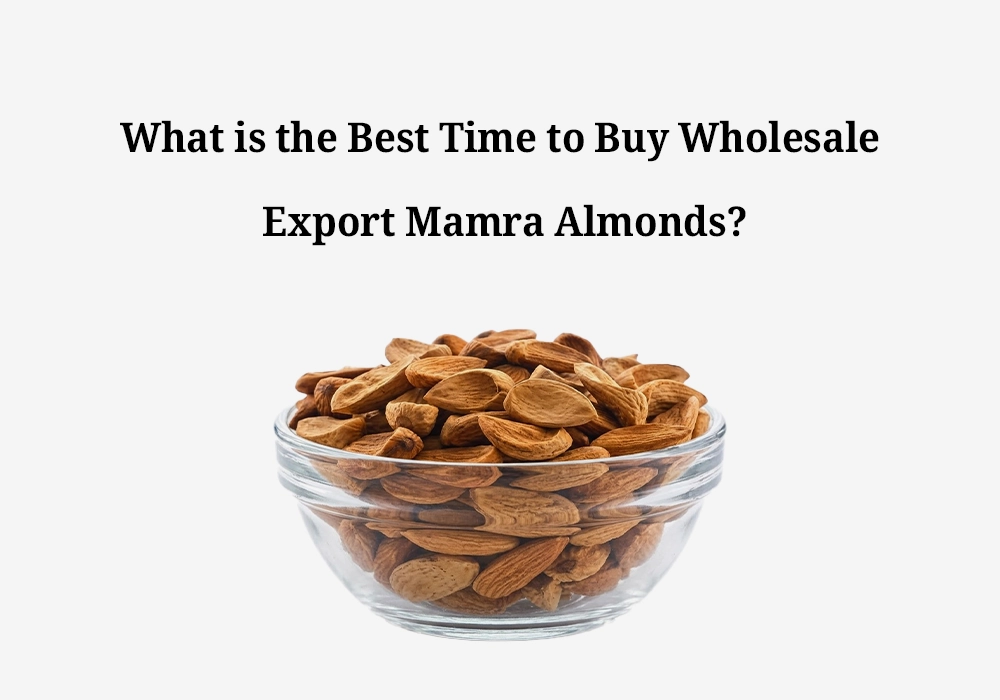
What is the Best Time to Buy Wholesale Export Mamra Almonds? B2B Roadmap and Commercial Calendar
In the ruthless and fast-paced world of the international dried fruit trade, especially within a volatile and luxury market like Mamra Almonds, finding a reputable supplier and high-quality product is only half the equation for success. The hidden and far more critical half is the "Art of Strategic Timing."
Entering the market at the wrong time can mean buying at Peak Price and completely losing your competitive profit margin. Worse yet, it can result in purchasing old, degraded, and oxidized cargo from the previous year, which will likely be seized at destination customs (such as in India or Europe).
For B2B merchants, powerful Indian importers in the "Khari Baoli" market, and bulk buyers in the Persian Gulf, the Mamra almond purchasing calendar is not a flat, static line. Rather, it is a series of price waves tied to the harvest season in Iran, currency fluctuations, and the calendar of major festivals in destination countries. In this article, we dissect the commercial calendar for wholesale export Mamra almonds so you know exactly when to sign your contracts and when to pull back from the market.
1. Harvest Season (Late August to Mid-October): Ground Zero and the Golden Pre-Order Opportunity
Mamra almond trees in Iran's primary production hubs (especially the orchards along the Zayanderud basin in Chaharmahal and Bakhtiari province) are typically ready for harvest from mid to late August. The period leading up to mid-October, when the cargo is fully hulled and dried, serves as "Ground Zero for Pricing" in the new commercial year.
Strategic Advantages of Buying During Harvest Season:
- Peak Quality and Freshness: Cargo during this time boasts the highest oil quality, authentic buttery flavor, and exceptional crunchiness. Free Fatty Acids (FFA) are at their absolute lowest.
- Access to Rare Grades: Bulk buyers can pre-order massive tonnages of large, highly scarce grades (such as Mamra 5A, 6A, and 7A), which are swept up by Indian market giants just weeks after harvest.
- Base Pricing: Typically, at the beginning of the season, prices reach a relative equilibrium due to high supply from farmers, before brokers enter the market and inflate prices.
The Hidden Challenge (The Moisture Trap): Purchasing fresh cargo requires intense precision in controlling the "Moisture Content." If the cargo (especially kernels) is not dried thoroughly, it will quickly mold during the humid maritime transit and be seized during India's strict customs testing. Reputable companies like Walmondhe only sort and package the cargo once it has reached the standard moisture level (around 5%).
2. India's Festival Calendar: Reverse Engineering for Diwali and the Wedding Season
Over 80% of Iran's exported Mamra almonds head straight to the thirsty Indian market. Therefore, your pricing and purchasing timeline in Iran is directly dictated by India's biggest consumption events: the Diwali Festival and the Indian Wedding Season.
Diwali typically occurs in mid-autumn (late October or early November). During this period, the demand for premium almonds for Corporate Gifting and household consumption explodes exponentially.
The Golden Timeline for the Indian Market:
A smart Indian importer or professional Iranian exporter never postpones their Diwali purchases to October. Let's reverse-engineer the logistics timeline:
- Time required for laser sorting and high-tonnage packaging: 10 to 15 days
- Maritime transit from Bandar Abbas to Nhava Sheva: 7 to 12 days
- Indian customs clearance and FSSAI testing: 10 to 15 days
- Distribution within India's domestic network: 5 days
Factoring in these durations (totaling roughly 35 to 45 days), the absolute best time to place an autumn order is from "June to late August." During this window, professional merchants secure the sorting capacity of reputable Iranian factories by signing Forward Contracts. Buying in October not only subjects you to astronomical prices but carries the massive risk of the cargo missing the Indian holiday market entirely.
3. Preparing for Ramadan: The Second Demand Wave in the Middle East
Beyond the Indian market, Persian Gulf countries (UAE, Qatar, Oman) are strategic buyers of Mamra almonds (particularly mid-sized grades and mixed cargoes) for confectionery and roasted nut applications. The peak consumption period in these nations is the holy month of Ramadan.
Because the lunar calendar shifts every year, exporters must finalize their orders at least two months prior to the start of Ramadan. This introduces another demand shock to the market; if it coincides with winter or early spring, it drastically impacts pricing.
4. Winter Season (January to March): Relative Stability but Severe Shortage of Luxury Grades
After passing the storm of Diwali demand and the end of the Gregorian year, the market usually settles into a period of calm and price stability during the winter.
- Market Status: By this season, farmers and small growers have completely sold off their stock, and the pulse of the market is exclusively in the hands of major traders, large corporations, and warehouse owners.
- Supply Challenge: If you are looking to purchase high tonnages (e.g., 5 containers) of very large grades (like 5A) in winter, you face a monumental task. The vast majority of high-quality, hand-picked cargoes have already been exported to India in the fall. Purchasing in this season is better suited for in-shell cargoes, mixed batches, or more economical grades (3A and 4A).
5. Spring and Early Summer (April to July): The Nightmare of Fraud and Storage Risks in the Traditional Market
Spring and the onset of summer heat represent the riskiest and most dangerous time to buy from traditional markets and brokers. Cargoes leftover from the previous year's harvest stored in standard, hot warehouses are highly susceptible to the following risks:
- Lipid Oxidation (Rancidity): Due to the heat, the beneficial fats of the Mamra almond (which exceed 50%) decompose, taking on a rancid smell and a bitter taste.
- Weight Loss: Moisture loss leads to a drop in cargo weight, resulting in direct financial loss for the buyer.
- Pest Attacks: Spring heat provides the perfect breeding ground for insect larvae and the Indian meal moth inside almond sacks.
Broker Tactics: During this season, brokers attempt to offload old cargo at seemingly attractive prices, or they mix it with cheaper varieties (such as Rabie almonds). Buying in this season is only logical and safe if your supplier possesses equipped industrial cold storage infrastructure and, most importantly, utilizes isolated, vacuum-sealed MAP packaging.
Why with Walmondhe, Time is Always on Your Side?
Attempting to perfectly time your purchases in Iran's volatile and inflationary market is an exhausting, stressful, and sometimes impossible task for foreign buyers or trading companies. Walmondhe, recognizing this massive challenge, has shattered the traditional seasonal trade structure, transforming it into an "industrial, year-round sustainable supply chain":
- Long-Term Forward Contracts: You don't need to battle price fluctuations every month. You can establish your annual contracts with us during the optimal time (Harvest Season). We reserve your cargo and sort/ship it exactly with day-one quality in the upcoming months (e.g., for Diwali or Ramadan).
- MAP Technology Isolation: Unlike the traditional system where cargo becomes rancid in spring, Walmondhe packages the almonds immediately after sorting into export cartons using Modified Atmosphere Packaging (Nitrogen gas flushing and absolute vacuuming). This means you can receive a shipment in mid-July that retains the exact taste, crunch, and quality as harvest day in September.
- Guaranteed Year-Round Inventory: Through direct and exclusive relationships with a network of the largest orchards in the Zayanderud basin, Walmondhe maintains the capacity to supply high tonnages of premium Mamra grades even during off-season months.
By choosing Walmondhe, eliminate the stress of seasonal fluctuations, the fear of missing the holiday market, and the nightmare of buying old cargo from your business forever. We are not merely a vendor; we are your strategic partner in managing time, quality, and capital.
Contact us to receive the catalog, review the export calendar, and learn about direct sales conditions:
- Get the latest price and request a Proforma Invoice via WhatsApp: 09136667618
- Contact the B2B Export and Sales Department directly: 09136667618 (Phone Call)
- Connect with us on our professional LinkedIn network: Hossein Ebrahimi - Walmondhe