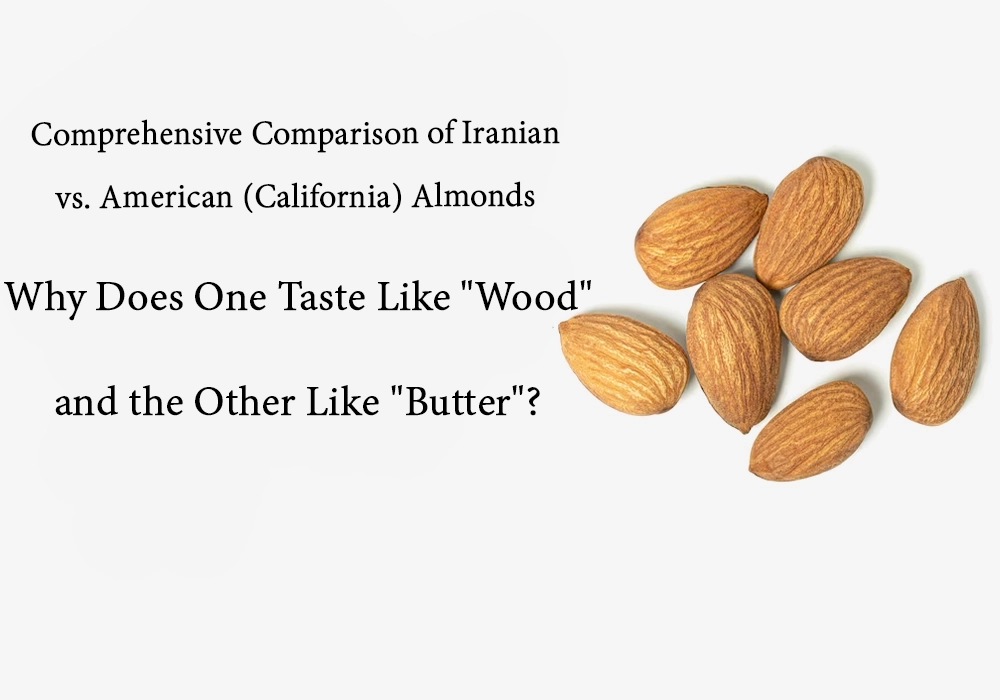
The World War of Almonds: A Comprehensive Comparison of Persian vs. American (California) Almonds; Why One Tastes Like "Wood" and the Other Like "Butter"?
When you step into the global nut market, you are faced with two superpowers: California (which controls 80% of the world market with mass production) and Iran (which produces less but offers elite quality adored by connoisseurs). Many consumers judge solely based on "appearance," preferring foreign almonds for their uniformity and beauty. But if you close your eyes for a moment and trust only your sense of taste, you will realize the massive difference between them.
Why do professional pastry chefs (for high-end sweets like Baklava) and traditional medicine experts insist on using "Only Persian Almond Kernels," despite the higher price? Is this just national bias, or is there scientific truth behind it?
In this analytical article from Walmond, we review the battle between "American Technology" and "Iranian Wild Nature" and uncover secrets that big traders might not want you to know.
1. Visual Difference: Industrial Beauty vs. Organic Beauty
Distinguishing the two at first glance is quite simple. Let's look closer:
American Almond (The Cosmetic Nut)
- Famous Varieties: Nonpareil, Carmel.
- Appearance: Very elongated, flat, with a light and smooth skin.
- Uniformity: Almost all kernels are the same size and shape (as if they were 3D printed!).
- Skin: The brown skin is very thin and separates easily.
Persian Almond (The Flavor Nut)
- Famous Varieties: Mamra, Sangi (Stone), Rabi.
- Appearance: Usually slightly shorter, "chubby," and with a darker skin.
- Surface Texture: The kernel surface has deep wrinkles and grooves. These are not "defects"; they are reservoirs for essential oils.
- Uniformity: Since trees are often propagated traditionally, sizes may vary slightly (unless laser-sorted).
2. Why is Persian Almond Oiler and Tastier? (5 Scientific Reasons)
If you chew an American almond, it has a dry, crunchy, and woody texture. But a Persian almond crumbles under your teeth, turning into a creamy, sweet paste. Why?
Reason 1: The "Water Stress" Paradox
California almonds grow in flat plains with precise drip irrigation and industrial fertilization. The plant lives in "total luxury" and doesn't need to struggle for survival. The result is a "Watery" almond with a lower concentration of nutrients. In contrast, Persian almonds (especially in the Zagros foothills) often grow with spring water, river water, or dry-farming methods. Environmental stress and mountain temperature fluctuations force the plant to concentrate all its energy and nutrients into the seed (kernel) to ensure the survival of its lineage. The result? An energy and flavor bomb.
Reason 2: The Massive Difference in Oil Content
This is the most critical factor for the food and pharmaceutical industries:
- American Almond: Average 35% to 40% oil.
- Persian Almond (Mamra): Average 55% to 60% oil. This 20% difference means 20% more Vitamin E, more unsaturated fatty acids, and a completely distinct taste profile. That is why 1 kg of Persian almonds yields a much smoother almond butter than its foreign counterpart.
Reason 3: Genetics (Modified vs. Native)
Americans have been modifying tree genetics for decades to:
- Make the shell thinner (Paper Shell).
- Double the tree's yield. In this "quantity-focused" process, the genes responsible for "Flavor and Aroma" have weakened. However, Persian breeds like Mamra or Sangi have retained their ancient, wild genetics.
Reason 4: The Hidden Secret of "Pasteurization" (The Mandate)
This is a point 99% of buyers don't know. Following Salmonella outbreaks in the early 2000s, the USDA mandated that all California almonds (even those labeled "Raw") must be pasteurized. Pasteurization methods include:
- Steam: Which slightly cooks the almond texture and reduces skin antioxidants.
- Chemical Gas (PPO - Propylene Oxide): A volatile chemical for sterilization! The Result: The American almond you buy is effectively a "dead" seed that won't grow if planted. But Persian almonds are truly raw, alive, and contain active enzymes (they will sprout if soaked).
Reason 5: Drying Method (Sun vs. Oven)
In the American industrial system, almonds are dried immediately after harvest using hot air in industrial dryers. Rapid heat oxidizes some of the healthy fats. In Iran, almonds are often dried traditionally under the sun. This slow process stabilizes the flavor and preserves the quality of the oils.
3. Practical Comparison Table (Which One to Buy?)
| Comparison Criteria | Persian Almond | American Almond |
|---|---|---|
| Taste & Flavor | Sweet, Milky, Strong Aroma | Neutral, Slightly Woody, No Aroma |
| Fat Content | Very High (High Fat) | Medium to Low |
| Nature (Traditional Medicine) | Warm & Wet (Highly Nutritious) | Balanced leaning towards Cold |
| Price | Higher (Luxury Item) | Cheaper (Mass Production) |
| Vitality | Yes (Can Sprout) | No (Mostly Pasteurized) |
| Ideal Use | Snacking, Almond Milk, Baby Food, Medicine | Cake Decoration, Cooking, Budget Nuts |
| Genetics | Mostly Non-GMO (Native) | Often Hybrid/Modified |
4. Home Test: Detect the "Fake"
To ensure the money you are paying is for authentic Persian almonds and not foreign ones, do this simple test: "The Grinding Test"
- Put a handful of kernels into an electric grinder.
- If the resulting powder is dry and fluffy (like white flour) -> It is American/Foreign Almond.
- If the powder quickly clumps together, becomes a paste, and releases oil -> It is authentic Persian Almond.
5. Professional Use: Why Are Persian Confectioners Biased?
In authentic Persian sweets like Gaz of Isfahan (Nougat) or Baklava, using foreign almonds is strictly forbidden. Why? Because foreign almonds dry out further and burn at high baking temperatures. However, Persian almonds, due to their high oil content, withstand the oven's heat, releasing their "Aroma" into the pastry's texture. If you eat a sweet where the nut is hard and tasteless, rest assured it used foreign almonds.
Conclusion: Choosing Between "Appearance" and "Substance"
If you are looking for almonds that line up on a serving tray like identical pearls and save you money, American Almonds are a good choice. But if you are looking for "Food as Medicine"; if you want to make almond milk for your child that truly contains calcium and healthy fats, or if you are searching for the real taste of nuts, there is no substitute for Persian Almonds.
At Walmond, we are proud to swim against the market tide filled with cheap foreign almonds, focusing solely on native and authentic Persian varieties. Almonds that may not look like a photocopy, but taste like the authentic soil of Iran.
[View Prices & Buy Persian Almond Kernels (Mamra & Stone) – Direct Shipment from the Orchard]